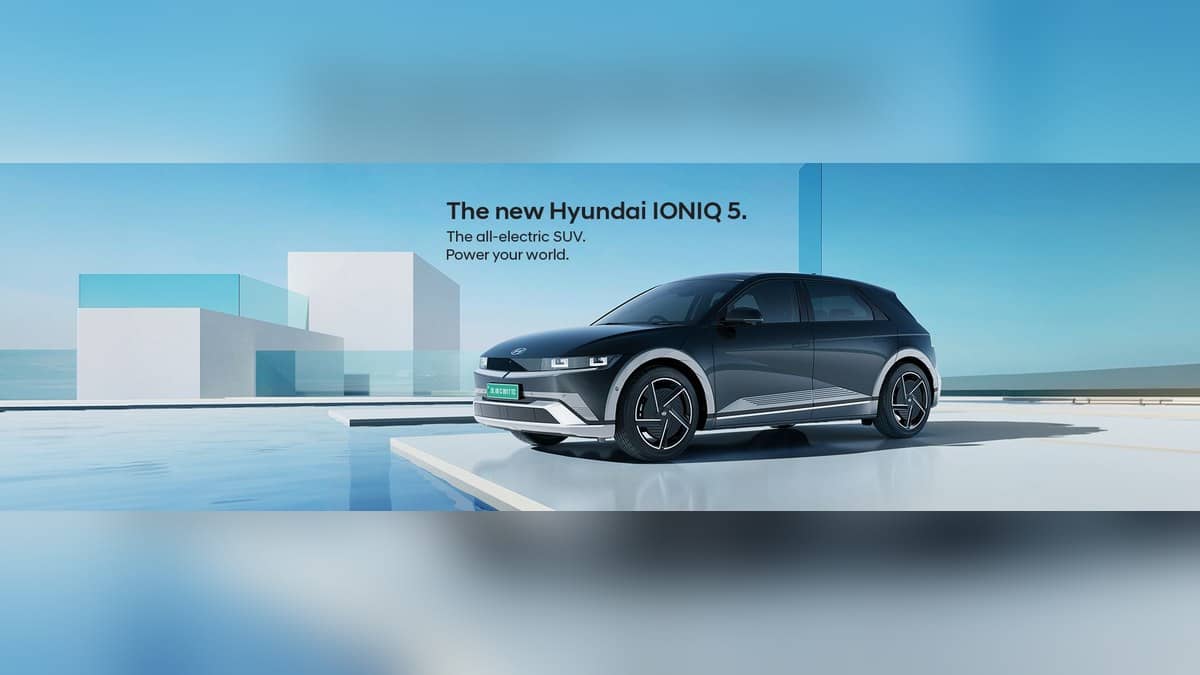
NEW DELHI: Hyundai lists seven hours and 35 minutes for the current 84 kWh IONIQ 5 to charge from 10% to 100% using an 11 kW AC charger. Its separate 18-minute DC claim covers 10% to 80% and requires a 350 kW ultra-fast charger. These are different charging windows, not interchangeable promises.
| IONIQ 5 charging fact | Official India specification |
|---|---|
| Battery | 84 kWh, liquid-cooled lithium-ion |
| AC reference | 11 kW; 10% to 100% in seven hours 35 minutes |
| DC reference | 350 kW charger; 10% to 80% in 18 minutes |
| Drive layout | Rear-wheel drive |
| Motor output | 168 kW, or 228.5 PS |
| Scheduled charging | AC or portable charger, where equipped |
Make the charging window part of the plan
For an overnight stop, check the wallbox rating before treating the AC estimate as a departure plan. Hyundai's specification qualifies the time by battery level, charger output, temperature, vehicle settings and uninterrupted supply. A socket at a destination and a suitably rated AC charger should not be treated as the same facility.
For a highway break, record the charger type and your intended arrival level. Leave room in the itinerary for access to the site, connecting the car and any wait before a session starts. The published charging duration describes the battery operation. It does not account for every activity between leaving the road and driving away again.
Use the current manual for the charging menu
Hyundai's manual selector separates the IONIQ 5 sold from May 2026 onward from the earlier edition. Open the matching manual before following screen instructions. That is particularly relevant if an owner is reading an older saved guide while the current India specification now identifies a different battery capacity.
In the current manual, scheduled charging is reached through the Electric Vehicle screen, its settings area, AC Charger and Scheduled Charging. The function applies to AC charging or the portable charger where equipped. If a connected car appears to be waiting rather than charging, check this setting before assuming that the wallbox has failed.
The manual offers a choice between charging only during the off-peak window and prioritising that window. With the first, the target charge level may remain unmet; with the second, charging can continue outside the window to reach the target. Set the departure plan around your electricity arrangement and required charge, rather than assuming the menu itself guarantees cheaper power.
To request immediate charging, the manual permits disabling the scheduled setting on the screen. It also describes setting or cancelling the schedule through Bluelink. After changing a setting, confirm the vehicle's displayed status instead of leaving on the assumption that a connected cable means energy is flowing.
Use the car's connected tools before departure
Hyundai's convenience page lists battery-status checks and a charging-station point-of-interest search that can send a location to the vehicle for navigation. These tools let the driver review the next stop before getting into the car. A saved station location is a useful planning aid, but it should not be read as confirmation that a particular connector is available when you arrive.
The same page describes a rear-seat power socket and external Vehicle-to-Load operation through a converter, with output up to 3.6 kW. That figure describes electricity supplied to devices. Keep it separate from the charger input rating when discussing a home setup or a journey with an installer.
Why the platform matters, and where it stops helping
The IONIQ 5 uses Hyundai's dedicated Electric Global Modular Platform. Hyundai describes a battery installed beneath the floor, a flat cabin floor and flexible interior packaging. These details explain why the car's electric layout is central to its design rather than an incidental addition to a conventional powertrain.
For the person planning a family stop, the distinction is practical. Cabin space can make a break more comfortable, but it cannot correct a mismatch between the assumed charger and the equipment actually at the destination. Review access to charging with the same care as luggage space or seating, especially when the next day's departure time is fixed.
Keep a simple trip note showing the planned overnight location, the charging facility you intend to use and an alternative stop. After the first session, use the actual result to refine later plans. Avoid turning a favourable session into a universal estimate for another charger, another arrival level or another day's conditions.
For related coverage, read our Hyundai IONIQ 5 price: Rs 55,70,600 for the 84 kWh RWD version, Kia EV6 price: Rs 65,97,937 starting MSRP and Creta Electric report. Each model's own charging conditions need to stay attached to its figures.
Official sources: IONIQ 5 specifications, current owner manual, convenience features and platform information.