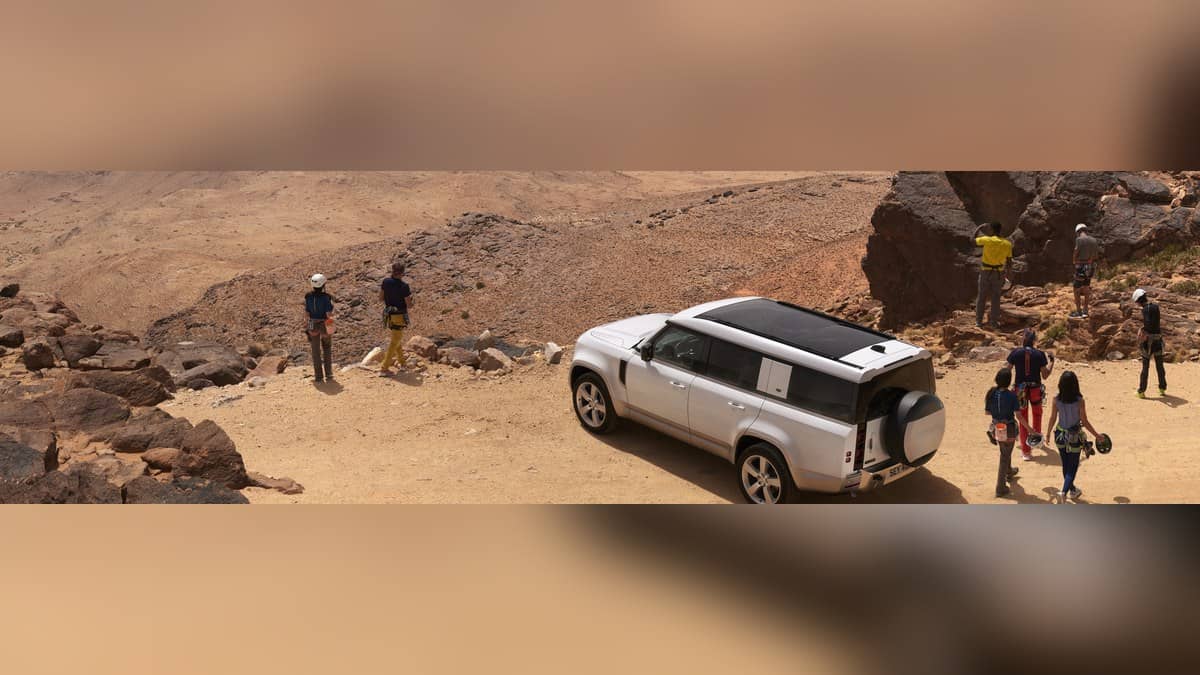
NEW DELHI: The Defender 130 offers up to eight seats, with its original three-row arrangement set out by Land Rover as 2+3+3. That puts a passenger place in the third row where many family SUVs have only a pair. For an Indian household travelling together, however, the seat count is only the start: luggage space, access and the exact vehicle configuration still need separate checks.
| Question | Officially documented answer |
|---|---|
| Maximum advertised seating | Eight people |
| Original eight-seat layout | 2+3+3 |
| India page, space behind third row | Up to 389 litres, with measurement qualifications |
| India page, current touchscreen | 13.1 inches |
| Published towing capability | Up to 3,500 kg, subject to vehicle specification |
What the seating arrangement changes
Land Rover's global introduction explains that the Defender 130's length was extended behind the family design to accommodate a full-size third row. The same announcement identifies the seating arrangement explicitly. The current India product page continues to advertise up to eight occupants. That agreement supports the basic layout, without assuming that every available derivative has identical seats or equipment.
The phrase up to remains important. A maximum in an advertisement is not the seating certificate for an individual car. Before planning a full family trip, match the order specification and registration details to the actual cabin. Confirm the belt and head-restraint provision at every intended passenger position, rather than infer usable capacity from the outside size of the vehicle.
The most revealing access exercise is to place the middle row where its usual passengers would sit, then try the rearmost seats. Assess the opening, the step into the cabin and whether passengers can get back out comfortably. A roomy-looking cabin photographed with seats moved aside does not establish how the same arrangement works with the whole family aboard.
Luggage figures need their own reading
The India page quotes up to 389 litres behind the third row. Its footnote explains wet measurement as a volume established by simulating the space filled with liquid, and adds a configuration qualification. Treat that published number as a measurement with conditions, rather than a promise that a particular set of rigid suitcases will fit with every passenger seated.
This matters especially for airport journeys. An extra passenger place and an extra suitcase are competing demands on the same journey, even when the brochure lists both seating and luggage capability. Bring the normal bags to an inspection and test the intended seating position, loading height and tailgate clearance. That gives a more useful answer than combining maxima from separate illustrations.
Land Rover's original release also distinguishes maximum luggage volume from the amount left behind an occupied third row. This report does not add together the India page's separate folding-seat figures, because the wording and configuration notes need care. A specification drawing for the exact ordered vehicle is the appropriate reference when the remaining cargo space determines whether a trip is workable.
Current equipment is different from launch equipment
The current India page describes Pivi Pro with a 13.1-inch touchscreen. The original global launch release describes an earlier display specification. It is useful for understanding the seating design, but should not become a current India equipment list. A familiar body shape does not establish that a launch-era photograph shows the specification now being ordered.
The India page also describes a ClearSight interior rear-view mirror that can help preserve a view behind when the luggage area is occupied. For the household using all rows, that is a particularly relevant feature to ask about. Check its presence and operation on the chosen vehicle, and compare the camera view with the conventional mirror during a stationary demonstration.
Passenger capacity is separate from load limits
The page advertises towing capability up to 3,500 kg. That is a separate specification from seating capacity. It does not establish the permissible combination of occupants, baggage, accessories and trailer for an individual car. Ask for the vehicle's documented weight limits and towing specification if those uses will overlap, rather than use the seating headline as a loading guide.
The 130's distinctive question is therefore how the last row fits into a real journey. A household regularly using it should test access and luggage together. Occasional users may have a different arrangement in mind, but should still confirm how the seats fold and how the remaining load is secured. These are inspection priorities, not a road-test verdict on comfort.
For other SUV contexts, see our Car price guide, Range Rover Evoque vs Discovery Sport price: Discovery Sport starts lower at Rs 63,37,000 and BMW X7 petrol vs X5 petrol price: X5 starts lower at Rs 96,90,000. They cover separate vehicles and should not be read as equivalent seating layouts.
Official sources: current Defender 130 India page and footnotes, Land Rover's original seating-design announcement and current Defender models and equipment.