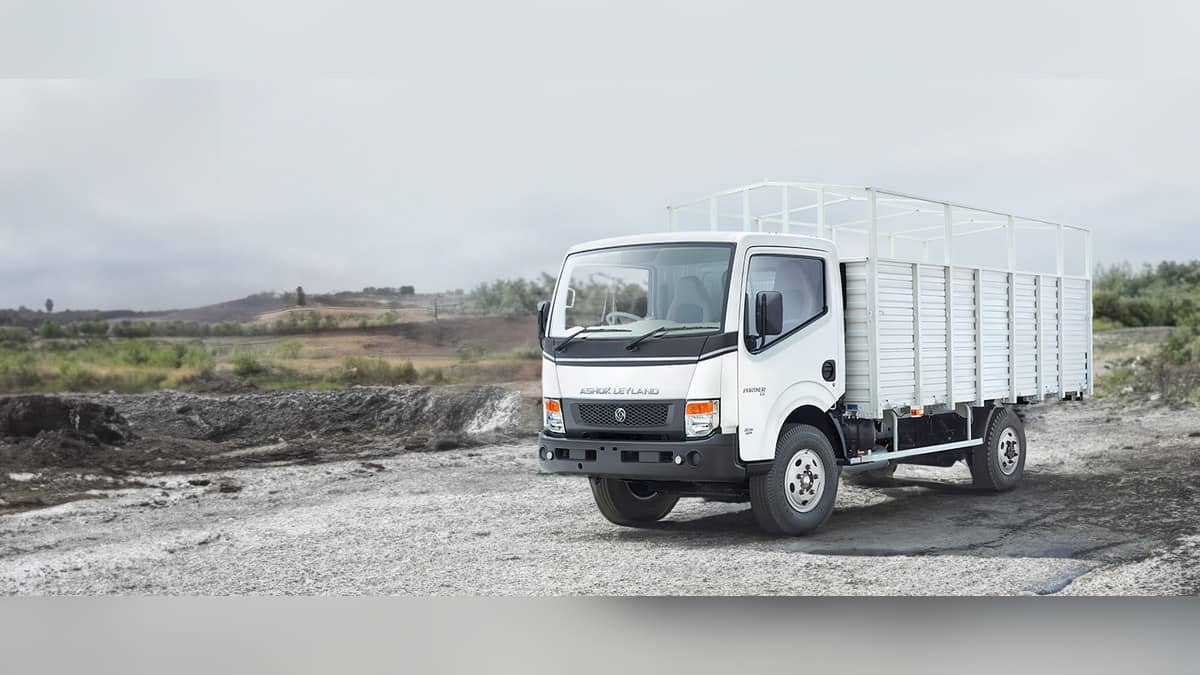
NEW DELHI: Ashok Leyland lists the Partner 4 Tyre with a ZD30 diesel engine producing 140 hp at 2,750 rpm and 360 Nm of torque from 1,350 to 2,750 rpm. Its official specification identifies the engine as a DDTi unit and lists CBC, FSD and HSD configuration labels for the model.
| Mechanical item | Official specification |
|---|---|
| Engine | ZD30 diesel with DDTi |
| Maximum power | 103 kW (140 hp) at 2,750 rpm |
| Maximum torque | 360 Nm at 1,350 to 2,750 rpm |
| Engine description | Double overhead camshaft, common rail, direct injection, turbo intercooled |
| Steering | Power steering |
| Clutch | 310 mm, diaphragm, push type, single dry plate, hydraulic actuation |
| Configuration labels | CBC, FSD, HSD |
The engine code is the useful starting point
A Partner 4 Tyre entry in a fleet record should preserve the engine designation as well as the model name. The ZD30 label identifies what Ashok Leyland has specified on this product page. It is more precise than referring to the vehicle only as a diesel delivery truck.
The manufacturer places several technical descriptions beside DDTi. These refer to the engine's camshaft, fuel-injection and induction arrangements. They describe hardware, rather than a separate equipment grade or a numerical promise about fuel use. The specification does not attach a route-specific consumption result to those descriptions.
For a workshop discussion, retaining the engine code can also keep the conversation tied to the correct product. A list of symptoms, the vehicle identity and its service history are more useful together than an assumed diagnosis based on a familiar truck badge.
Read power and torque with their engine speeds
The power output is quoted at an engine-speed point, while the torque figure is quoted across a band. Removing the rpm information loses part of the published description. It would turn a more specific engine entry into a pair of headline numbers without the conditions printed beside them.
These figures do not establish the time needed to complete a delivery round, the speed on a particular gradient or the fuel consumed by a loaded vehicle. Such outcomes require operating conditions and measurements that are absent from the mechanical sheet. They cannot be calculated from the advertised power alone.
The Partner 4 Tyre product page repeats the headline power and torque figures, while the detailed specification provides the engine-speed information. Reading them together supplies a fuller description without treating the model's promotional panel as a complete technical record.
Steering, clutch and suspension are separate entries
Ashok Leyland specifies power steering and a hydraulically actuated clutch for this model. The clutch description includes its diameter and construction. Those details belong in the mechanical specification, rather than being treated as proof of a particular driver's experience or a quantified reduction in effort.
The front suspension is listed as an overslung parabolic arrangement with double-acting shock absorbers. At the rear, the company lists an overslung semi-elliptic arrangement, also with double-acting shock absorbers. The front and rear descriptions are different, so a shortened record saying only leaf-spring suspension omits useful detail.
That distinction matters when a fault report refers to the front or rear of a truck. A service note should identify where a symptom is observed and the circumstances in which it occurs. The published suspension description can help identify the arrangement, but it cannot diagnose an individual vehicle remotely.
Do not make the engine figure stand in for the body
The specification lists several configuration labels under the same model. A shared engine description does not settle the finished body or its equipment. For a distribution operation, the vehicle record needs the complete configuration alongside its drivetrain, rather than assuming that the power figure describes everything relevant to the job.
Separate reading includes the Car price guide, Ashok Leyland Partner 6 Tyre vs 4 Tyre price: 4 Tyre starts lower at Rs 15,95,000 and Ashok Leyland Bada Dost price list: Rs 8,85,000 to Rs 10,99,000 in starting figures. Their named models and specifications should remain separate from this Partner 4 Tyre engine description.
Official sources: Partner 4 Tyre product page and Ashok Leyland Partner 4 Tyre specifications.