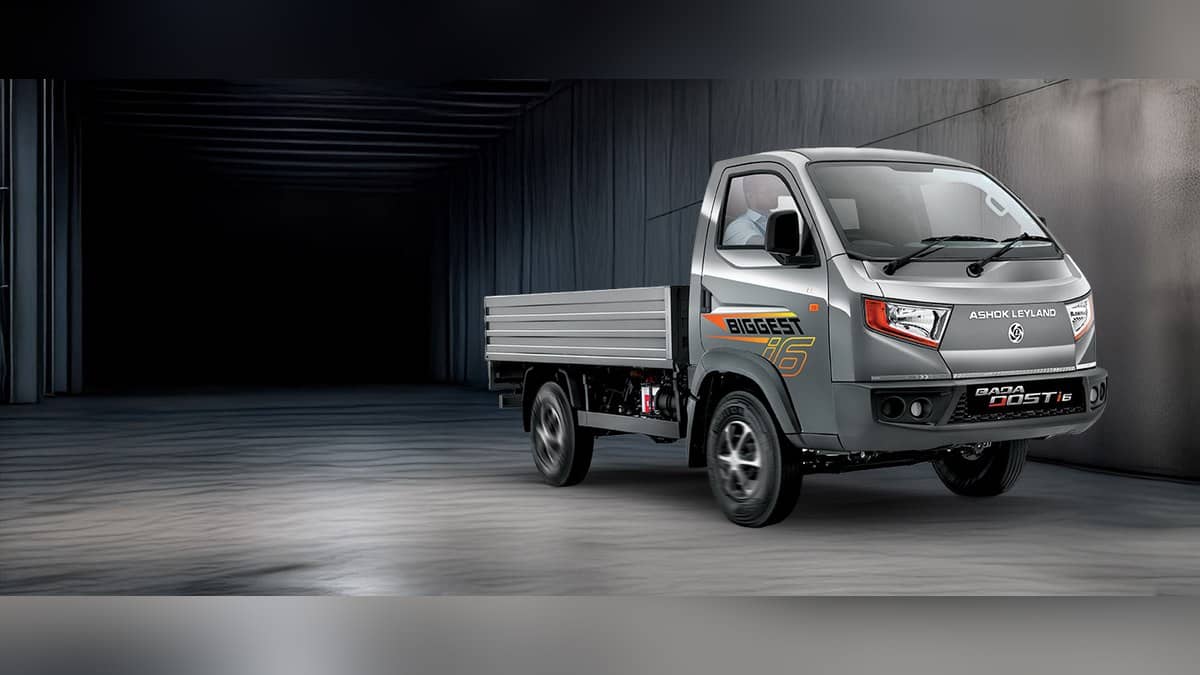
NEW DELHI: Ashok Leyland's official catalogue lists Bada Dost starting prices from Rs 8,85,000 for i2 to Rs 10,99,000 for i6. The table below includes every Bada Dost entry visible in that catalogue. Each number is an onwards price for the named entry, rather than a complete tariff for its individual body and equipment variants.
| Official Bada Dost catalogue entry | Listed starting price |
|---|---|
| i2 | Rs 8,85,000 onwards |
| CNG | Rs 9,00,000 onwards |
| i3+ with LNT | Rs 9,80,000 onwards |
| i3+ | Rs 9,80,000 onwards |
| i4 | Rs 9,80,000 onwards |
| i5 | Rs 9,81,000 onwards |
| i3+XL | Rs 10,10,000 onwards |
| i5 XL | Rs 10,22,000 onwards |
| i5+ | Rs 10,40,000 onwards |
| i6 | Rs 10,99,000 onwards |
A family table needs the complete name
Price as of 28 October 2026, 23:29 IST. The catalogue lists i3+ and i3+ with LNT separately, even though their displayed starting figures match. Both entries are retained here. Combining them would erase a distinction made by the manufacturer; assigning an equipment premium would invent a price difference that the listing does not show.
The suffixes matter elsewhere too. An i5, an i5 XL and an i5+ have separate entries. This is why a quotation saying only Bada Dost is insufficient for a meaningful comparison. The model name, body supplied and equipment description need to accompany the amount before two offers can be assessed on the same basis.
The i6 shows why body details change the reading
At the upper end of this starting-price table, the i6 specification page identifies FSD LX and CBC LX separately. It gives payloads of 2357 kg and 2567 kg respectively. The same page lists a gross vehicle weight of 4100 kg. The higher CBC figure should therefore never be copied into a description of the completed FSD version.
The practical reason to keep those labels visible is that a body and its fittings contribute weight. An operator planning a specific conversion needs the completed vehicle's permitted weights, rather than assuming that a catalogue figure remains unchanged after additional equipment is fitted. The price table cannot settle that engineering question.
For FSD, Ashok Leyland gives a load body measuring 3250 x 1750 x 490 mm. That provides a useful second check on suitability: bulky cargo may use the available space before reaching the weight allowance. A route serving a furniture workshop would need a different loading plan from one carrying compact industrial supplies, even if both consignments weigh the same.
Engine and chassis details for the illustrated vehicle
The i6 page lists a 1478 cc turbocharged, intercooled three-cylinder diesel engine producing 80 hp and 190 Nm. Its specifications also identify power steering, a 2740 mm wheelbase and a 932 mm loading platform height. These figures describe i6; they have not been applied to the other entries in the family table.
That distinction is particularly useful when a business is comparing the smallest and largest starting figures. A price gap alone does not describe what changes in load space, body arrangement or rated carrying capacity. The appropriate comparison is between exact configurations whose specification sheets are available, rather than between two family names on an invoice.
Who the different entries are for
The lower starting-price entries give operators a place to begin a configuration enquiry, while the i6 figures are relevant to heavier goods work within its stated ratings. Neither observation is a recommendation to select a vehicle by price alone. The consignment, route, unloading arrangement and completed body need to be defined first.
For an operation with variable consignments, the difficult load deserves attention. A deck that works for ordinary cartons may not suit the longest package accepted by the business. Similarly, an occasional dense load can create a weight issue even when most deliveries are light. A manifest and loading sketch make those questions concrete.
What these prices do not include as verified detail
The readable catalogue does not map separate prices to every body and trim combination or provide a city-specific on-road breakdown. No missing variant price has been estimated. The listed range is the spread between model-entry starting figures, not the lowest and highest possible Bada Dost invoice.
Related reading includes our Car price guide, Ashok Leyland Saathi price: Rs 6,45,000 starting figure explained and Bolero MaXX Pik-Up HD: which version carries 2,000 kg?. Each addresses a separate part of evaluating a commercial vehicle.
Official sources: Ashok Leyland catalogue, Bada Dost i6 product page and i6 specifications.