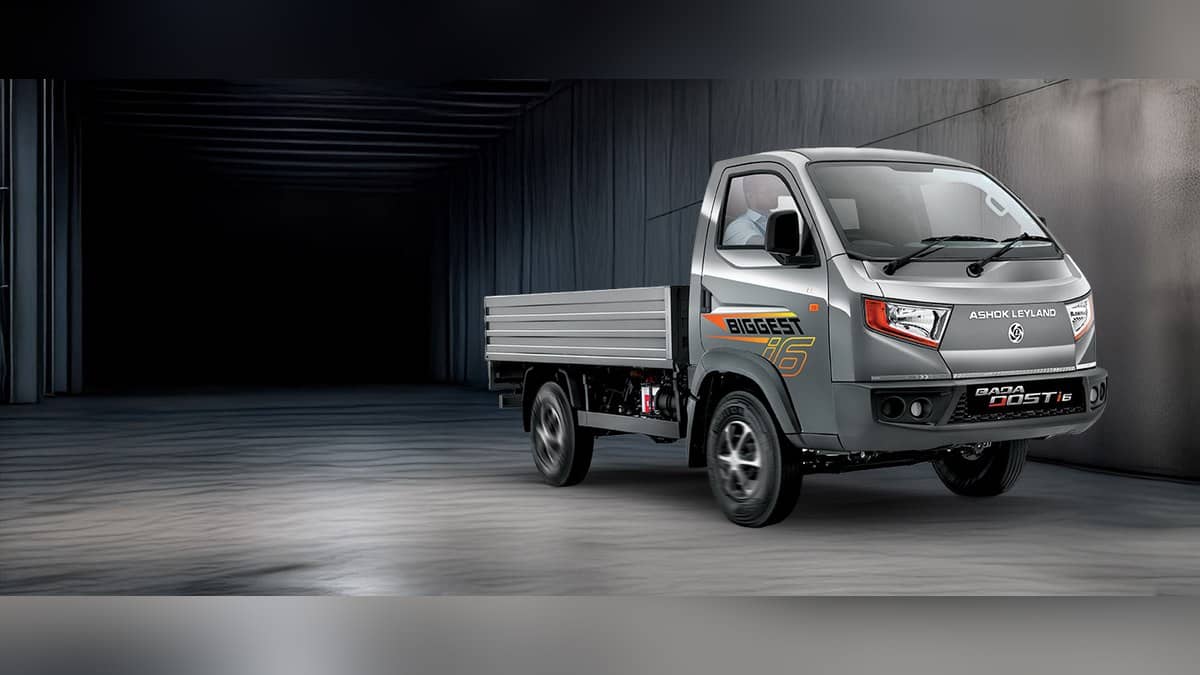

NEW DELHI: Ashok Leyland's official light-vehicle catalogue lists the Saathi from Rs 6,45,000. Its specification page describes a diesel goods carrier with an 1120 kg rated payload, a 2500 mm cargo deck and a manual gearbox. The price is explicitly an onwards figure, so it does not establish the cost of every equipment or body configuration.
| Saathi fact | Official specification |
|---|---|
| Catalogue price | Rs 6,45,000 onwards |
| Engine | 1478 cc, turbocharged three-cylinder diesel |
| Output | 45 hp at 3300 rpm; 110 Nm at 1000 to 2400 rpm |
| Transmission | 5 forward gears, 1 reverse, manual |
| Gross vehicle weight | 2288 kg |
| Rated payload | 1120 kg |
| Cargo deck | 2500 x 1620 x 380 mm |
| Fuel tank | 40 litres |
| Seating | Driver plus 1 |
What the starting price establishes
Price as of 28 October 2026, 23:29 IST. The catalogue does not attach this starting figure to a detailed equipment grade in its readable listing. It also does not provide a location-specific registration and insurance breakdown. Those omissions matter: a published entry price is useful for identifying the model's position, but it cannot stand in for a completed local invoice.
There is therefore no invented variant ladder here. A quotation should identify the vehicle, the body supplied and the equipment covered by its price. If a dealer document includes an additional item, it should be identifiable as an additional item. The headline figure should not silently acquire charges or equipment that the official catalogue does not specify.
The deck gives the payload useful context
The most informative pairing on the Saathi sheet is its carrying allowance and deck dimensions. The deck describes the space available for arranging a consignment, while payload describes the permitted cargo weight. A long item may be awkward despite being light; dense sacks can create the reverse problem. Both measurements belong in a dispatch assessment.
Consider a supplier delivering mixed cartons to shops. Loading the last delivery underneath everything else could force repeated unloading at earlier stops. The Saathi's published deck dimensions allow an operator to sketch the arrangement before assigning a route. This is a practical interpretation of the sheet, rather than a claim about a tested number of cartons or completed trips.
The specification also gives an 835 mm loading height. That measurement is relevant when planning how goods will move from a store platform into the truck. It does not establish that loading will be effortless. Package weight, handling equipment and the place where the vehicle can stop still determine the work required.
Read the diesel figures together
The engine's torque band and manual transmission describe a driver-operated diesel vehicle. The sheet also identifies a cable-shift arrangement, front disc and rear drum brakes, and leaf-spring suspension. These are concrete equipment details; they do not supply a measured fuel-consumption result for a shop-delivery route.
No mileage or profit estimate has been inferred from the fuel-tank capacity. A larger tank changes how much fuel can be carried, but it is not itself an efficiency figure. For a working business, fuel records from its intended route would answer that question more directly than multiplying an assumed mileage number by the tank size.
Who it is for
The Saathi specification is relevant to an owner carrying goods within the stated deck and payload limits, with a driver and an accompanying person. A business needing more cabin seats would have to examine another configuration. A business carrying heavier consignments would need to assess the actual permitted weights of a different vehicle.
The company's product page identifies logistics, FMCG, agricultural and fisheries applications. Those labels show the intended work areas, rather than confirming a specialist conversion is included. An operator moving temperature-sensitive goods, for example, still needs the body specification and handling arrangement confirmed separately from the base vehicle.
Related checks before a vehicle enters service
For another small-truck configuration example, see our Car price guide. Our Ashok Leyland Bada Dost price list: Rs 8,85,000 to Rs 10,99,000 in starting figures covers a different capacity category. Neither model's figures should be transferred to the Saathi.
Operators examining finance can also read our How to read Maruti Super Carry's 4 petrol and CNG variants. For this truck, the essential starting documents remain a configuration-specific quotation and specification sheet that describe the same body and equipment.
Official sources: Ashok Leyland price catalogue, Saathi product page and Saathi specifications.