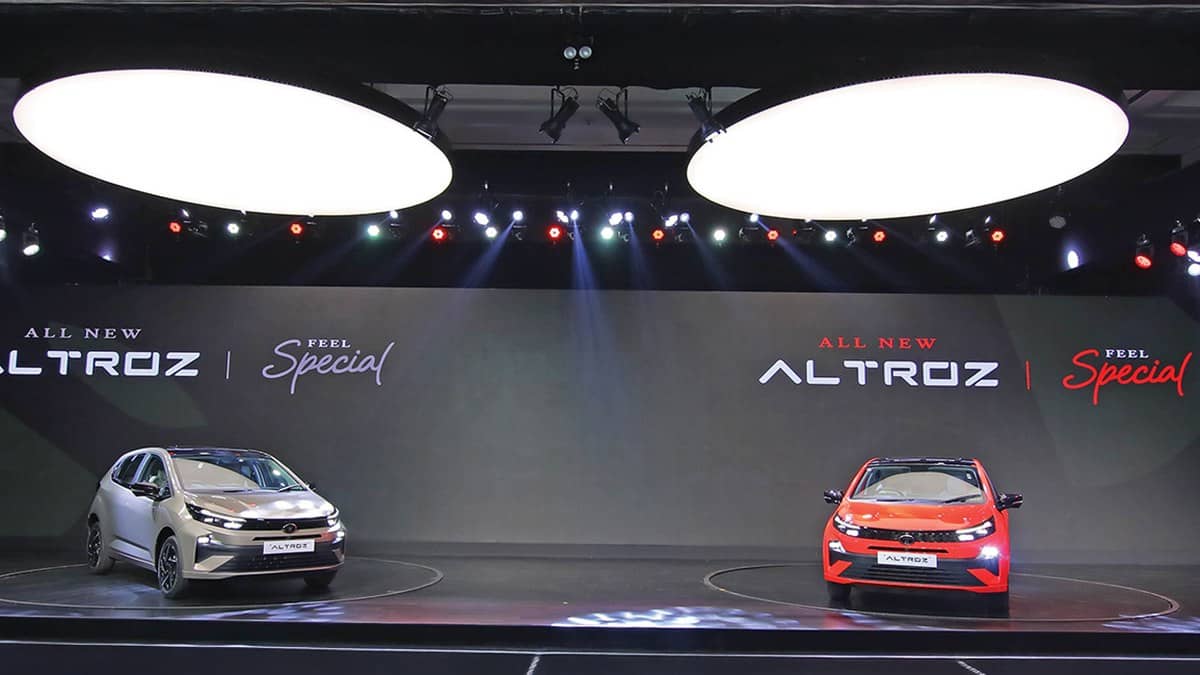
NEW DELHI: Tata's product note for the Altroz introduced in May 2025 lists 345 litres of boot space for petrol and diesel versions, against 210 litres for iCNG. The practical point is straightforward: the twin-cylinder CNG arrangement retains a luggage area, but the official figures do not describe equal luggage capacity across fuels.
| Altroz powertrain | Boot space in Tata product note | Fuel storage listed |
|---|---|---|
| Petrol | 345 litres | 37 litres |
| Diesel | 345 litres | 37 litres |
| iCNG | 210 litres | 37 litres petrol; 60 litres CNG water capacity |
A useful boot is different from an identical boot
Tata's launch announcement describes the iCNG system as using twin cylinders. Read alongside the technical table, that explains why the company can emphasise useful luggage space while publishing a lower volume for CNG. The marketing description and the specification answer different questions.
For a family carrying school bags on weekdays and travel luggage on weekends, the relevant test is the actual collection of bags. A litre figure cannot show whether a rigid suitcase fits through the opening or leaves a useful corner for a folded pushchair. Bring the awkward items when checking the car.
A sensible packing trial starts with the rear seats in the position they will occupy on the journey. Put in the largest rigid item first, then check where the smaller bags go. Photographing that arrangement can be more useful for the next trip than remembering an abstract capacity figure.
If the household changes between an Altroz petrol and an iCNG, repeat the packing trial. Carrying over a familiar arrangement without checking would miss the precise fuel-related difference that Tata records in its own specifications.
Keep the two fuel-capacity units separate
The same technical note labels the CNG figure as water capacity. That is the container-volume description in the document, not a promise that a filling station will dispense an equivalent numerical quantity of gas. Avoid treating the petrol and CNG storage figures as interchangeable measures when estimating a journey.
Equally, the boot number is a volume, not a permitted baggage weight. It should not become an invitation to fill every visible gap with heavy objects. These are separate questions to resolve from the vehicle's applicable operating instructions.
Tata lists the Altroz at 3,990 mm long with a 2,501 mm wheelbase in that product note. Those common dimensions sit alongside different boot capacities. The example shows why checking only the outside dimensions cannot establish the luggage space of a particular fuel version.
Cabin access deserves its own check
The May 2025 launch announcement describes wide 90-degree door openings, a flat rear floor and rear seating with extended thigh support. Those features concern getting people into the cabin and accommodating them after they sit down. They do not enlarge the luggage figure in the technical table.
That distinction is especially useful when a household carries both passengers and bulky equipment. Check access with the person who will actually use the rear seat. Then check the luggage separately. A comfortable entry and a workable packing arrangement are both valuable, but success at one does not prove the other.
With a child seat, for example, the parent handling the daily routine should try the loading and seating tasks rather than relying on an unoccupied display car. This is a practical assessment of the family's routine, not a claim that a particular item or child restraint will fit without checking.
Do not infer a complete variant specification from one photograph
Tata's launch material also lists flush front door handles, connected rear lamps and available cabin technology including a surround-view camera and digital displays. These help identify the updated Altroz, but appearance is a poor way to establish a specific car's full equipment. Use the exact variant description for that job.
For other hatchback ownership questions, see our EV battery rental explained: BaaS prices for Punch.ev, Syros EV, Creta, BE 6 and Tata Aeris introductory prices span Rs 5.29 lakh to Rs 9.74 lakh. Our Tata.ev prices: Tiago.ev from Rs 6.99 lakh, Nexon.ev offers up to Rs 1.41 lakh addresses a separate part of the hatchback decision.
The Altroz's model-specific lesson is to keep passenger access, luggage volume and fuel storage on separate lines of the checklist. A twin-cylinder layout answers the packaging problem in its own way. The official boot table remains the clearest numerical description of the space that accompanies it.
Official sources: Altroz product note and technical table and Tata's Altroz announcement.