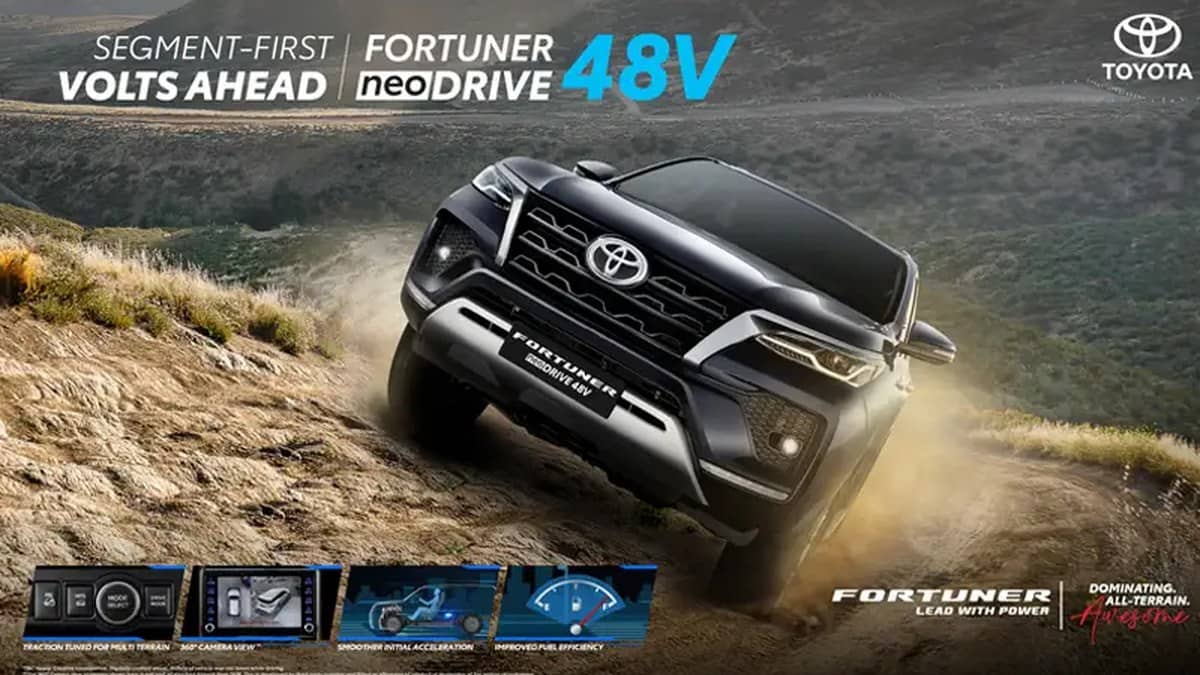
NEW DELHI: Toyota's Fortuner Neo Drive combines a 48V electrical assistance system with its diesel powertrain. The current India brochure lists an 8.5 kW motor and a six-speed automatic transmission for the Neo Drive version. Its purpose is to assist the engine and recover energy during deceleration, with Toyota describing smoother low-speed response and engine stop-start operation among the benefits.
| Component or function | Official specification |
|---|---|
| Diesel engine displacement | 2,755 cc |
| Electrical system | 48V, with lithium-ion battery |
| Motor power | 8.5 kW |
| Transmission | Six-speed automatic |
| Neo Drive drivetrain | 4WD |
| Energy recovery | During deceleration |
| Seating and fuel tank | Seven seats; 80 litres |
What the electrical system actually changes
Toyota's technical description identifies a belt-integrated starter generator and a lithium-ion battery alongside the turbo-diesel engine. The battery receives recovered energy as the vehicle slows. Electrical assistance can then support the powertrain, while the Smart Idle Start-Stop function switches off the engine when stationary. These are the functions that give the Neo Drive badge its meaning.
Think of the system as a set of interventions around ordinary driving events: slowing for a junction, waiting in traffic and moving away again. That is a more useful reading than treating the electrical label as a promise of a different kind of vehicle. The Fortuner still has a diesel engine, and the published material describes assistance rather than a separately advertised electric-only driving range.
Read motor output separately
The brochure's 8.5 kW motor figure is a component specification. It is not, on its own, a declared combined-system output. Adding an electric motor rating to an engine rating would create a new headline number that Toyota has not supplied in that form. The useful questions concern how assistance is delivered and what the driver notices during starts and low-speed acceleration.
The same caution applies to economy. Toyota describes improved efficiency in its launch material, but that statement is not a measured result from this article. A household should not convert it into a guaranteed monthly diesel saving. Route, traffic and driving conditions belong in any real-world assessment, and the official material opened for this explainer does not establish a fixed saving for an individual owner.
The brochure also retains the familiar chassis description: double-wishbone front suspension, a four-link rear arrangement with coil springs, and ventilated disc brakes at both ends. These specifications help locate the electrical addition within the complete vehicle. They do not provide an independent ride or braking assessment, which would require separate testing.
The automatic and four-wheel-drive combination
The Neo Drive column in the current brochure specifies automatic transmission and 4WD. The broader Fortuner range also contains other combinations, which is why a general Fortuner advertisement is insufficient to identify the electrical system. The exact grade description should appear on the vehicle specification and quotation, rather than being inferred from the SUV's appearance.
This is especially useful context for Indian families looking at an SUV that may divide its time between urban commuting and longer journeys. Ease of moving away in traffic and traction equipment address different tasks. Electrical assistance does not explain the entire drivetrain, while the presence of 4WD does not tell you whether the car has the Neo Drive system. Both entries need checking.
Our report on the Fortuner Leader Edition concerns a separate edition. Its existence should not be read as evidence that every Fortuner edition includes the same powertrain technology.
Check the extra equipment carefully
The Neo Drive launch release also discusses Multi-Terrain Select, a panoramic camera and wireless charging. There is a detail to resolve before treating that list as factory fitment: the brochure's footnote identifies the illustrated camera and wireless charger as accessories supplied by a third party and fitted after sale. Ask for the actual supply and warranty terms to be recorded.
That difference is worth checking because an accessory can still be part of a delivered vehicle without being factory equipment. A demonstration of the camera proves that the demonstration car has it. The order sheet should establish how the customer car will receive it, who supports it and whether the quoted configuration includes it. The powertrain specification and accessory description answer separate questions.
Who this version is for
As an equipment proposition, Neo Drive is relevant to readers examining a diesel automatic Fortuner with 4WD and wanting to understand its added electrical assistance. It is less useful to approach it through an assumed electric commute or a promised fuel saving. Assess the actual operating behaviour during a demonstration, and keep Toyota's qualitative claims separate from measured personal experience.
Our Land Cruiser 300 GR Sport guide examines a different Toyota SUV. Its off-road geometry should not be transferred to the Fortuner. For a different Toyota hybrid architecture, the Innova Hycross hybrid-system guide provides separate context. A shared hybrid label does not make those technical or warranty descriptions interchangeable.
Official sources: Toyota's Neo Drive technical announcement and current linked Fortuner brochure.