
NEW DELHI: Nissan's currently linked India X-Trail brochure specifies 255/45 R20 tyres, tyre-pressure monitoring and a tyre repair kit. The pressure to use should come from the individual vehicle's tyre placard. Wheel size identifies the published fitment; it does not establish an inflation setting, and a brochure illustration of the pressure display should not be treated as a pressure recommendation.
| Check | Official reference |
|---|---|
| India brochure tyre size | 255/45 R20 |
| Pressure monitoring | TPMS listed in India equipment |
| Spare provision | Tyre repair kit listed |
| Inflation target | Read the vehicle's own placard |
| Cold-reading guidance | Nissan UK's X-Trail manual: parked at least three hours, or driven less than 1.6 km |
| After a temporary kit repair | Arrange professional inspection |
Separate India fitment from general care guidance
The India specification comes from the brochure that Nissan's India product page currently links. That brochure is dated July 2024. The care guidance discussed here comes from Nissan's public UK online manual for the same-generation X-Trail. It is identified as UK guidance rather than presented as a newly issued Indian service instruction. The handbook supplied with an individual car remains the reference for its operation.
This distinction prevents a common research mistake. An international X-Trail search can return several wheel options and different market configurations. An Indian owner needs the equipment information for the car in the driveway, followed by that car's own pressure label. A matching model name on an overseas page is insufficient grounds for copying an inflation value.
The overseas manual illustrates why market checks matter: its wheel table also includes 235/60 R18 and 235/55 R19 fitments. Those alternatives are not the tyre specification listed in the linked Indian brochure. Do not turn an international equipment table into a list of approved replacements for an Indian vehicle without the appropriate vehicle-specific confirmation.
Find the label before setting a target
Nissan's online tyre-placard chapter locates the label on the driver's-side centre pillar. Read the information on the actual vehicle and record the front and rear entries as shown. If the label is missing, damaged or unclear, have the correct vehicle-specific information established before setting an assumed target.
A useful household practice is to keep a clear photograph of the label with the car's maintenance records. That gives another family member or a tyre technician something concrete to consult. It also avoids a pressure setting becoming an oral instruction that is repeated long after its source has been forgotten. The photograph should remain linked to that particular vehicle.
Compare readings taken in the right condition
The UK manual defines cold tyres as those on a vehicle parked for at least three hours, or driven less than 1.6 km. It directs the owner to use cold-pressure values from the placard. Follow the supplied Indian handbook if it gives different instructions for the particular car, and avoid treating an after-journey reading as equivalent to a cold check.
For an Indian weekend journey, the practical opportunity is before departure, while the vehicle is still parked and the label is easy to consult. Record the conditions alongside the reading if a tyre repeatedly needs attention. That produces a more useful maintenance record than comparing figures obtained at different points in unrelated journeys.
Our Nissan Gravite price list: Rs 5,73,400 to Rs 9,08,500 covers a separate product category. Whatever equipment is used, the target pressure still needs to come from the car's label and handbook.
Use TPMS as information
The India brochure lists a tyre-pressure monitoring system. Nissan's online care chapter also warns that monitoring may not detect a sudden pressure loss. A dashboard display is therefore useful information to check alongside the condition of the tyre, rather than a reason to ignore visible damage or a change that needs investigation.
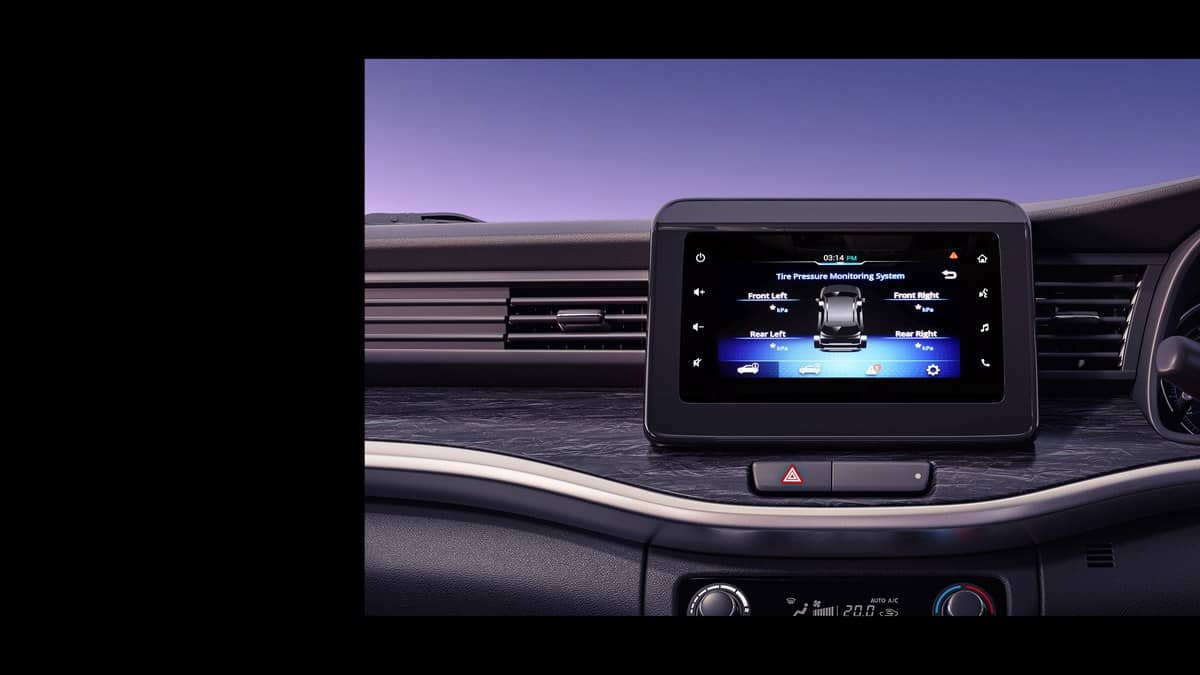
There is another X-Trail-specific detail: the brochure illustrates the pressure display with sample readings. Those graphics explain a feature, while the specification lists the tyre size. Neither supplies a universal inflation instruction for every vehicle. This guide deliberately does not reproduce a numerical pressure from an illustration.
Understand the repair kit before needing it
Nissan's India brochure lists a repair kit in its spare-tyre entry. The UK manual describes kit repairs as temporary and directs the owner to arrange professional inspection afterwards. It also excludes situations such as sidewall damage, a damaged rim and expired sealant. Read the supplied kit instructions and check its condition before a trip.
Who this guide is for
For families using the X-Trail for outstation travel, this is a concrete planning issue. Establish what is actually carried in the vehicle and where its instructions are stored. Do that while parked at home, rather than discovering the equipment only after a puncture. An inflator, a sealant kit and a spare wheel should not be assumed to be interchangeable solutions.
Readers can separately explore the How Nissan X-Trail varies engine compression from 8:1 to 14:1 and our Nissan Magnite price list October 2026: Rs 5,69,400 to Rs 8,76,000. Both address other parts of planning a Nissan family-car journey.
Official sources: Nissan India X-Trail brochure, Nissan UK's cold-pressure guidance and repair-kit limitations.