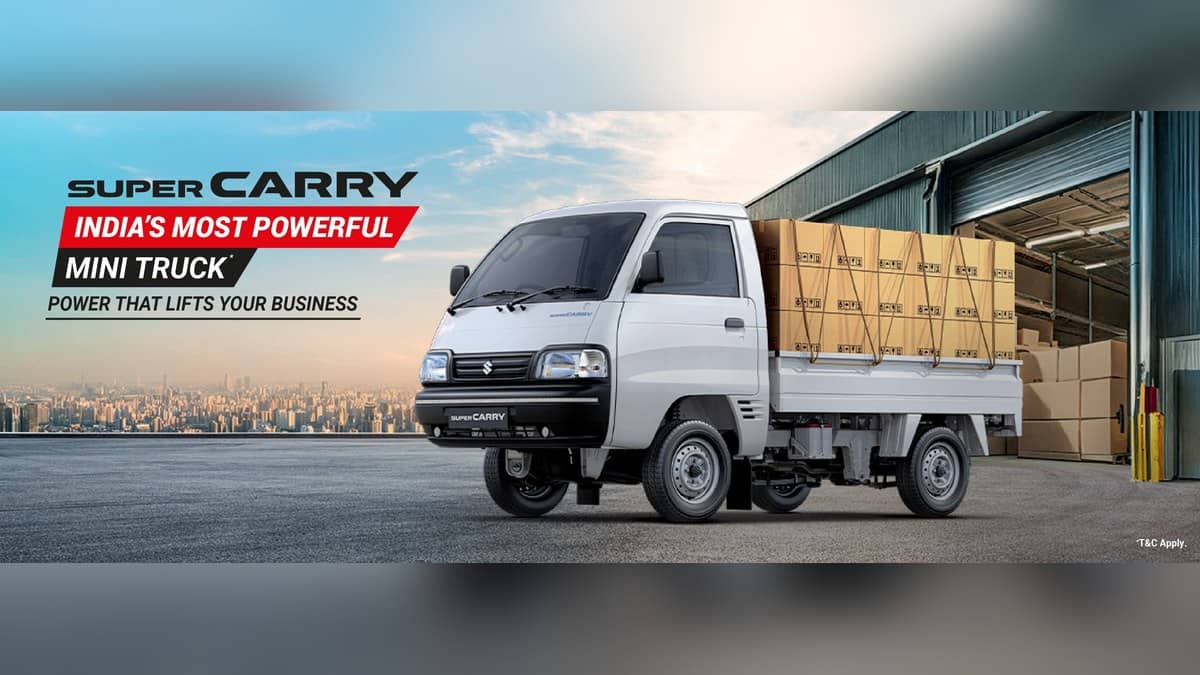
NEW DELHI: Maruti Suzuki describes the Super Carry's Electronic Stability Program as a package of seven safety functions, covering braking, wheel slip and vehicle stability. The official commercial vehicle page continues to list ESP. For an operator, the useful question is what each function does during a delivery run, rather than treating the ESP badge as a single extra brake feature.
| Function | Stated purpose |
|---|---|
| ABS | Helps prevent wheel lock during braking |
| EBD | Distributes braking force across changing loads |
| Engine Drag Control | Addresses wheel slip during sudden deceleration |
| Traction Control System | Helps maintain grip on slippery surfaces |
| Rollover Prevention | Intervenes in critical stability situations |
| Hydraulic Brake Assist | Supports emergency braking |
| Electronic Stability Program | Helps counter loss of stability around turns |
Why the seven names describe different problems
Maruti's Super Carry announcement separates wheel lock, wheelspin and sudden deceleration instead of describing them as the same event. ABS and traction control therefore have different jobs. One concerns braking, while the other concerns maintaining traction. Engine Drag Control addresses another situation, when a sudden reduction in speed can cause wheel slip.
That distinction gives a fleet supervisor a more useful way to explain the equipment to a new driver. A discussion confined to emergency braking misses the acceleration and deceleration functions in the same package. Equally, a traction-control label does not describe everything that happens when the driver presses the brake pedal. The equipment list needs to be read as a group of functions with separate purposes.
Braking assistance and stability belong together
The manufacturer's general safety explanation says ESP assists vehicle control and braking to counter skidding and reduce the likelihood of a rollover or side collision. Its explanation of EBD connects that system with ABS. These are active safety functions, intended to help before a crash, rather than descriptions of occupant protection after an impact.
The same official safety page distinguishes active safety from passive protection and responsible driving behaviour. This is a useful boundary for interpreting the Super Carry's equipment. An electronic intervention is support for the driver. It is not a published promise that the truck can negotiate any bend, recover from every mistake or stop within a particular distance.
The delivery truck context matters
Super Carry is offered in petrol and CNG forms, with standard and cab-chassis versions. Its product page lists a manual transmission, a compact turning radius and an engine immobilizer alongside ESP. Those details describe different parts of the working vehicle: manoeuvrability, propulsion, security and stability. None should be used as a substitute for another when checking a vehicle specification.
Consider a business allocating trucks between parcel deliveries and a different goods route. The useful operational question is whether drivers understand the safety equipment fitted to the actual vehicle they receive. A supervisor can include the abbreviations in a handover sheet, alongside the vehicle's documents and operating instructions, without turning the handover into a demonstration of emergency manoeuvres.
Maruti identifies courier work, e-commerce deliveries, FMCG and goods distribution as Super Carry applications. That makes the cargo part of the safety discussion particularly relevant. The company specifically links EBD with varying loads. It does not publish a loading exemption because ESP is fitted, and this article does not infer an additional carrying allowance from the electronics.
The current product page specifies a 1.2-litre K-Series Dual Jet, Dual VVT engine, a five-speed transmission and a 4.3 m turning radius. These describe the truck itself; they are not thresholds at which ESP switches on.
Keep model identification separate from a recall check
The ESP description concerns the truck's safety equipment. It does not settle whether an individual vehicle is included in a separate service action. Owners can read our Super Carry seat-adjuster recall explainer for that different question. A feature badge and a vehicle-specific campaign record answer different parts of an ownership check.
For body and fuel terminology, our Super Carry variant guide explains the commercial range. Readers comparing operating formats can also consult the Eeco Cargo dimensions explainer. Neither changes the meaning of the seven functions listed here.
Before using a truck, keep the model's operating instructions with the vehicle and include unfamiliar warning indicators in the handover discussion. The practical value of this ESP breakdown is a clearer vocabulary: wheel-lock control, braking-force distribution, traction support and stability intervention are related, but each describes a particular task. Maruti's official material supports those distinctions without establishing a universal stopping-distance or rollover-prevention guarantee.
Official sources: Super Carry product page, company ESP announcement and Maruti Suzuki safety technologies.