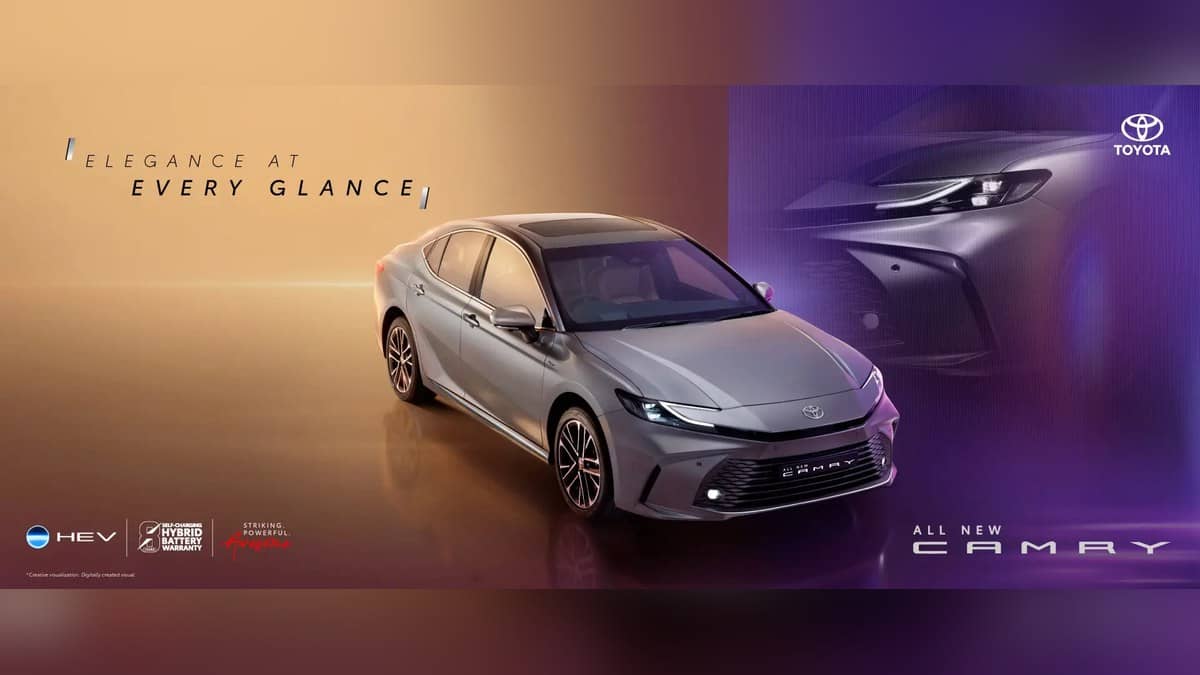
NEW DELHI: Toyota Camry prices are Rs 48,69,000 to Rs 48,89,000 ex-showroom Delhi in Toyota's current price selector. Elegant and Sprint Edition carry the same listed price, while Platinum White Pearl has its own higher-priced entry for each. All the listed versions use an automatic hybrid powertrain.
| Camry entry | Transmission | Ex-showroom Delhi price |
|---|---|---|
| Elegant | Automatic | Rs 48,69,000 |
| Sprint Edition | Automatic | Rs 48,69,000 |
| Elegant, Platinum White Pearl | Automatic | Rs 48,89,000 |
| Sprint Edition, Platinum White Pearl | Automatic | Rs 48,89,000 |
Price as of 26 October 2026, 14:27 IST. The table reproduces all Camry entries in Toyota's Delhi selector. These are ex-showroom amounts, not a calculation of registration, insurance or the complete amount payable for a particular purchase.
What separates Elegant and Sprint Edition
The price list is unusually compact because it does not offer a ladder of different engines or gearboxes. The main distinction is presentation, followed by the separately priced pearl finish. Neither a manual Camry nor a non-hybrid Camry appears in the official list checked for this report.
Toyota's Sprint Edition announcement describes matte black treatment for the bonnet, roof and boot, along with matte black wheels. Its sports kit includes front and rear body additions and a rear spoiler. The release also identifies door warning lamps and ambient lighting among the additions.
The same announcement says the marked accessories are developed by a third party and fitted by authorised dealers. That qualification matters when comparing an Elegant with a Sprint: the styling package should be itemised as supplied, rather than treated as evidence of a different engine tune or an independently tested performance upgrade.
The hybrid hardware behind both names
The Camry uses Toyota's 2.5-litre Dynamic Force petrol engine with its fifth-generation hybrid system and a lithium-ion battery. The official brochure gives total system output as 169 kW, or 230 PS. It is the combined system figure, so it should not be added to the separately listed output of the electric motor.
An e-CVT handles transmission duties, with Eco, Normal and Sport driving modes. Toyota also describes a sequential shift function. These modes give the driver different control choices within the same powertrain; they do not create additional price-list variants or change the Camry into a separate petrol-only model.
Toyota publishes certified fuel efficiency of 25.49 km/l. Its brochure explicitly warns that actual road mileage can vary. That number is useful as a standardised specification, but it is not a promise of what a particular Delhi commute will return, especially without a measured route, traffic pattern and driving record.
A sedan with rear-seat equipment
The product page places substantial emphasis on the rear cabin. Power-reclining rear seats and touch controls in the armrest let occupants adjust functions without asking the driver. The car also has a tilt-and-slide moonroof and wireless smartphone charging, alongside its digital information and multimedia displays.
The brochure specifies seating for five and a body length of 4.92 metres. This is a conventional sedan layout with a separate boot, rather than a people carrier with another seating row. Its cabin proposition therefore centres on comfort for the existing passengers, not adding passenger positions.
Front occupants have power seat adjustment, while the official equipment material includes ventilated front seats, a head-up display and JBL audio. These details are relevant to someone who alternates between driving and travelling in the rear. They also explain why the Camry cannot be understood simply by comparing its engine capacity with a less expensive sedan.
Assistance systems and ownership terms
Toyota lists Safety Sense driver assistance, including radar cruise control, lane-related assistance and a pre-collision system. The Sprint release also specifies nine airbags and a panoramic camera system. Toyota's brochure makes clear that the driver remains responsible for observing the surroundings and driving safely.
The current warranty page lists hybrid battery coverage of eight years or 1,60,000 km, whichever comes first, with different limits for specified commercial and converted uses. Battery cover is separate from the general vehicle warranty and does not mean every maintenance item is included.
Related reading includes our Lexus hybrid and electric sedan comparison, Honda range price overview and Invicto hybrid variant guide.
Official sources: Camry model page, Camry brochure, Sprint equipment announcement, warranty terms and Toyota's Delhi price selector.