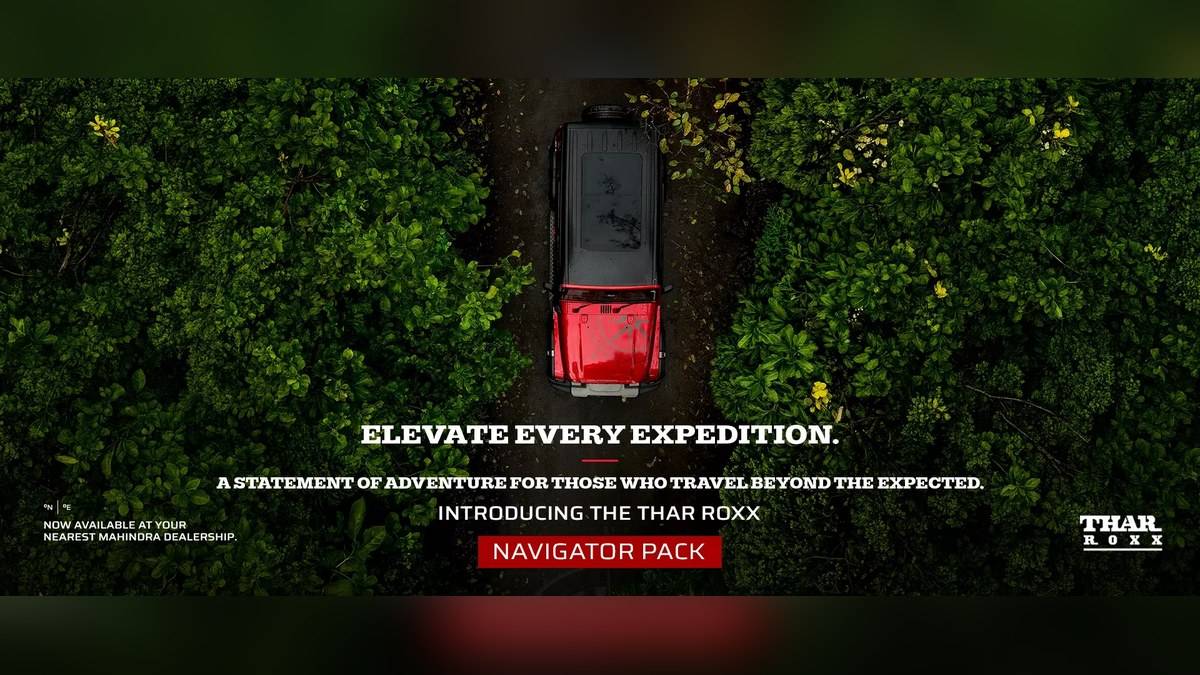
NEW DELHI: Mahindra advertises a 650 mm water-wading capability for the Thar ROXX, but the publicly available owner's manual gives more restrictive water-crossing cautions. It warns against still water above the bottom of the axle hubs and against flowing water above the bottom of the bumper or tyre centre line. The promotional number should therefore be read alongside the operating instructions.
| Published item | Official figure or instruction |
|---|---|
| Promotional water-wading figure | 650 mm |
| Approach angle | 41.7 degrees |
| Departure angle | 36.1 degrees |
| Ramp-over angle | 23.9 degrees |
| Manual's still-water caution | Do not enter above the bottom of the axle hubs |
The claim and the instructions answer different questions
The 650 mm figure appears in Mahindra's original Thar ROXX launch material and in its subsequent announcement for the diesel four-wheel-drive range. Those publications establish that the number is an official manufacturer claim. They do not, in the passages read for this report, explain a test procedure that reconciles it with the lower physical reference points used in the public manual.
That missing explanation matters. A capability figure is not enough to identify the condition of a flooded street, the depth of a hidden depression or the state of a vehicle that has already taken in water. This report does not convert the advertised depth into a recommended crossing depth. Owners should use the instructions applicable to their vehicle and seek clarification from Mahindra when the promotional material and handbook appear difficult to reconcile.
Water depth is separate from obstacle geometry
Mahindra also publishes approach, departure and ramp-over angles for the ROXX. Approach concerns the front of the vehicle meeting an incline; departure concerns the rear clearing it. Ramp-over concerns clearance over a crest between the axles. These are different geometric questions from whether water can enter mechanical components. None of the angle figures establishes that a water-covered route is passable.
This is particularly relevant to the ROXX's appeal as a passenger SUV with off-road hardware. Its published geometry can help explain how the vehicle is packaged, but a photograph of it climbing an obstacle says little about an unseen surface beneath water. An approach angle cannot be substituted for information about current, a soft streambed or a submerged obstruction.
Our Thar ROXX variant price guide covers the range separately. The important distinction here is between a specification that describes the vehicle and information needed to assess a particular route.
Four-wheel drive describes traction hardware
Mahindra's four-wheel-drive announcement identifies a low-ratio transfer case and an electronic locking differential in the 4XPLOR package. It describes selectable Snow, Sand and Mud terrain modes. These features address traction and control. They do not erase the handbook's cautions about water entering the engine, transmission or other components.
The same announcement specifies different diesel outputs for the gearboxes: the manual configuration is quoted at 111.9 kW and 330 Nm, while the automatic is quoted at 128.6 kW and 370 Nm. Both are described with a 2.2-litre mHawk diesel engine and six-speed transmissions. These are manufacturer specifications from the four-wheel-drive announcement, not measurements from a test drive conducted for this article.
That gearbox distinction is a useful reminder to keep the exact vehicle configuration in view. A broad ROXX badge does not describe every mechanical choice. Readers comparing the related vehicles can consult our Thar and Thar ROXX comparison.
The manual treats immersion as a service issue
For a stationary vehicle submerged above the bumper, the handbook calls for an authorised service centre and towing to inspect for water entry. It says not to attempt an engine start without service-centre advice. It also calls for inspection after off-road driving through water and attention to contaminated fluids. These instructions address what may have happened to the vehicle, rather than what its advertised wading figure suggests it could do.
The manual separately advises avoiding swift, rising water until the level or flow reduces. That warning concerns a changing environment, which a fixed depth specification cannot describe. It is another reason to keep the handbook instructions beside the promotional claim when assessing what the published number actually establishes.
The distinction also prevents a misleading assumption about electronic assistance. A selected terrain mode or an off-road display is not evidence that the engine and lubricants remain uncontaminated after immersion. A service assessment needs the actual circumstances: whether the vehicle was stationary, whether it stalled and how high water reached. Recording those circumstances is more useful than citing a brochure number alone.
The ROXX's low-speed assistance controls are covered in our separate Crawl Smart operating-window guide. This report concerns the published wading claim and its relationship to the handbook, not a new launch, a change in capability or a field verification of flood performance.
Official sources: ROXX launch specifications, four-wheel-drive announcement and public owner's manual.