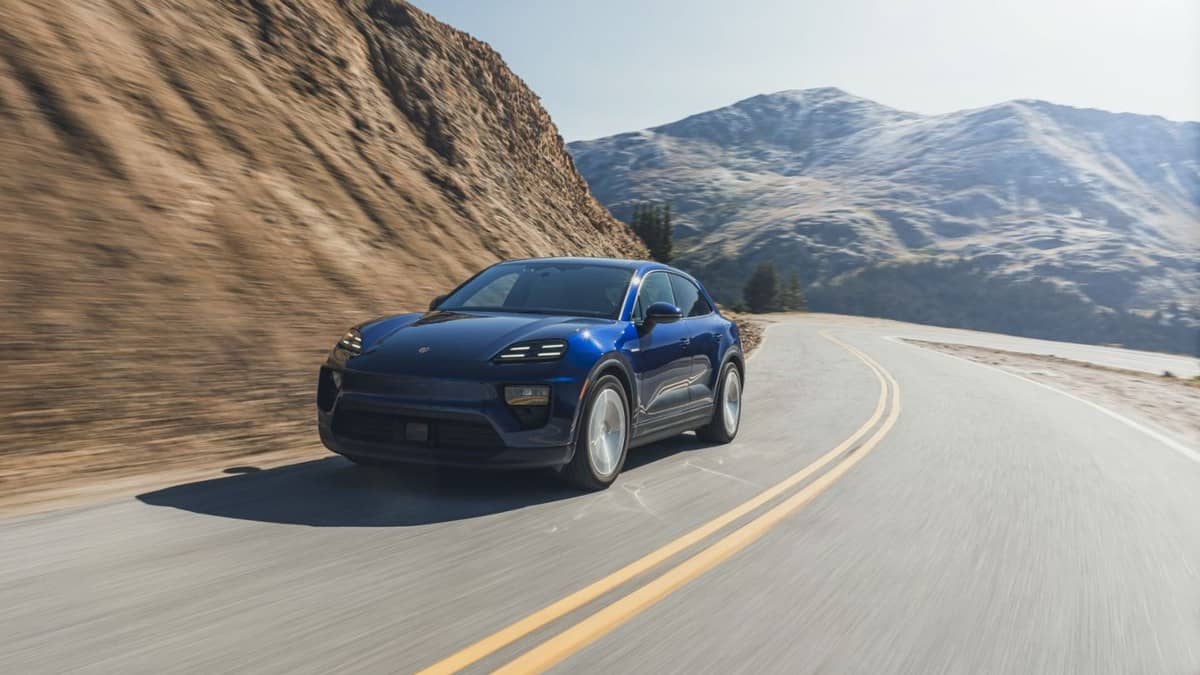
NEW DELHI: Porsche's India website lists the Macan Electric from Rs 1,21,62,000, the Macan 4S Electric from Rs 1,63,04,000 and the Macan Turbo Electric from Rs 1,77,74,000. Price as of 28 October 2026, 00:12 IST. Each is a starting price labelled inclusive of VAT by Porsche, with the final configuration and on-road bill requiring separate calculation.
| Electric variant | Starting price | Drive | Overboost with Launch Control | 0-100 km/h with Launch Control |
|---|---|---|---|---|
| Macan Electric | Rs 1,21,62,000 | Rear-wheel drive | Up to 360 PS | 5.7 seconds |
| Macan 4S Electric | Rs 1,63,04,000 | All-wheel drive | Up to 516 PS | 4.1 seconds |
| Macan Turbo Electric | Rs 1,77,74,000 | All-wheel drive | Up to 639 PS | 3.3 seconds |
A range with different drive layouts
This table covers every electric Macan variant currently displayed in the India configurator. Porsche labels the entry electric car as model year 2025, while the 4S and Turbo entries carry model year 2027. Those labels are part of the website listing; they do not establish the build date of a particular vehicle offered to a customer.
The entry Macan Electric drives the rear wheels through a single-speed gearbox. Porsche lists 563 Nm and a steel-spring suspension arrangement, with Porsche Active Suspension Management available optionally. It is therefore a distinct mechanical proposition within the family, rather than simply an all-wheel-drive model with fewer cosmetic features.
The 4S uses electric motors at both axles and electric Porsche Traction Management. Its published torque figure is 820 Nm. The change from the entry car consequently includes driven wheels and motor hardware as well as the higher output shown in the table.
On the 4S page, adaptive air suspension with PASM and Porsche Torque Vectoring Plus are marked optional. The latter uses an electronically controlled rear differential lock. Anyone comparing a configured 4S with a Turbo should identify these choices explicitly, because the badge and starting price alone do not describe the complete chassis specification.
What the Turbo adds to the proposition
The Turbo's India page lists 1,130 Nm, a top speed of 260 km/h and an all-wheel-drive system with a rearward emphasis. It also describes adaptive air suspension and Torque Vectoring Plus. The name identifies the higher-performance electric variant; the car remains an EV, rather than gaining a combustion engine.
Porsche shows optional 22-inch wheel designs on the Turbo page and identifies rear-axle steering as optional. Those distinctions matter when looking at promotional photographs. The wheel and steering choices can be part of the configuration conversation without being silently included in the advertised entry figure.
The performance columns need their full labels. Overboost and the acceleration times are quoted with Launch Control, rather than as a promise about every departure from a traffic signal. The figures show the hierarchy Porsche advertises, but do not measure ride quality, passenger comfort or ease of parking.
Shared battery size does not provide a verified range figure
All three model pages state a battery capacity of 100 kWh gross. Gross capacity describes the battery's total rating and should not be relabelled as usable energy. The India pages leave their range fields as TBA, so this guide does not substitute an overseas range claim for a missing local figure.
The published charging architecture is 800 volts, with peak DC charging power of up to 270 kW. A peak capability is useful when checking charger compatibility, but does not describe the power delivered throughout a charging session. The route's available charging hardware is a separate part of the assessment.
Porsche quotes a 21-minute charge from 10% to 80% under specified optimal conditions. Its footnote calls for a CCS station exceeding 270 kW and 850 volts, battery temperature of 25 degrees Celsius and an initial state of charge of 9%. The fuller charging note also specifies remaining range below 60 km.
The model choice and the equipment choice are separate
The unusual feature of this Macan ladder is that moving up changes the drive layout, while several expensive chassis choices still need attention within a variant. A fair comparison begins with matching the equipment the household actually needs, then considering whether the additional performance has a useful role in its driving.
For other premium SUVs, see our Cayenne Electric report, Volvo EX90 report and Lexus RX comparison.
Official references: India configurator, Macan Electric, Macan 4S Electric and Macan Turbo Electric.