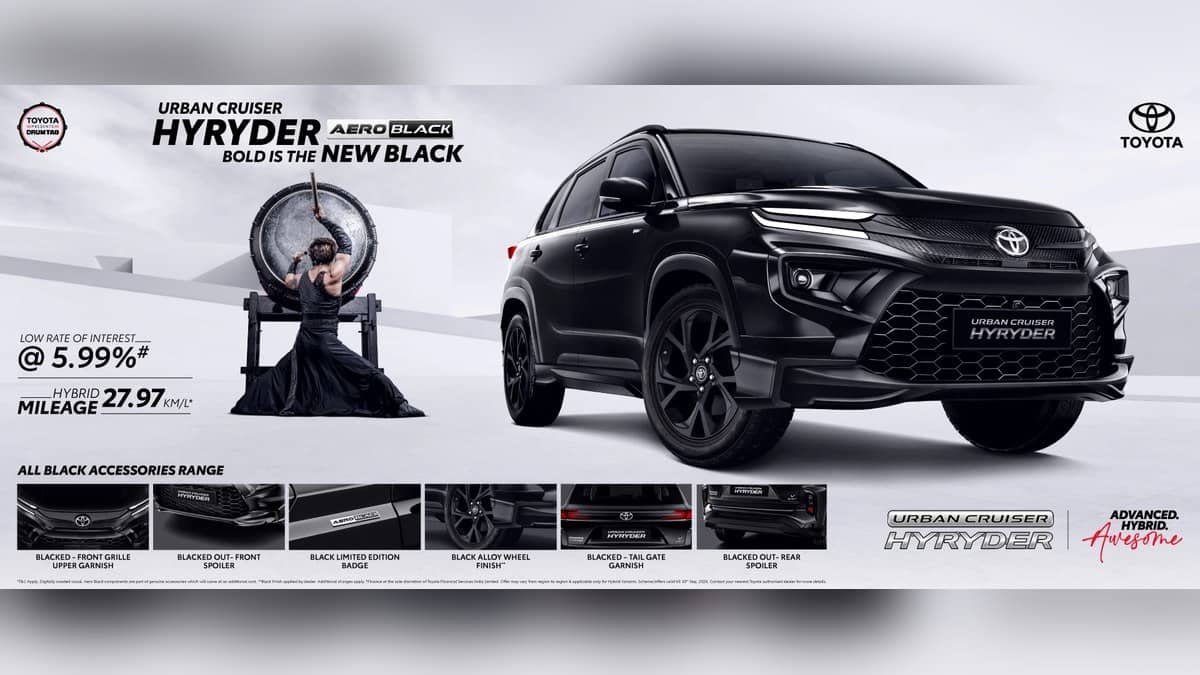
NEW DELHI: Toyota's 27.97 km/l fuel-efficiency figure for the Urban Cruiser Hyryder applies to the strong hybrid with e-Drive, not to every version carrying the Hyryder name. The Indian range also includes NeoDrive petrol and E-CNG powertrains. Their engines, transmissions and output figures need to be kept separate when comparing specifications.
| Powertrain | Engine capacity | Published output | Transmission |
|---|---|---|---|
| Strong hybrid | 1,490 cc | 115.56 PS combined system | e-Drive |
| NeoDrive petrol | 1,462 cc | 103.06 PS engine | 5-speed manual or 6-speed automatic, depending on grade |
| E-CNG | 1,462 cc | 87.8 PS in CNG mode; 100.6 PS in petrol mode | 5-speed manual |
The hybrid figure belongs to a specific system
Toyota's model page identifies 27.97 km/l as a figure certified under Rule 115(G) of the Central Motor Vehicles Rules. It is a certification result for the hybrid configuration, rather than a promise that every journey will return that economy. A daily commute is not the same thing as a certification test.
The hybrid combines a petrol engine, an electric motor and a lithium-ion traction battery. Toyota specifies 92.45 PS for the engine and 80.2 PS for the motor, but lists total system output separately at 115.56 PS. Adding the component peaks would produce a number that Toyota does not quote for the car.
That distinction is particularly useful here because the NeoDrive and hybrid engines are both marketed as 1.5-litre units. Their exact capacities and supporting hardware differ. A specification comparison that stops at the shared engine-size label misses the main reason these are separate powertrain choices.
Self-charging does not mean the engine disappears
Toyota's brochure describes a hybrid that can run on electric power or with the engine and motor working together. The electric capability is part of a petrol-powered vehicle's operating system. It should not be confused with the ownership pattern of a battery-electric vehicle whose routine energy supply comes from charging.
The hybrid's transmission is identified as e-Drive, and Toyota lists it with two-wheel drive. The NeoDrive range uses a K-series petrol engine with an integrated starter generator. Its manual and conventional automatic choices therefore belong to a different branch of the Hyryder specification sheet.
E-CNG is another separate branch. Its power rating changes with the fuel being used, so quoting only the petrol-mode figure would give an incomplete picture of CNG operation. It also retains the manual gearbox in Toyota's published specification, rather than inheriting the hybrid's e-Drive label.
Why older AWD references need care
In its update announced on 7 April 2025, Toyota said a six-speed automatic replaced the previous five-speed manual in the all-wheel-drive variant. That is a useful date marker when reading older Hyryder material. An old reference to manual AWD does not describe the transmission change Toyota subsequently announced.
The same update made six airbags standard across the range and introduced structural enhancements. Higher variants gained features including an eight-way powered driver's seat, rear door sunshades and ventilated front seats. These changes concern equipment and model specification; they do not turn every version into the strong hybrid.
Toyota's announcement also sets out a hybrid battery warranty of eight years or 1,60,000 km, alongside a vehicle warranty of three years or 1,00,000 km. The battery cover and the whole-car cover are separate entries. Their written conditions should be read separately rather than treating the longer battery term as cover for everything.
Read the powertrain before the feature list
The practical comparison starts with the full model description: fuel system, gearbox, driven wheels and grade. Only then do features such as a panoramic roof or camera equipment become a like-for-like comparison. With the Hyryder, the same exterior nameplate can sit above materially different propulsion hardware.
This also explains why a single headline mileage figure is insufficient for comparing quotations. A quote headed simply Hyryder needs its powertrain identified before the hybrid's economy claim can be attached to it. The relevant question is which mechanical version the document actually specifies.
For other Toyota configurations, our Innova Hycross price guide, Camry price guide and Taisor variant guide provide separate model context. Their figures should not be substituted for the Hyryder's own specification.
Sources: Toyota Hyryder model page, official brochure and Toyota's April 2025 update.