
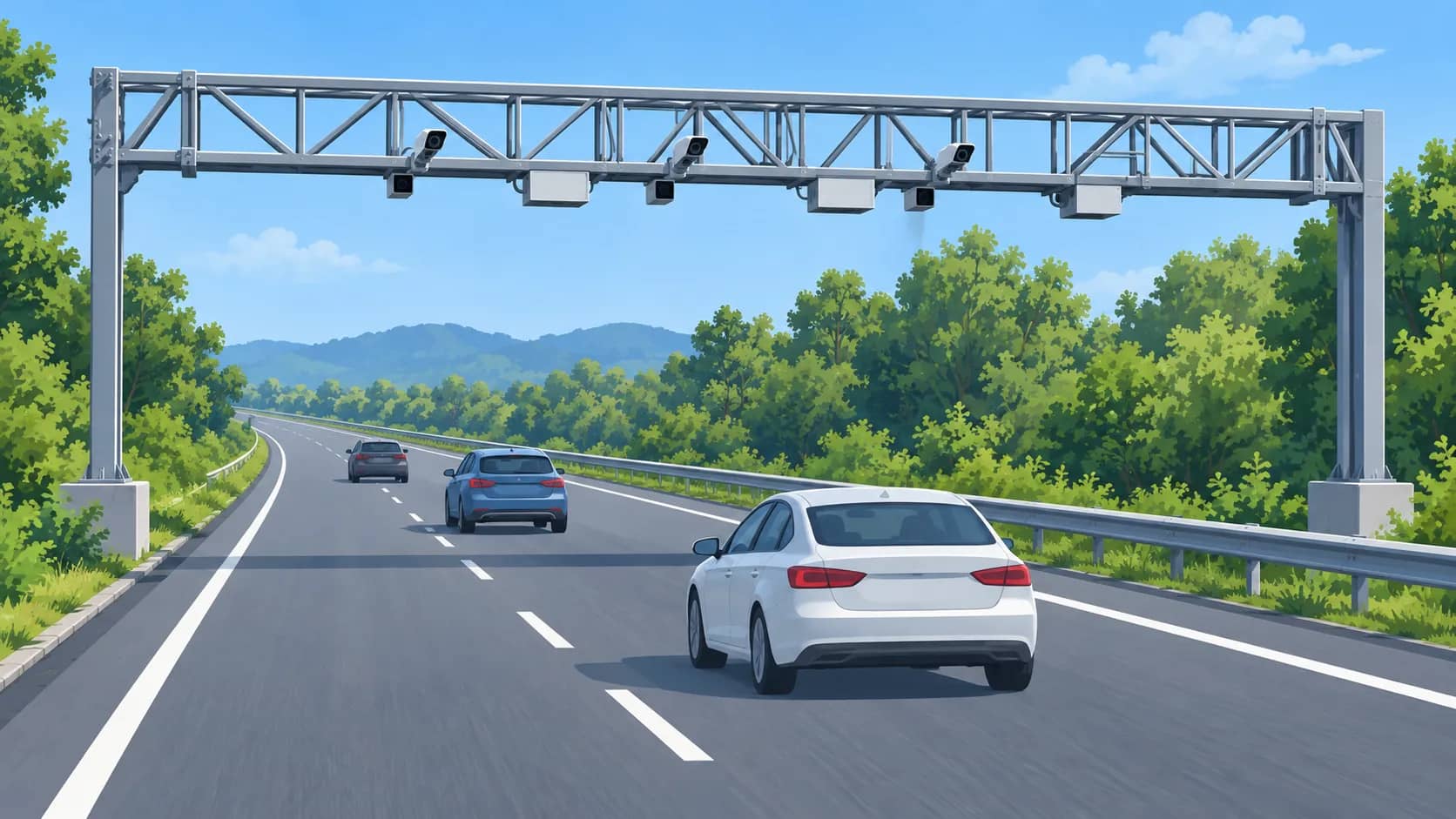
NHAI has introduced barrierless toll collection at Paranur on the Tambaram-Tindivanam corridor, with vehicles identified through number-plate cameras and FASTag. The authority announced the Tamil Nadu rollout on 1 October, describing it as the state's first Multi-Lane Free Flow installation.
The official announcement says vehicles can pass the toll location without stopping. It also makes clear that a functioning FASTag with sufficient balance remains necessary to avoid an electronic notice for unpaid toll. Removing the barrier does not remove the charge.
Paranur joins locations already operating the system in Gujarat, Delhi-NCR, Rajasthan and Haryana. NHAI says the rollout is phased. Its stated goals include less congestion, lower fuel use and reduced emissions, but the release supplies no measured Paranur-specific savings or waiting-time data.
How toll collection works without a barrier
NHAI's 25 June operating explanation, issued for the Gharaunda rollout, describes sensors and cameras mounted on overhead gantries. These identify passing vehicles and collect the user fee through FASTag. The technology replaces a stopping point with electronic identification and payment processing.
A 22 July parliamentary reply explains that the deployed system combines automatic number-plate recognition with the radio-frequency technology already used by FASTag. It distinguishes that arrangement from GPS-based tolling, for which expert committees had recommended further deliberations. Paranur's October announcement likewise names cameras and FASTag, not satellite tracking.
The same reply describes the payment chain: the toll-plaza acquiring bank, the National Payments Corporation of India and the FASTag issuing bank participate in each transaction. The fee deduction is communicated to the highway user and recorded centrally. A road user passing freely beneath a gantry still generates a chargeable journey record.
An unpaid toll can produce an e-notice
The recovery framework predates the Paranur rollout. In an 18 March statement, the transport ministry said revised National Highways Fee Rules took effect on 17 March 2026. They cover a recorded vehicle passage for which the applicable user fee has not been received.
Under that framework, an e-notice identifies the vehicle, the date and location of passage, and the amount due. Notices can be delivered by SMS, email, mobile applications or other electronic means, and are also placed on a designated portal. The system uses VAHAN registration information to identify the vehicle owner.
The ministry says payment within 72 hours of the notice's issuance requires only the normal toll. After that window, the amount is twice the applicable toll. A representation disputing a notice can also be submitted within 72 hours. The stated clock runs from issuance, rather than from whenever a message is first read.
The representation must be decided within five days, otherwise the unpaid-fee claim lapses. When a fee remains unpaid beyond 15 days and no representation is pending, it can be entered in VAHAN and restrictions may apply to vehicle-related services until payment.
A separate 20 January ministry statement identifies the linked services: an ownership-transfer or interstate-transfer no-objection certificate, a vehicle fitness certificate, and a National Permit for commercial vehicles. It says outstanding national highway user fees must be cleared for those processes. These provisions were announced months before Paranur began barrierless collection.
The official checking and complaint channels
NHAI's June guidance identifies the NIC National Highway Fee e-Notice portal as the place to view and manage notices. Access requires a vehicle registration number and a one-time password sent to the mobile number registered in VAHAN. It also says notices can be viewed in the Rajmargyatra app.
That guidance lists insufficient balance, an inactive tag and other tag problems among reasons a payment may fail. It calls for an active FASTag properly fixed to the windscreen and a clear, compliant registration plate. These are NHAI's published operating requirements for the camera-and-tag system.
For wider toll-payment complaints, the July reply lists the national highway helpline 1033, FASTag issuer-bank helplines and the Rajmargyatra app. Those general support channels sit alongside the specific e-notice representation process. The two are described separately in the official material; a routine support enquiry is not stated to replace a time-limited representation.
The July reply had listed Paranur among 17 awarded installations. October's announcement confirms operation, rather than merely a contract award. Those are different stages of the highway rollout.
Related Dalimss News coverage includes Haryana toll-rate changes and the revised exempted-FASTag guidelines for persons with disabilities. Paranur's new collection method does not, by itself, announce a new toll tariff or change those separate eligibility rules.