BENGALURU: Green hydrogen is often described as the fuel that could clean up steel, fertiliser and refining, but it has one stubborn problem. Making it by splitting water takes a lot of electricity, and electricity is the biggest part of its cost. Newtrace, a Bengaluru climate tech startup, is working on a narrow but important piece of that puzzle: the electrode inside the electrolyser.
Its flagship product, called VoltaGen, is a coated cathode that the company says can be dropped into existing alkaline electrolyser stacks and cut the electricity needed to make each kilogram of hydrogen. Here is what Newtrace makes, what it claims, and what to keep in mind.
The problem Newtrace is attacking
An electrolyser uses electricity to split water into hydrogen and oxygen. Newtrace's website says electricity accounts for 60 to 70 percent of the total cost of producing hydrogen this way. Every kilowatt hour saved per kilogram therefore shows up directly in the final cost.
In an alkaline electrolyser, the electrodes carry the current and host the chemical reactions. Better electrodes can lower the voltage needed for the same output, which means less power drawn for the same amount of hydrogen. That is the lever Newtrace is pulling.
Alkaline electrolysers are the older and more widely used of the main designs. They use a liquid potassium hydroxide electrolyte and do not need the scarce platinum and iridium catalysts that newer proton exchange membrane machines rely on, which makes them cheaper to build. Their weakness has been efficiency, and that is exactly where a better electrode can help.
VoltaGen, the coated cathode
The company says VoltaGen was engineered after systematically screening more than 1,000 combinations of catalysts and base materials. It claims the cathode cuts specific energy consumption by up to 9.5 kWh per kilogram of hydrogen, at a rated current density of 0.5 amperes per square centimetre.
Two other claims are central to its pitch. First, Newtrace says VoltaGen contains no platinum group metals or other critical raw materials, which matters because those metals are expensive and mostly imported. Second, it says the cathode is dimensionally and mechanically compatible with existing alkaline stacks, so it can replace the cathode element directly without changing cell geometry, balance of plant or control systems.
The company translates the energy saving into a cost figure, saying it can lower the levelised cost of hydrogen by up to Rs 60 per kilogram, and that at current electricity tariffs the extra cost of the electrode is typically recovered within 12 months of continuous operation. These are company estimates that depend on power prices, plant size and operating hours. Dalimss News has not seen independent test data, and buyers would want to see results from their own stacks.
Full electrolysers and plant systems too
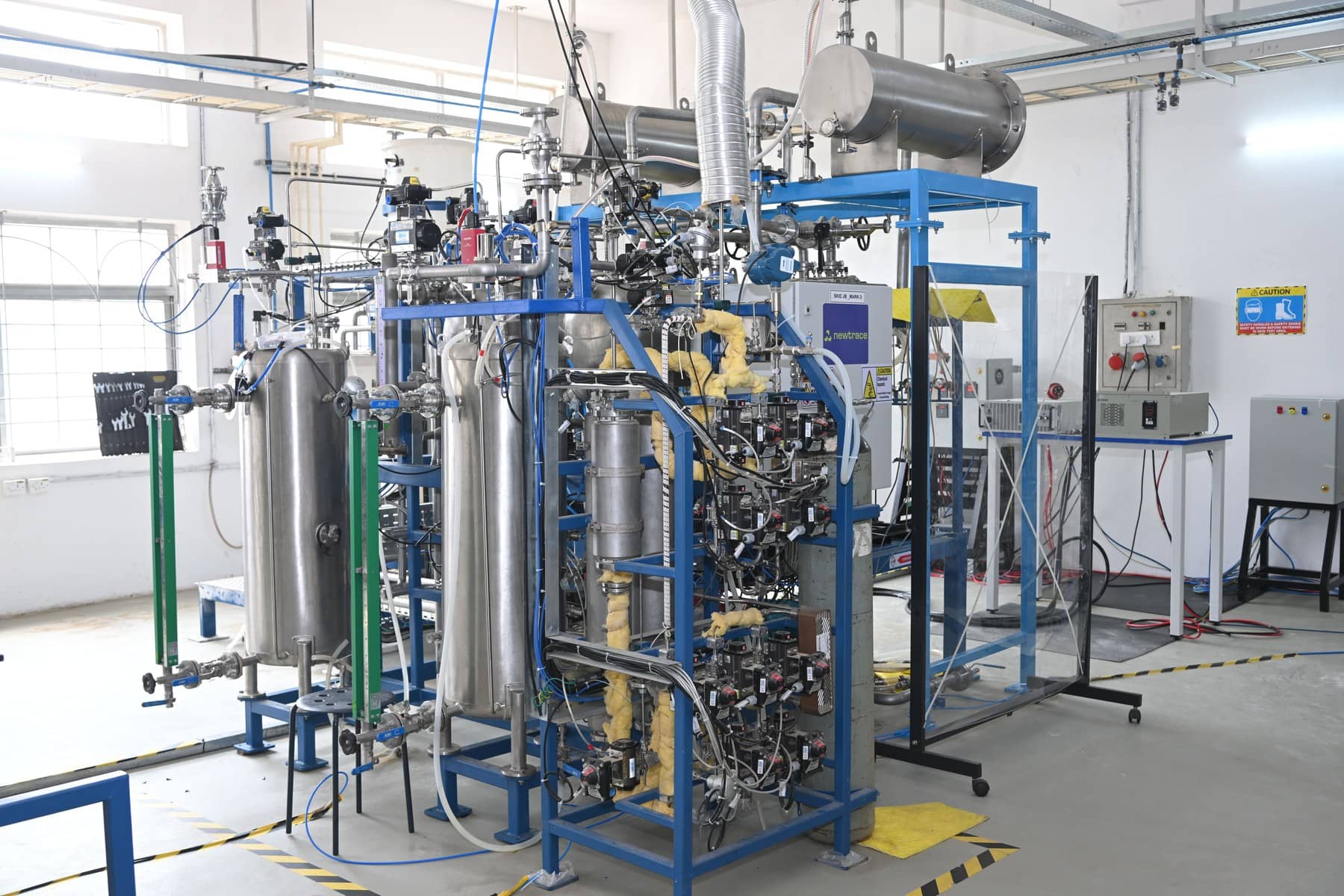
Newtrace does not stop at electrodes. Its website lists three product lines. Apart from VoltaGen, it offers complete alkaline electrolyser stacks built around the same cathode, which it rates at 44.4 kWh per kilogram with hydrogen purity above 99.9 percent. The product enquiry form lists electrolyser sizes from 10 to 100 kW, 250 to 500 kW and above 1 MW.
The third line is what the company calls a vertically integrated balance of plant, combining power electronics, fluid management and real time control for alkaline electrolysis. Newtrace says this reduces auxiliary losses and total system capital cost. It describes the stacks as designed for high current operation coupled to renewable power, which matters because solar and wind output rises and falls through the day.
Newtrace says it has an in house catalyst coating facility, on site assembly and in house testing, with a 30,000 square foot technology facility in the Doddanekkundi industrial area of Bengaluru. It claims every part is fully manufactured in India.
Deployments, team and backing
On its website, Newtrace says it has deployed membrane less electrolysers with BPCL and ONGC, two of India's large state owned energy companies. It does not give the size or results of those deployments.
The company is led by co-founder and CEO Prasanta Sarkar, who holds a PhD in fluid mechanics and energy engineering from Universite Grenoble Alpes and earlier worked as an aerospace engineer at Leonardo Helicopters, and co-founder and CTO Rochan Sinha, who holds a PhD in applied physics from Eindhoven University of Technology. The site lists more than 40 team members, including four PhD researchers, and more than five years of research and development.
The website highlights a 6.3 million dollar pre-Series A round, with HDFC Bank, Mitsui Sumitomo and Peak XV among the investors named. It also lists a Shooting Star award at LEAP in Riyadh worth 150,000 dollars, a place among 10 Indian startups picked for the Indo-Pacific Economic Framework's climate tech programme, a Nasscom top 50 deep tech startups listing in 2024, a CII Startupreneur award and an IKP Rise award.
Why it matters for India
India has set out to become a major producer of green hydrogen, and the cost of electrolysis is one of the main hurdles. Indian companies are already testing the fuel, as seen in Maruti Suzuki's 300 kW green hydrogen pilot plant at Manesar. Other startups are working on how to use hydrogen once it is made, like DheyaTech with its micro gas turbines.
A cheaper, locally made electrode that fits existing stacks would be a practical way to bring costs down without asking producers to redesign their plants. The open questions are how long VoltaGen lasts in real plants running on variable renewable power, how its claimed savings hold up at large scale, and whether Newtrace can manufacture in volume. Those answers will come from field data rather than lab tables.