BENGALURU: Weeding is one of the most tiring and expensive jobs on a vegetable farm. Crews walk the beds by hand, or tractors spray whole fields with chemicals that only a small share of the plants actually need. Niqo Robotics, a Bengaluru company founded in 2015, builds tractor-mounted robots that look at each plant and spray only the ones that need it. This week the company is due at a melon growers' conference in Australia with its newer, smaller machine, the RoboWeeder Solo.
The RoboWeeder Solo page lists the Australian Melon Conference and Field Day in Townsville from 7 to 9 October 2026, and a robotics and agtech event for growers in Yakima, Washington State, from 20 to 22 October. Both are part of a push the company announced in March into new crops and new markets. Here is what Niqo makes and what it claims.
From Tartan Sense to Niqo
Niqo's history page says the company was incorporated in 2015 as Tartan Sense, raised seed funding in 2019 and a Series A in 2021, and rebranded as Niqo Robotics in 2022. It launched Niqo RoboSpray in India in 2023, crossed 100,000 acres of spot spraying and raised a Series B in 2024, and by 2025 had sprayed more than 180,000 acres, the same year it launched the RoboWeeder in North America.
The company is headquartered in Bengaluru, with US operations registered in Dover, Delaware and dealer networks in California and Arizona. Its founder and CEO is Jaisimha Rao, whom the company describes as a Carnegie Mellon-trained engineer and former BlackRock professional. Investors named in its March release are Fulcrum Global Capital, Omnivore, Bidra Innovation Ventures, Blume Ventures, Beenext and FMC Corporation, the crop protection company.
How Niqo Sense works
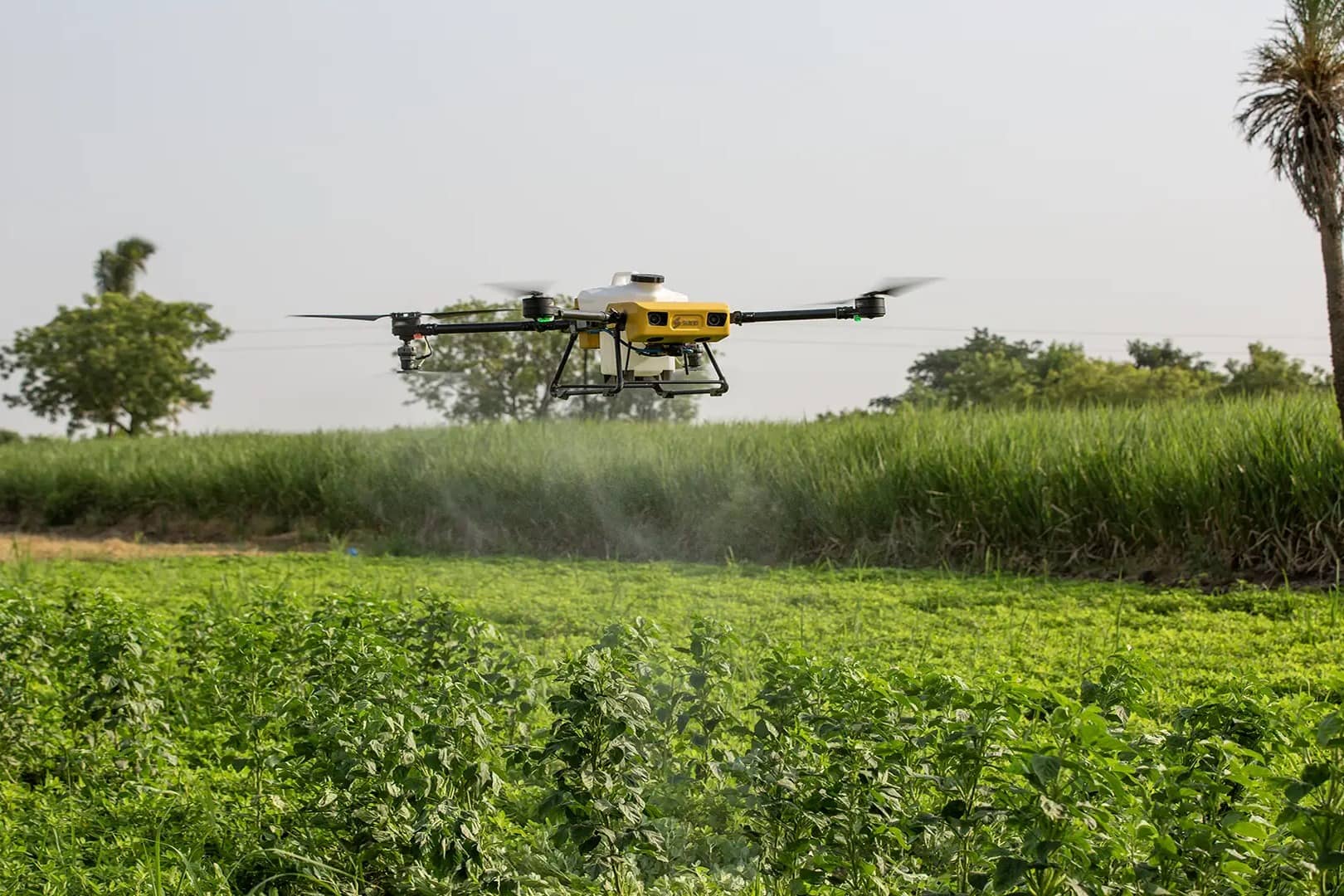
Everything Niqo sells is built around Niqo Sense, a camera system it designed in-house. The technology page describes it as a rugged, IP66-rated unit with its own motherboard, a GPU and a deep learning accelerator, plus strobe lights synchronised with the camera so it can work early in the morning, late in the evening or at night. Fitted to a sprayer, it looks at the crop, decides plant by plant what to spray, and fires high-precision nozzles in real time.
The company says the system can pick out targets as small as one inch against bare soil, and can also tell plants apart against dense green foliage, which is the harder case. It can be used with pesticide, herbicide, fungicide or liquid fertiliser. Niqo adds a set of supporting tools: an RTK GPS base station it says can bring mapping accuracy down to about 14 mm, an in-cabin touchscreen called Niqo View for the tractor driver, and an online fleet dashboard called Niqo Track.
In its March release, Niqo said the system runs entirely on the edge with no cloud connection, makes thousands of plant-level decisions per second, and is over 99 percent accurate even in weedy fields. These are company figures.
RoboWeeder and RoboWeeder Solo
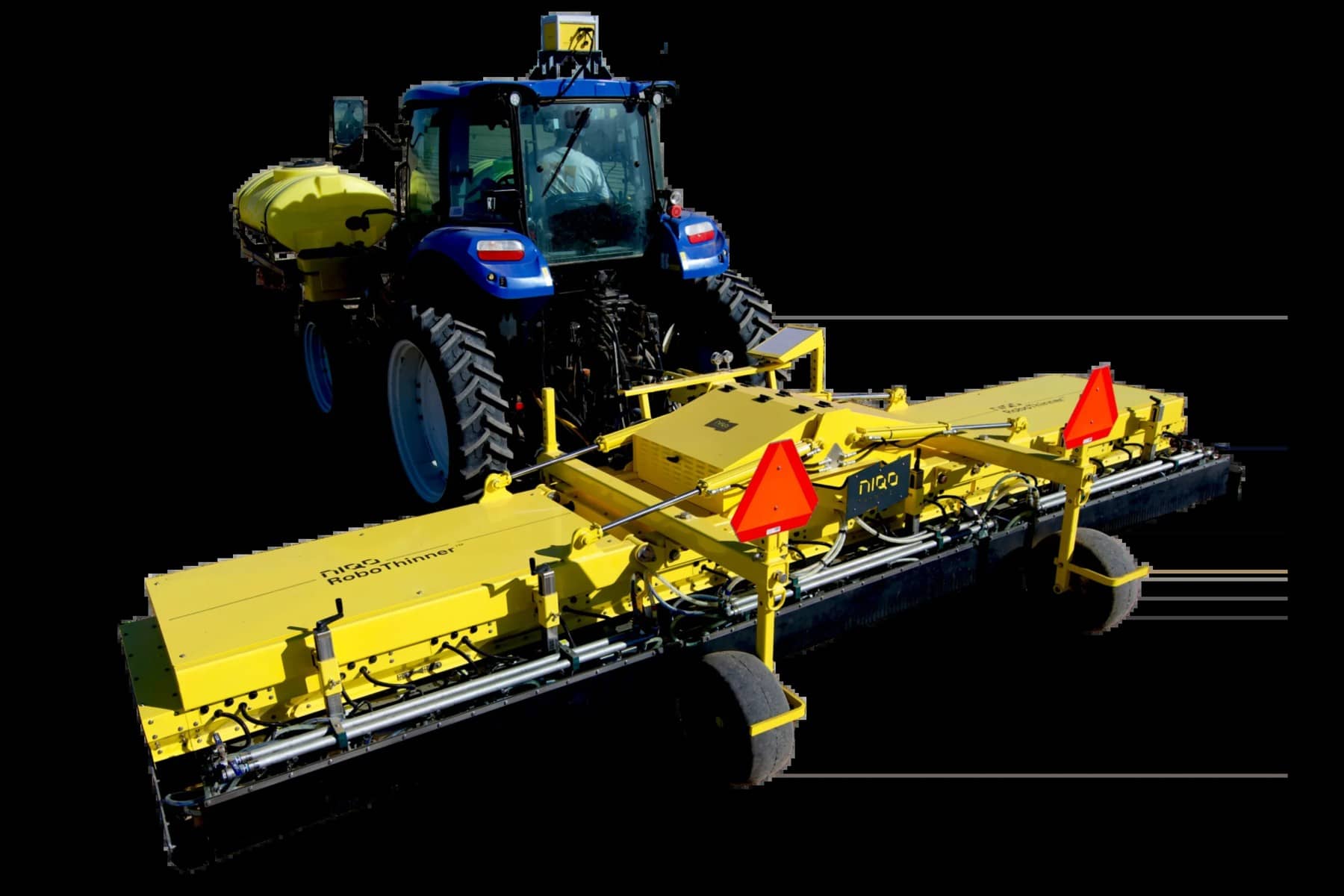
The flagship RoboWeeder is a wide implement pulled by a tractor. Niqo calls it a 3-in-1 machine because it can weed, thin and apply beneficial sprays in a single pass. It has three tanks and a twin-nozzle setup, runs at up to 4.5 miles per hour, and has been tested on Romaine and Iceberg lettuce in six-bed and three-bed layouts. It weighs about 1,670 kg unladen and needs a tractor of at least 50 hp with a CAT II three-point hitch. The company claims it pays for itself in about 2,200 acres.
RoboWeeder Solo is the smaller, single-bay version. It weighs about 800 kg with fluids, has two modes for weeding and beneficial spraying, and works on bed sizes from 1,728 mm to 2,134 mm. Niqo lists tomato, onion, chilli, melon, broccoli, turf, kale and lettuce among the crops it has been tested on, and claims a payback within about one and a half seasons.
Niqo has not published prices for either machine on its website. Its March release says it sells them as a one-time purchase with no recurring fees, 24-hour service and locally stocked parts.
The profitability claim
The most striking line in Niqo's 16 March 2026 announcement is about money, not machines. The company said its core business was on track for profitability in its first full commercial year, and claimed that no agricultural robotics company had publicly achieved that before. Rao said Niqo was built "to prove that Physical AI can be a real business, not just impressive technology that burns cash indefinitely."
The company did not publish revenue or profit figures to back the claim, so it should be read as a stated target. In the same release, Niqo said its weeding software would cover more than 15 crops, that it was entering the Pacific Northwest and targeting Europe and Australia, and that a next-generation weeding robot for the US would arrive in the second half of 2026.
What it means for Indian farms
Most of Niqo's recent announcements are about lettuce growers in California's Salinas Valley and Arizona's Yuma region, which can make it look like an American company. But its engineering base is in Bengaluru, its spot spraying started in India, and its website carries testimonials from Indian cotton and chilli farmers alongside US growers. The company says its technology has delivered returns to more than 3,000 farmers across India and the US.
For Indian agriculture, the appeal is lower chemical use and less dependence on scarce farm labour. That fits a wider shift towards input-saving farm technology, from modern irrigation systems helping Kashi farmers cut water use to new robotics courses such as those in IIT Madras's new academic programmes. The catch is cost. A machine that pays back over 2,200 acres suits large commercial farms far better than the small holdings that make up most of Indian agriculture.
The things to watch are whether Niqo publishes India pricing or a service model for smaller farmers, whether the next-generation robot arrives on schedule, and whether the company backs its profitability claim with numbers.