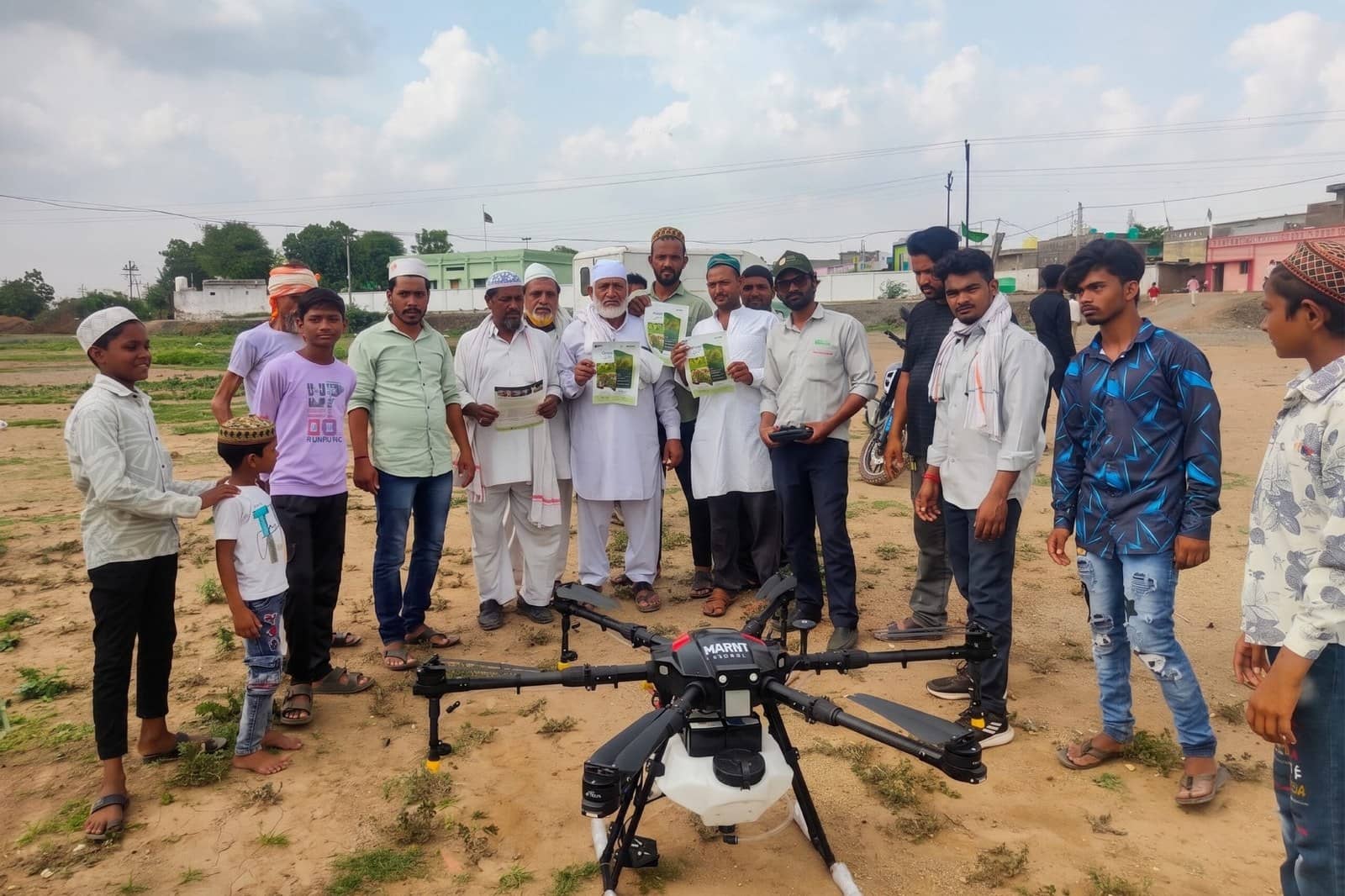
HYDERABAD: Most people picture a farm sprayer when they hear the words Indian drone startup. Marut Drones, a Hyderabad company run by three co-founders, builds those too, but its catalogue goes much further. It also makes drones that drop seed balls on degraded hills, carry fish feed across ponds, spray mosquito breeding sites and move cargo in difficult terrain, and it runs a pilot training academy on the side.
The company describes itself as India's first multi-utility drone manufacturer and says on its homepage that it has five DGCA certified drone platforms, more than 1,800 drones deployed across India, eight patents granted and more than 50 filed. These are company figures, and Dalimss News has not independently audited them. Here is a plain guide to what Marut makes and who it is for.
Who is behind Marut Drones
Marut Dronetech Pvt Ltd is based in Madhapur, Hyderabad. Its about page lists three directors and co-founders. Prem Kumar Vislawath, described as founder and chief innovator, is an IIT Guwahati graduate in electronics and computer engineering. Suraj Peddi, the chief technology officer, also studied at IIT Guwahati, in electronics and communications engineering, and leads drone development. Sai Kumar Chinthala, an entrepreneur and filmmaker, co-founded the company and is named as CEO of Marut Drone Academy.
The company's milestones section says it raised 6.2 million dollars in Series A funding from investment firm Lok Capital. Its homepage also lists awards such as a TiE Global top 100 emerging startup award and a FICCI award for sustainable agriculture in 2022.
The Kisan Drone range for farms
Farm drones are still the core of the business. The Kisan Drone page lists five current models in the AG 365 family, all aimed at spraying, granular spreading, seeding and crop monitoring. The AG 365I and AG 365XP carry up to 10 litres, fly for more than 30 minutes and, according to the company, can cover more than 30 acres in a working day. The original AG 365 and the portable AG 365H carry 11 litres with flight times of about 22 and 23 minutes, and the compact AG 365S carries 10 litres for about 16 minutes.
The page also lists upcoming models: a 30 litre version with a 15 kg payload, a 50 litre version with a 25 kg payload, a hybrid model with a claimed 90 minute flight time, and an AG365i variant the company says is 80 percent Indian made. No launch dates are given. Marut says its drones are eligible under central and state agriculture drone subsidy schemes, subject to each scheme's rules, and that its team helps buyers with paperwork. Farmers should confirm eligibility with their own state agriculture department before buying.
Seedcopter, Aquacopter and Marut ZAP
The Seedcopter is an aerial seeding drone. Its spec sheet lists a maximum take off weight of up to 30 kg, a payload of up to 10 kg, a 25 minute flight time, a 10 km range and room for 1,500 to 2,000 seed balls per flight. The company says it wants the platform to help plant one billion trees in India by 2030, a target rather than a result, and that the work should create local and women led jobs.
The Aquacopter series is built for fisheries. The AQ 30 carries 30 kg of granular feed, while the AQ 70, which the company calls India's first heavy lift aquaculture drone, carries up to 70 kg of liquid or granular load with a maximum take off weight of 110 kg. Marut says an Aquacopter was demonstrated with ICAR's Central Inland Fisheries Research Institute on 26 December 2025 at Kultali in the Sundarbans, at an event it says drew more than 4,000 women fishers.
Marut ZAP is pitched as a public health tool. The company says it combines drones, IoT sensors and AI to find mosquito breeding sites, spray larvicide precisely and check results after treatment, with a dashboard for city officials. Mosquito control is a live concern across north India, where cities such as Gurugram have run monsoon malaria and dengue surveillance drives this year. Marut does not publish independent efficacy studies for ZAP on its site, so its impact figures should be read as claims.
Logistics drones and other work
The logistics page lists a family of Hepicopter cargo drones. The smallest models carry 10 to 16 kg, the Hepicopter 30 carries up to 30 kg with a 25 km range, and the Hepicopter 70 carries up to 70 kg. The company cites case studies on medicine delivery to remote villages, disaster response in Vijayawada and work with the Telangana State Disaster Response Force. It also sells surveillance drones, a high pressure cleaning drone called Cleancopter and training drones, and it builds custom drones for clients.
India's drone makers are finding uses well beyond farms. Readers can compare Marut's approach with Omnipresent Robot Tech's mapping drones, which take a very different route into the same industry.
The academy and its course fees
Drone rules require a remote pilot certificate for most commercial flying, and Marut has built a training business around that. Marut Drone Academy lists a four week DGCA certified remote pilot course at Rs 35,000, a five week agricultural drone operations course at Rs 35,000, a six week surveying course at Rs 40,000, an eight week drone building and maintenance course at Rs 50,000, a five week industrial inspection course at Rs 38,000 and a seven week cinematography course at Rs 45,000. All fees are as listed on the academy page, price as of 7 October 2026, 10:10 AM IST, and may change, so check with the academy before you enrol.
Training centres listed include Professor Jayashankar Telangana Agricultural University in Hyderabad, Holy Mary Institute of Technology and Science in Hyderabad and a Krishi Vigyan Kendra in Buldana, Maharashtra. In September 2025 the company announced a training facility with Kaveri University in Siddipet, Telangana, which it said would train more than 1,000 people a year across four flying zones.
What to keep in mind
For a farmer, fisher or municipal buyer, Marut's spread of products is both its strength and the reason to ask careful questions. Ask which model is DGCA type certified for your use, what after sales service is available in your district, how much spare batteries cost and what the subsidy actually covers. For students, the academy route is clear, but course fees are only part of the cost of turning a licence into steady work.
Marut is one of the more visible names in a crowded Indian drone market, and its next test will be getting the larger 30 and 50 litre farm drones and its heavy lift cargo machines from the brochure into regular use.