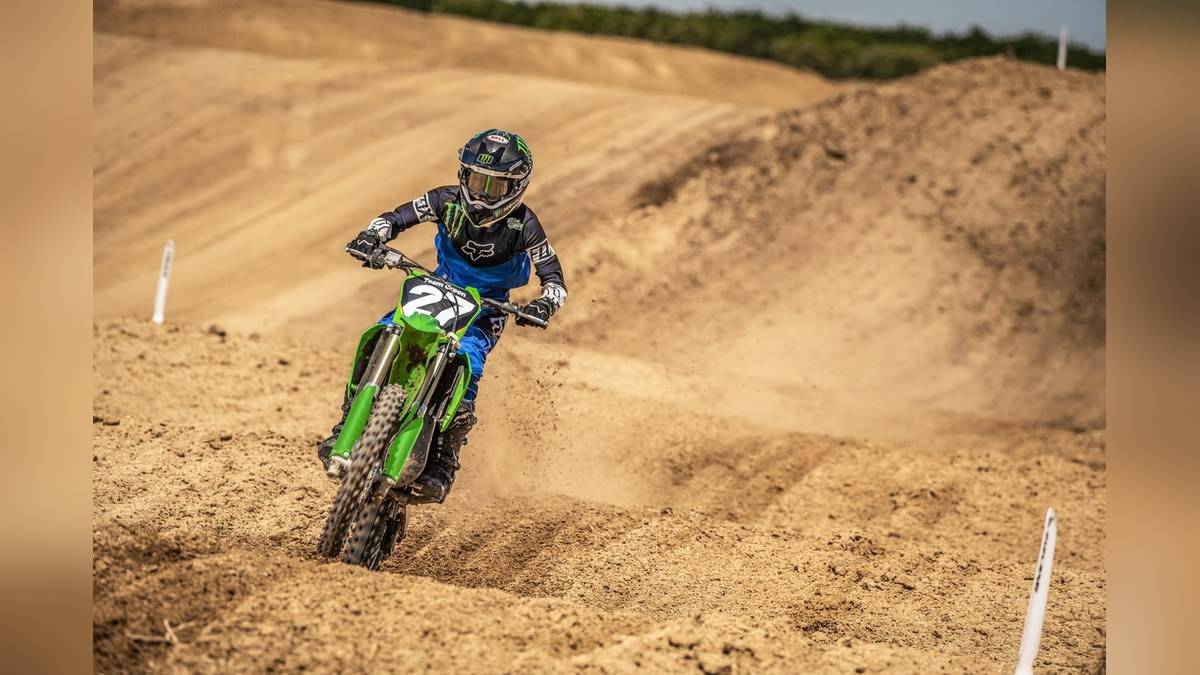
NEW DELHI: Kawasaki's India website lists the KX112 Standard at Rs 4,50,000 in Lime Green. The model is identified as a 2024 motorcycle and uses a 112 cc two-stroke engine. Its supermini motocross format is intended to bridge the step towards full-size competition machines, making rider fit more relevant than the small displacement might suggest.
| Item | India specification |
|---|---|
| Variant | Standard, Lime Green |
| Listed price | Rs 4,50,000 |
| Engine and fuel system | 112 cc, liquid-cooled two-stroke single, 28 mm carburettor |
| Transmission and starting | Six-speed, primary kick |
| Seat height | 870 mm |
| Curb mass | 77 kg |
| Wheel travel | 275 mm front and rear |
| Fuel tank | 5.0 litres |
Price as of 7 November 2026, 23:31 IST. This is the amount displayed on the official Indian product page. The page read for this report presents a single Standard edition, rather than a range of differently priced trims. It is not a verified all-inclusive ownership or delivery quotation.
Why 112 cc needs a different reading here
The KX112 is a motocross motorcycle, not a small-capacity commuter described with racing graphics. Its engine uses liquid cooling, a piston reed valve, petrol-mix lubrication and a manual wet multi-disc clutch. Kawasaki also specifies chain final drive. Those details place the rider's controls and preparation much closer to a dedicated riding session than routine urban transport.
Kawasaki's official American material for the same model year describes an exhaust power-valve system and an engine intended to deliver useful drive out of corners and at the start. That is manufacturer context, not a measured result from an Indian test. No claimed horsepower figure has been added here because the Indian specification table does not supply one.
For a rider progressing through motocross training, the important question is how the engine and clutch can be managed together. Merely comparing capacity with a road motorcycle will not answer it. A supervised assessment should explore smooth starts, gear selection and control through changes of pace before anyone treats the motorcycle as an automatic next step.
Supermini does not mean a low seat
The front and rear tyre sizes are 70/100-19 and 90/100-16. The Indian listing gives 330 mm ground clearance and a 1,310 mm wheelbase. These proportions help explain why the KX112 can be light on the scales yet still demand a careful physical fit check. Weight, seat reach and room to move are separate characteristics.
The official feature description includes a slim, flat seat and bodywork intended to permit movement. That matters when a rider changes position through a corner or stands over uneven ground. A useful static assessment should therefore include the standing position, access to the controls and the ability to move forward and back, rather than ending once a rider can sit on the saddle.
Kawasaki describes six possible handlebar positions through its adjustable mounting arrangement. Adjustability gives a coach or technician a useful way to refine the cockpit. It cannot establish that the motorcycle suits every rider, nor does it replace checking lever reach and how comfortably the rider can operate the controls while wearing riding equipment.
Suspension belongs in the training conversation
The motorcycle has an inverted front fork and Uni-Trak rear suspension. Kawasaki describes compression adjustment at the front and compression, rebound and spring preload adjustment at the rear. Front and rear disc brakes complete the listed chassis equipment. The specification is built around the needs of track riding rather than the convenience features associated with a daily road motorcycle.
The original context for this machine is progression. A rider moving towards a larger motocross chassis needs space to develop body movement without having the equipment overwhelm the lesson. That makes the relationship between suspension setup, rider size and coaching especially important. A capacity increase by itself is a poor way to define when that progression should happen.
For an Indian family or riding school planning sessions, the practical discussion should include a suitable venue, transport, protective equipment, maintenance support and an instructor familiar with the rider. These are planning considerations, not expenses included in the listed motorcycle price. The official Indian page does not provide a complete training or operating budget.
Who it is for
The KX112 is most relevant to a developing motocross rider whose coach has identified a need for this size of machine. Its combination of low mass, a tall stance and adjustable controls deserves an individual assessment. A rider's age or experience label alone cannot establish the fit, and the manufacturer listing supplies no universal height recommendation.
Readers comparing off-road formats can also consult our Kawasaki 650 price: Z650 Rs 7,26,000, Ninja 650 Rs 7,91,000, Versys 650 Rs 8,63,000. Our Kawasaki Ninja 300 and Ninja 500 2027 price in India: Rs 3.34 lakh and Rs 5.76 lakh deals with another ownership question, while the Kawasaki W175 Rs 1,21,000, KLX230 Rs 2,19,000, Eliminator Rs 6,16,000 price shows why model-specific measurements should be checked independently.
Official sources: Kawasaki India KX112 listing, official model-year specification sheet and Kawasaki's model-year background release. Overseas prices and market-specific equipment have not been substituted for the Indian listing.