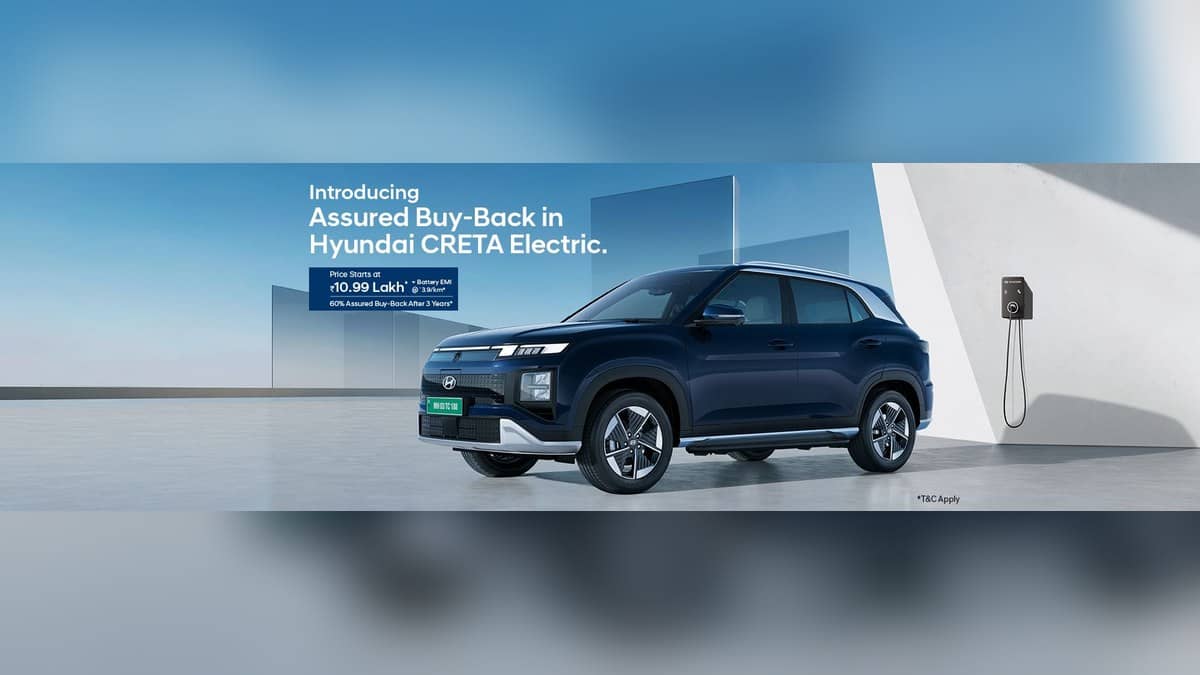
NEW DELHI: Hyundai lists a 39-minute DC fast-charging time from 10% to 80% for both Creta Electric battery options. The specification page attaches that estimate to a DC charger rated above 100 kW at 400 V. Home charging has a different timetable and a different finishing charge level.
| Official specification | 42 kWh | 51.4 kWh Long Range |
|---|---|---|
| DC charging, 10% to 80% | 39 minutes | 39 minutes |
| DC charger condition | Above 100 kW / 400 V | Above 100 kW / 400 V |
| 7.4 kW AC charging, 10% to 100% | 6 hours | 7 hours 15 minutes |
| Certified driving range | 420 km | 510 km |
| Charging standard | CCS2 | CCS2 |
What the 39-minute claim measures
The company's current specification sheet gives the same DC estimate for the smaller and larger batteries. Its brochure repeats the fast-charging claim, and the highlights page confirms that it applies to both packs. The estimate is therefore not restricted to the smaller battery merely because that pack stores less energy.
It is a defined charging window. The session starts with charge remaining and ends before the battery is full. Treating it as the time needed to arrive with an empty battery and leave with a full one would change both ends of the manufacturer's stated test. The published claim does not support that reading.
For an Indian family planning an outstation trip, that distinction affects the stop itself. A route plan built around this figure should identify the starting and finishing charge levels, alongside the charger specification. Writing only a charging time beside a stop hides the assumptions that make the estimate meaningful.
Home charging ends at a different point
Hyundai's 7.4 kW AC estimates run from 10% to 100%. The smaller pack takes six hours under the published conditions, while the Long Range pack has a longer estimate. The AC and DC rows therefore cannot be compared as if they refill the same portion of the battery using different equipment.
The highlights page puts the six-hour home-charging claim beside a footnote specifying the smaller battery. That qualification is easy to miss when reading a large promotional panel. The detailed specification table is clearer because it gives the larger pack its own AC time, rather than leaving the reader to infer it.
Hyundai also lists a portable charging cable among the charging options. The home-wallbox estimate should not be transferred to that cable without checking its own specification. In a housing society or shared parking area, the useful question is which charging arrangement is actually being discussed, not merely whether a power point exists.
The equipment rating is only part of the condition
The specification-page footnote lists several reasons actual time can change: battery charge level, charger output, vehicle and battery settings, battery temperature, outside temperature and an uninterrupted electricity supply. A compatible connector is therefore only part of the information needed to judge whether a stop matches the published estimate.
This matters specifically to the Creta Electric comparison because both packs carry an identical DC time while their AC estimates differ. Quoting a single charging time for the entire model range loses that difference. The battery version, charging method and charge window need to travel together whenever the figure is repeated.
The range figures have their own qualification. Hyundai identifies them as ARAI certification under controlled conditions for a new battery, using the stated MIDC cycle. They are separate from the charging-time estimate. Neither label tells an owner exactly how far the next journey will go under its particular load, route and conditions.
The brochure separately lists battery warranty cover of up to eight years or 1,60,000 km, whichever comes first. That is a different kind of assurance from the charging estimate. A statement about how quickly a charging session can proceed does not define how a later battery claim will be assessed, so the charging and warranty documents should be kept as separate references in the car ownership file.
Keep charging, finance and warranty questions separate
Charging describes how the battery is replenished; it does not settle the financing terms. Readers can find that separate discussion in our Hyundai IONIQ 5 price: Rs 55,70,600 for the 84 kWh RWD version. Our EV battery rental explained: BaaS prices for Punch.ev, Syros EV, Creta, BE 6 shows why the installed charger rating belongs in route research, while the Kia EV6 price: Rs 65,97,937 starting MSRP covers a different part of EV ownership.
Official sources: Creta Electric specifications and charging footnotes, model highlights and Hyundai's current brochure.