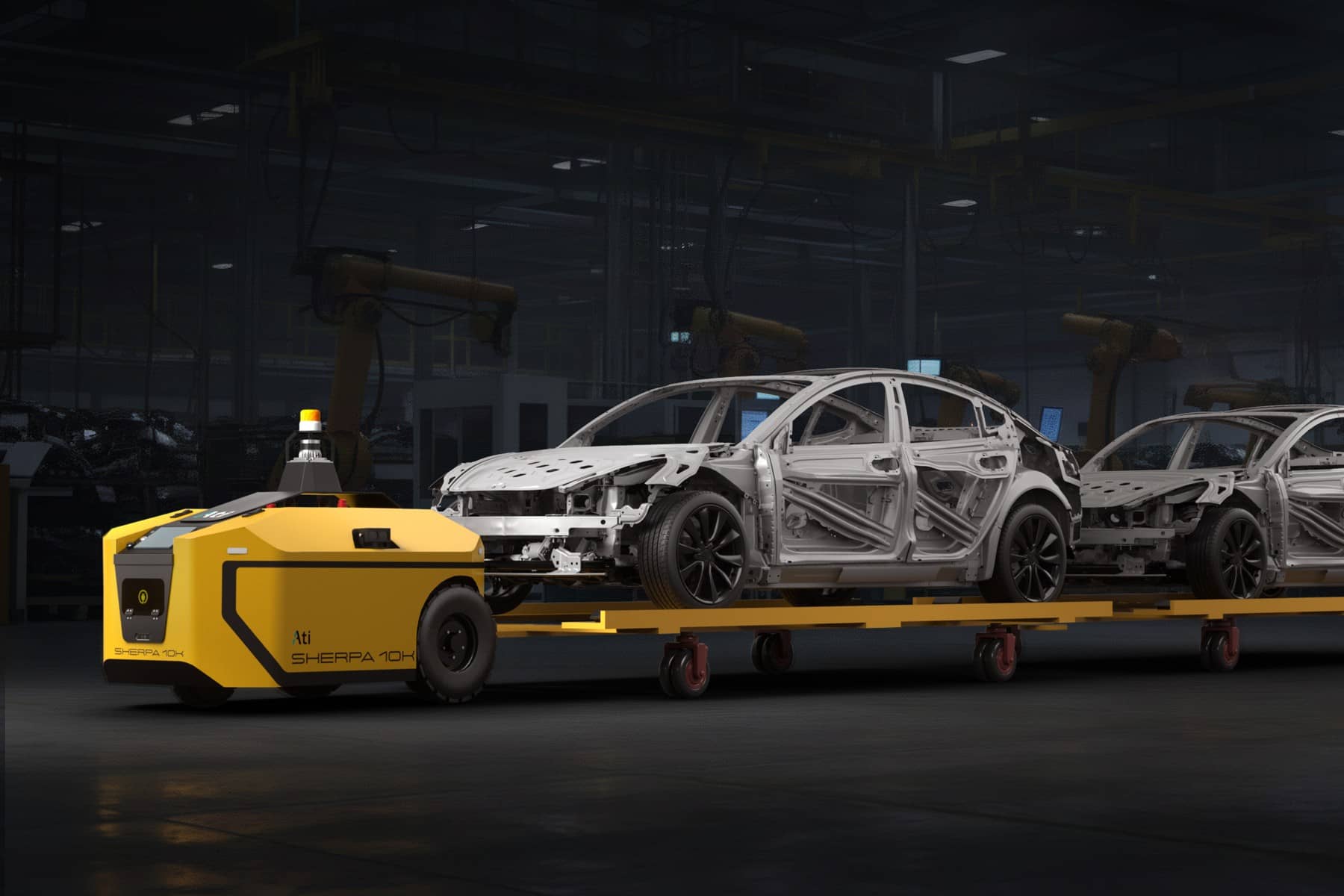
BENGALURU: Factories have been buying robots for decades, but the trolleys of parts, bins and pallets that move between workstations are still pushed around by people and forklifts in most plants. Ati Robotics, the company formerly known as Ati Motors, has built its business on that gap. It makes autonomous mobile robots, sold under the Sherpa name, that tow, carry and lift material across factory floors, and software that decides where each load should go next.
The company was founded in 2017 and has an India office in Goraguntepalya, Bengaluru, alongside offices in Michigan in the United States, Puebla in Mexico and Chonburi in Thailand. In April 2026 it changed its name from Ati Motors to Ati Robotics and moved to a new web domain, atirobotics.ai. This explainer looks at what the company actually sells, what changed with the rebrand, and the claims it makes about its deployments.
From Ati Motors to Ati Robotics
The rebrand was announced on 22 April 2026. In the release, the company said it had "outgrown its original name" because it now sells what it calls a full-stack material orchestration platform: robots, real-time tracking and AI agents that coordinate how goods move through a plant. The name Ati Motors had suggested a vehicle maker. Ati Robotics, the company said, describes what it has already become.
Founder and CEO Saurabh Chandra put it this way in the announcement: "Ati Robotics is not a new company. It is the honest description of the company we have already become." The company also told customers that existing contracts, deployments, service agreements and Sherpa product names stay the same.
Ati now groups its products into four families. Tugging robots pull carts and trolleys along fixed or flexible routes. Pallet handling robots move loaded pallets between stations. Lifting and handling robots pick up and set down loads. The fourth family is software, which the company calls material orchestration.
The Sherpa robots and Ativerse
The robots are the visible part. The Sherpa 10K, for instance, is a heavy-duty tugger that the company shows towing a long trolley loaded with car bodies through an assembly plant. Other Sherpa models handle bins, pallets and lighter tugging jobs. In September 2025, still as Ati Motors, the company launched the Sherpa Mecha, which it describes as a humanoid-inspired robot for manufacturing. Rather than copying the human form closely, it is built around tools and practical tasks: tending machines and carrying heavy bins and parts for inspection.
The software layer is called Ativerse. According to the company, it sits above a factory's existing ERP and MES systems, the software that plans production and tracks work on the shop floor, and connects robots, live floor data and AI agents into one system. The idea is that a robot is not just told to go from point A to point B. It is told what material is needed where, and when, based on what the factory is actually producing.
The company demonstrated this at Automate 2026 in Chicago in June. Its release for the show described a loop in which a Sherpa XT Lite tugger moved bin-loaded trolleys between stations, a Sherpa Mecha transferred bins between trolleys, racks and pallets, and a Sherpa Pallet Mover carried finished pallets downstream while an operator reloaded bins. Each robot's move was meant to trigger the next without manual direction.
What Ati says about scale
Ati's own figures are worth reading carefully, because they vary slightly between releases. The April rebrand note says the company serves more than 50 enterprise customers across more than 70 factories worldwide, and elsewhere in the same release it mentions 70-plus enterprise customers. Both the April and June releases say its platform has tracked more than 2 million autonomous missions with a 99 percent mission success rate. The June release adds that an average deployment takes less than four weeks and that, for US customers, the average payback period is under six months. None of these numbers has been independently audited.
The most recent funding the company has announced on its own site is a US$20 million Series B, published in January 2025 and led by Walden Catalyst Ventures and NGP Capital. Existing investors True Ventures, Exfinity Venture Partners, Athera Venture Partners and Blume Ventures also took part. At the time, the company said it had deployed hundreds of Sherpa robots across 40 manufacturers, including Forvia and Hyundai, and that its order book had tripled in the last quarter of 2024.
In that release, Chandra said the company's approach was to focus on manufacturing as a vertical and to think of its robots as "purpose-built self-driving vehicles". That framing explains the original Motors name. The early Sherpa machines were, in effect, small autonomous vehicles for indoor and outdoor factory roads.
Why this matters for Indian manufacturing
For Indian readers, Ati is an interesting case of a company with a Bengaluru base selling into some of the most demanding factory customers in the world, especially automotive plants in North America. Much of the Indian conversation on robotics has focused on research labs and academic centres, such as the new school of physical AI and autonomous systems at IIT BHU. Ati shows what a commercial product in the same space looks like when it is sold to plants that measure every minute of downtime.
The bigger question is how quickly Indian factories adopt this kind of automation themselves. Moving material inside a plant still takes a lot of manual work in many Indian factories, and the networking side is getting local attention too, with moves like Belden's decision to make Ruckus ICX switches in Pune. Autonomous tuggers and pallet movers need reliable plant networks and clean data from production systems before orchestration software can do much.
The company's public releases do not break out how much of its business comes from India, or name Indian factory customers. That is one detail to watch. The other is the Sherpa Mecha: whether a humanoid-inspired robot moves from trade-show demonstrations to repeat orders, which would be a far harder test than a single booth loop in Chicago.
For now, Ati Robotics is betting that the real value in factory automation lies less in any one robot and more in the coordination between them. The rename was its way of saying so.