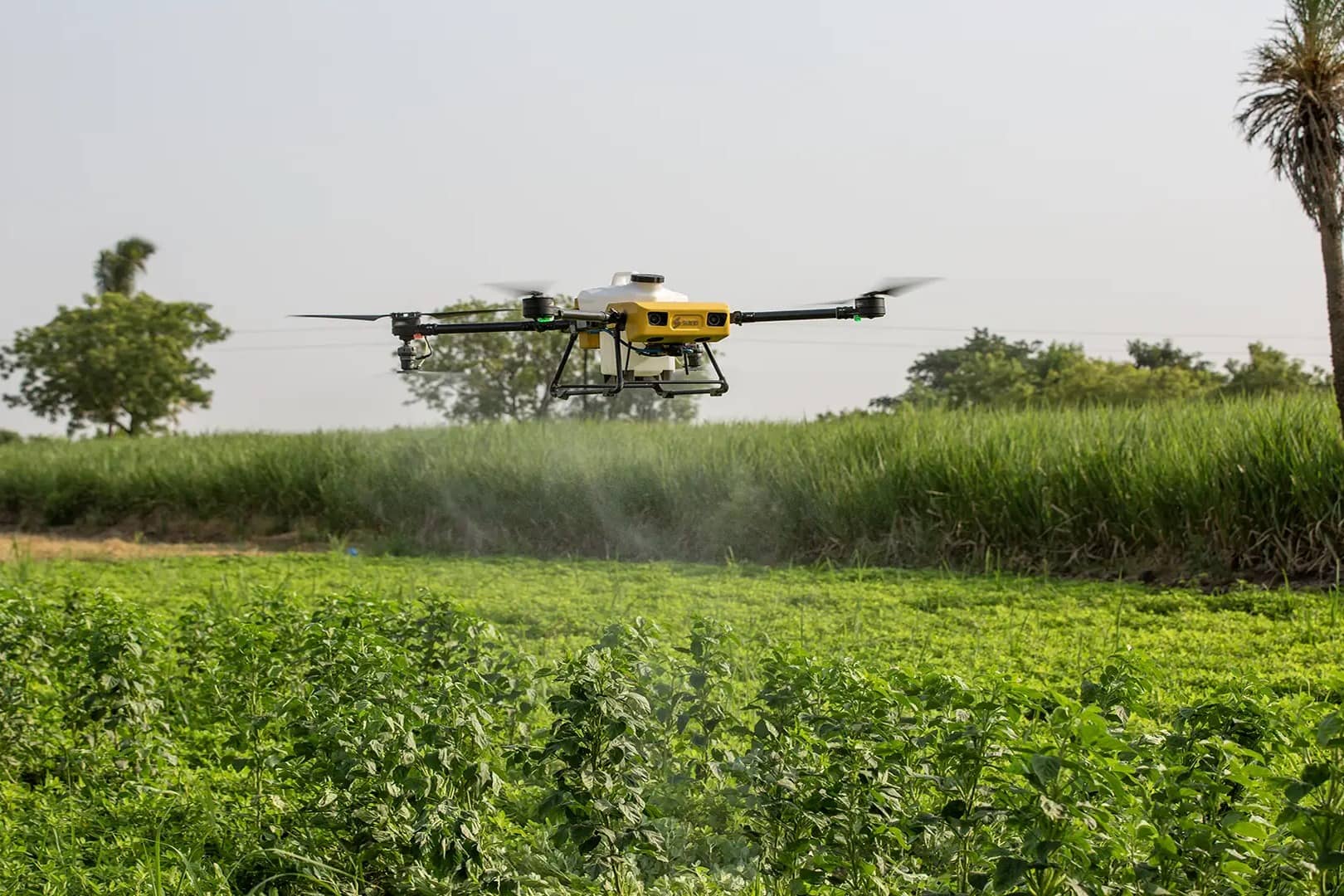
BENGALURU: Most farm drones in India still fly the way a GPS-guided toy does. They follow coordinates from above and assume nothing is in the way. SUIND, a Bengaluru aerial robotics startup, is betting that this breaks down in exactly the fields where spraying is hardest: tall sugarcane, dense orchards, palms and uneven slopes. Its answer is a spraying drone that navigates by what its cameras see.
The company, registered as Suind Autonomous Systems Private Limited, calls this "near-earth autonomy". Its flagship product is Bumblebee, a DGCA type-certified agricultural spraying drone, and it is now building a second platform for inspection work. Its media page lists a seed round of Rs 20.5 crore led by Transition VC with participation from IIMA Ventures, raised this year to scale Bumblebee's commercial deployment and speed up development of that inspection platform.
What near-earth autonomy means
SUIND's pitch rests on one problem. A drone flying a few metres above crops has very little room for error, and GPS signals near tall canopy, trees and terrain can be unreliable. Most spraying drones manage this by flying higher, which wastes chemical through drift, or by relying on a skilled pilot, which limits how many acres one operator can cover in a day.
The company's website says its autonomy core uses vision-first perception, builds a real-time 3D picture of the surroundings and plans low-altitude paths around obstacles, slopes and gaps. GPS helps when it is available, but the company says the system does not collapse without it. In its own words, the drone reads terrain, structure and obstacles onboard rather than depending on external signals.
On the Bumblebee product page, that translates into a four-camera perception system, obstacle detection out to 15 metres with a 2 metre safety margin, and terrain sensing up to 12 metres for height control on slopes. There are two obstacle modes. In the first, the drone detects a pole or tree and plans a path around it. In the second, meant for very uneven plots, it flies over the obstacle and keeps spraying so the mission is not broken.
Bumblebee on the farm
SUIND claims Bumblebee can cover an acre in about six minutes and cut chemical use by up to 40 percent compared with conventional methods. The drone uses a custom centrifugal atomiser, and its software recalculates spray output during flight based on the spray width, target volume and flight speed set in the ground control station. The aim is consistent dosing whether the drone is crossing an open plot or a dense canopy.
There are practical touches aimed at operators who run many sorties a day. The company lists a modular payload system for quick swaps, a reserve-aware automatic return to home when the battery runs low, and a turnaround time of under two minutes between flights.
The company's field work so far has centred on Maharashtra. Its media page describes a farmers' seminar and live demonstration in June 2026 for the 75th Amrit Mahotsav of the Malegaon Bu. Farmers Cooperative Society, where sugarcane growers watched the pilot mark the area and Bumblebee spray the crop on its own. SUIND says that demonstration covered an acre in about seven minutes with 30 percent less chemical. It also lists work with sugarcane, banana and rubber growers.
The company's homepage claims more than 3,000 autonomous missions, more than 200 clients and over four years of research and validation. These are SUIND's own figures and have not been independently audited.
Who is building it
SUIND was founded by Kunal Shrivastava, who is CEO, and Kevin Kleber, who is CTO. The company describes both as ETH Zurich alumni, and its team page lists Prof. Davide Scaramuzza, a well-known name in drone vision research, as a technology advisor. The team includes machine learning engineers, mechatronics engineers, pilots, an agronomist and field technicians, which fits a company that spends a lot of its time in actual fields rather than only in a lab.
In a note on the about page, the founders say they started the company because most drones "perform well only when environments are simple and GPS signals are clean", and that reliability drops once operations move close to terrain. They describe agriculture as the proving ground because it is demanding, unpredictable and tied to farm economics.
Before the latest round, SUIND's media page says, it completed an earlier seed raise backed by Sunicon Ventures, Zetta Farms and angel investors. The new money from Transition VC and IIMA Ventures is meant for scaling Bumblebee and for WASP, which the company describes as its aerial intelligence and inspection platform.
What comes after farming
SUIND's inspection product is still marked as upcoming on its website, with a clear note that features and specifications may change. The company says it wants to extend its near-earth autonomy to work close to real structures, where manual inspection is risky and hard to repeat. It is talking to select partners and plans controlled pilots first.
The company also lists infrastructure, forestry, mining, logistics, disaster response and ISR (intelligence, surveillance and reconnaissance) as target markets for the same autonomy core. That is a long list for a seed-stage company, and agriculture is where it has actual deployments to show.
India's drone sector has been crowded with spraying drones since the government began pushing them for farm use, and SUIND is not the cheapest or the biggest name in the field. Its argument is that tall crops and messy terrain are where most current drones struggle and where autonomy pays off. Dalimss News has covered other Indian drone makers, including Verniq UAVs and its Recon TR-01 training drone and Omnipresent Robot Tech's mapping drones.
For farmers and spraying service operators, the real test will be cost per acre and how the drone copes across a full season, not a single demo. SUIND has not published Bumblebee's price on its website; the product page invites pre-bookings. The company also runs explainers on its blog about the agriculture drone subsidy and the Agriculture Infrastructure Fund, which buyers can read alongside official government notices before committing money.
What to watch next is whether SUIND names commercial customers and fleet sizes for Bumblebee in the coming months, and when WASP moves from development to its first pilots.