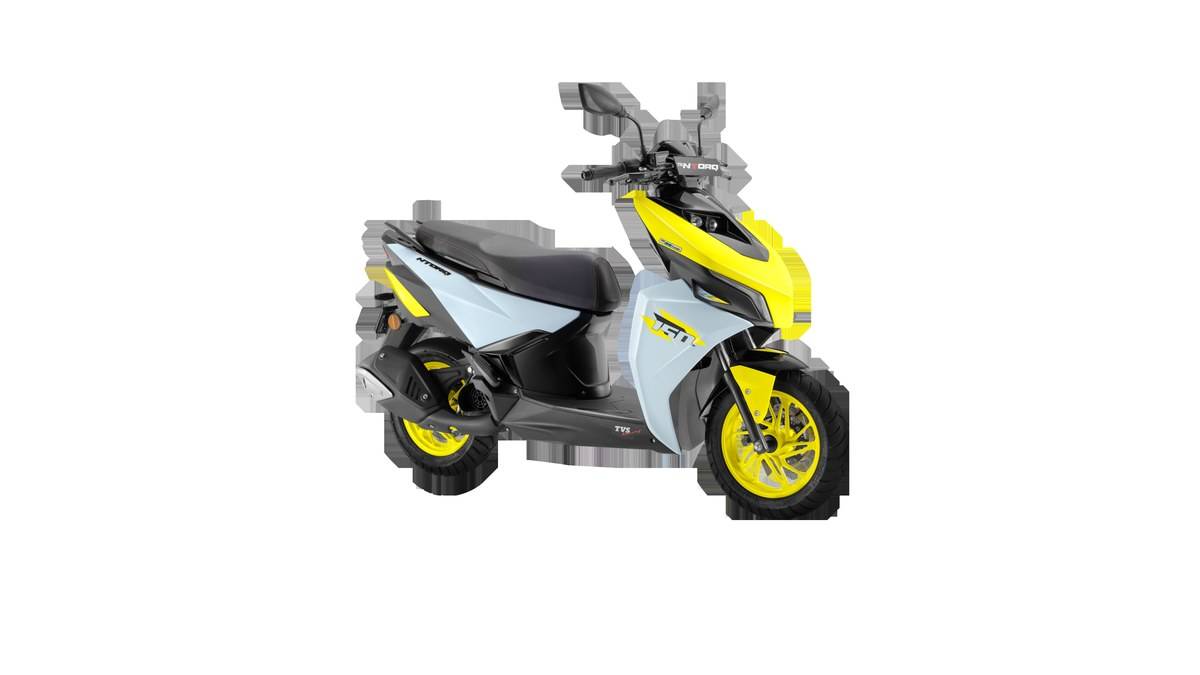
NEW DELHI: The TVS NTORQ 150 combines a 220 mm front disc, a 130 mm rear drum and single-channel ABS. Its traction control addresses rear-wheel slip during acceleration. These systems perform different jobs, a distinction that matters more to an owner than treating every electronic feature as another name for improved grip.
| Item | Official specification or function |
|---|---|
| Front brake | 220 mm disc |
| Rear brake | 130 mm drum |
| ABS | Single channel, acting at the front wheel |
| Traction control | Monitors rear-wheel slip during acceleration and adjusts power delivery |
| Engine | 149.7 cc |
| Kerb weight | 115 kg |
Read the front and rear brake specifications separately
The hardware description is straightforward: a disc at the front and a drum at the rear. The presence of ABS does not turn that rear drum into an independently controlled anti-lock brake. TVS identifies the system as single channel and explains its operation through front-wheel monitoring and brake-pressure modulation.
That makes the phrase single channel essential when comparing equipment sheets. A listing that merely says ABS leaves out which wheel receives the intervention. On this scooter, the official material supports a specific front-wheel function. It does not support describing the NTORQ 150 as having dual-channel ABS or rear-wheel anti-lock protection.
The disc diameter is a hardware measurement, not a published stopping distance. It tells an owner what assembly the scooter uses, but cannot by itself establish how quickly the vehicle will stop in a particular road situation. TVS's cited pages do not provide a controlled braking-distance result, so there is no verified metres-to-stop figure to attach to this specification.
Traction control works on the acceleration side
TVS describes traction control as monitoring the rear wheel and intervening when slip is detected. Its explanation centres on managing power delivery under acceleration. ABS, by contrast, deals with the front wheel during braking. Both relate to grip, but the trigger and the action are different.
For an Indian city commuter, that distinction helps make sense of a journey with repeated stops and departures. Braking towards a junction and accelerating away from it are separate demands on the scooter. Counting ABS and traction control as two identical braking features would miss why the manufacturer fits both to this model.
The company's technical explanation calls the traction-control system switchable. That is an equipment description rather than a recommendation to disable it. Anyone checking settings should use the instructions supplied for their own vehicle and display version. This article does not substitute a guessed button sequence for an owner-manual procedure.
Keep performance claims apart from brake claims
The NTORQ 150 uses a 149.7 cc engine, and TVS's brochure lists a 115 kg kerb weight. Those figures describe the machine carrying this brake package. They help distinguish it from a smaller scooter sharing the NTORQ name, but neither figure proves a particular level of stopping performance.
This is especially relevant within TVS's own range. A reader moving from the smaller NTORQ to the 150 should compare the actual brake and electronic-assistance descriptions rather than transfer assumptions from the familiar badge. Our TVS NTORQ 150 price list: Rs 1,09,400 to Rs 1,18,400 provides separate context for the range; the present explanation concerns the braking hardware and intervention.
TVS also describes Street and Race riding modes in its product material. A mode name is not an ABS-channel specification. Nor does a sporting mode label establish that the rear brake gains electronic anti-lock control. Keep engine-response features and braking architecture in separate columns when reading a dealer's equipment sheet.
What to check when the scooter is handed over
A useful handover discussion starts with identification: ask the representative to point out the front disc, rear drum and the relevant dashboard indicators on the actual scooter. Then ask for the matching manual and an explanation of normal indicator behaviour. This is a practical checklist, not an additional warranty condition attributed to TVS.
Record any unanswered question about the assistance systems on the delivery paperwork and ask for clarification before treating a display message as normal. A feature list can establish that equipment exists; understanding what a warning means requires the vehicle-specific instructions. Avoid trying to provoke ABS or wheelspin on a public road as a demonstration.
For related comparisons, our TVS NTORQ 125 variants: Race XP makes 10.2 PS, XT adds a TFT examines another manufacturer's equipment descriptions, while the TVS Apache price list: Rs 1,15,140 to Rs 2,62,240, on-road Delhi from Rs 1,40,949 separates drum and disc hardware. Those stories concern their named models. Their specifications should not be carried across to the NTORQ 150.
Official sources: TVS braking-system explanation, TVS ABS and traction-control detail, TVS model overview and official NTORQ 150 brochure. Checked on 9 November 2026.