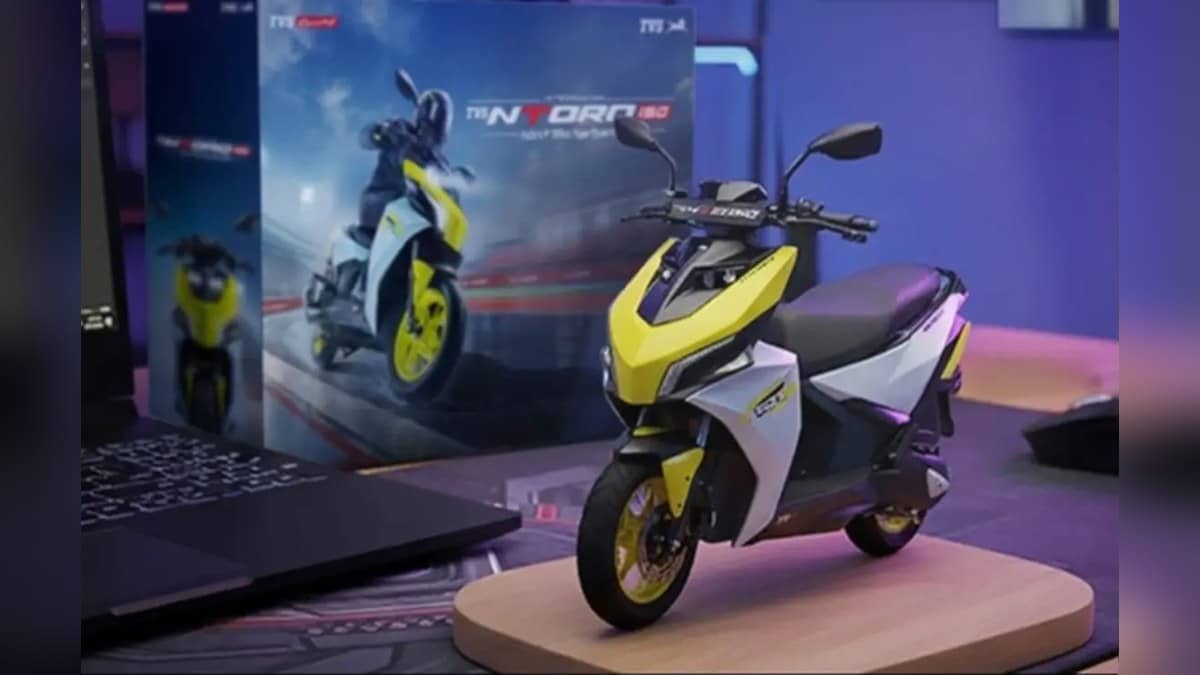
NEW DELHI: TVS Motor's official NTORQ 150 price article lists the base scooter from Rs 1,09,400 and the TFT version from Rs 1,18,400, ex-showroom Delhi. The larger NTORQ uses a 149.7 cc engine. Its variant choice centres on equipment, with the TFT display providing the clearest reason to examine the more expensive version.
| Version | Official listed price, ex-showroom Delhi |
|---|---|
| NTORQ 150 base | From Rs 1,09,400 |
| NTORQ 150 TFT | From Rs 1,18,400 |
Price as of 28 October 2026, 23:10 IST. These are the figures displayed in TVS Motor's official article dated 2 March 2026. They are starting prices for the named versions, not a fresh announcement tonight or a final on-road quotation. Registration, insurance and selected extras need a separate quotation.
Read the model number before the variant name
The NTORQ 150 is a distinct engine-size choice within the NTORQ family. TVS lists peak output at 9.7 kW at 7,000 rpm and torque at 14.2 Nm at 5,500 rpm. Its published acceleration claim is around 6.3 seconds from rest to 60 km/h. That last figure is a manufacturer claim, not a result from a road test for this article.
The first useful distinction is therefore between choosing the larger scooter and choosing its dashboard. A rider interested in acceleration should start with the engine specification. A rider interested in navigation and a richer screen should then examine the TFT equipment. Treating the most expensive badge as a shortcut to understanding both can obscure what the extra money actually addresses.
This makes the NTORQ 150 an unusually specific shopping question: how much connected equipment does a rider want on a performance-focused petrol scooter? It is not enough to ask whether a dashboard looks modern. The more useful question is whether its information and controls improve the journeys the owner actually makes.
What the TFT version is about
TVS's equipment descriptions include a 5-inch TFT cluster, SmartXonnect, navigation assistance and voice functions. Its separate model explainer describes a four-way navigation control and incoming call and SMS alerts. These are features to have demonstrated on the exact version being quoted, because the brand's general feature descriptions should not be read as a promise that every item belongs to the base scooter.
A sensible demonstration would begin with pairing a phone and displaying a familiar route. Then check how the handlebar control moves through the information. This is a more meaningful way to assess the screen than reading a long connectivity feature count. Clarity, legibility and ease of operation are individual usability questions that a specification sheet cannot settle.
TVS also describes Street and Race riding modes. Its model explainer associates Street with relaxed delivery and automatic engine start-stop, while Race enables peak delivery and iGO Assist. The difference is worth understanding as part of the scooter's controls rather than assuming that a mode name alone explains how it behaves.
Everyday dimensions still matter
The official price article lists a 115 kg kerb weight, 770 mm seat height, 155 mm ground clearance and 5.8-litre fuel tank. It also identifies a front disc and rear drum brake arrangement with alloy wheels. Those dimensions are useful preparation for a showroom check, but they do not establish how comfortably a particular rider can balance the scooter or accommodate a passenger.
Try moving it in a parking space, getting on and off, and placing both feet down. For a scooter with sporting ambitions, these ordinary checks are easy to neglect. They matter on every weekday, including the journeys when there is no opportunity or reason to explore the engine's performance.
Who it is for
The base version is relevant to someone primarily seeking the larger engine and the underlying scooter package. The TFT version addresses a rider who also places value on the display and connected functions. Neither description substitutes for confirming the equipment on the order form. This guide explains the distinction; it does not rate untested ride quality or claim a fuel-efficiency result.
For a different set of scooter priorities, see our TVS Jupiter price: Rs 74,400 to Rs 90,225, Jupiter 125 from Rs 82,100, TVS Apache price list: Rs 1,15,140 to Rs 2,62,240, on-road Delhi from Rs 1,40,949 and TVS iQube price: Rs 95,374 in Delhi, Rs 1,11,560 in Bengaluru, 7-city list.
Official sources: TVS NTORQ 150 prices and specifications and TVS model and equipment explainer.