NEW DELHI: The Defender 110's advertised roof limits refer to different situations: up to 168 kg while moving and up to 300 kg when stationary. Land Rover's current India page attaches conditions to those figures, including tyre fitment, the weight of the rack and exclusions for particular versions. A roof tent therefore needs a vehicle-specific loading check before it becomes part of a travel plan.
| Defender 110 roof figure | How to read it |
|---|---|
| Up to 168 kg dynamic load | Applies while moving, with specified off-road tyres and rack conditions |
| Up to 300 kg static load | Applies when stationary |
| Rack weight | Included within the stated roof load |
| V8 versions | Separate restrictions apply; do not assume the general allowance |
| Overall loading | Gross vehicle and maximum axle limits still apply |
The moving limit governs the packed tent
A tent travels as cargo before it becomes accommodation. The dynamic limit concerns the load carried on the roof during that journey. It is therefore the relevant category for the closed tent, its mounting equipment and anything else attached to the roof. The larger static figure cannot be used to justify a heavier travelling installation.
The India model page states that the maximum load includes the roof rack. This is easy to miss when comparing a tent's advertised weight with the roof figure alone. A rack does not disappear from the calculation because it was supplied separately or installed before the tent. The complete assembly is the useful starting point for checking the load.
Tyres and the derivative change the answer
Land Rover's India models-and-specifications footnote ties the higher dynamic allowance to off-road tyres and the Expedition Roof Rack. It also gives separate V8 and OCTA qualifications. The correct reading is that the headline capacity is conditional. A Defender badge, a similar roof shape or an impressive engine output does not establish accessory compatibility.
The same page says roof load is zero when OCTA mode is activated. That is a particularly clear reason to keep the precise derivative and operating mode in the conversation. A general loading explainer should not be treated as approval to combine every Defender version, roof accessory and driving mode. The relevant handbook and approved installation specification must settle the individual setup.
An official UK specification sheet illustrates how detailed these distinctions can be: it separates roof carrying according to tyre category and includes the cross bars in the allowance. That sheet describes its own vehicle specification. It is useful background for understanding the terminology, rather than a replacement for the loading limits applicable to an Indian car.
Why the stationary number exists
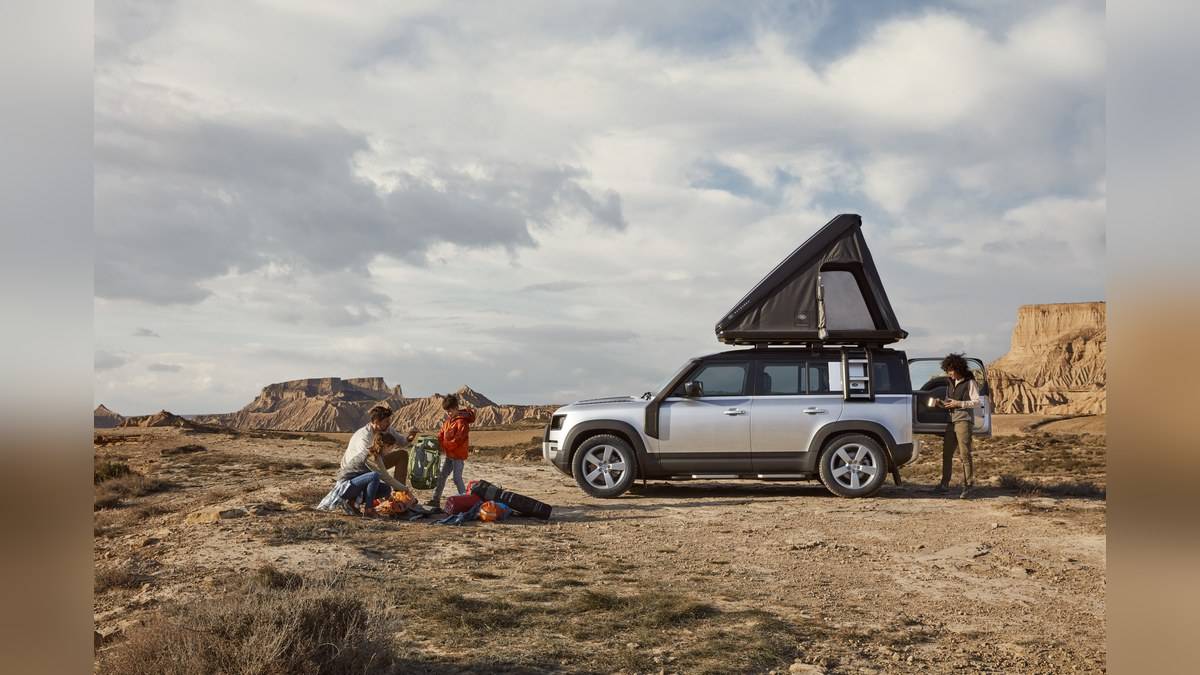
Static loading concerns the vehicle when parked. Land Rover's historical roof-tent announcement describes a collaboration with Autohome for the Defender 110, with sleeping accommodation for two adults. The announcement links the tent to the official roof rack and rails. It demonstrates the intended camping use, but does not establish present Indian accessory availability or a current retail price.
In that design, a protective shell covers the tent during travel, while a ladder provides access once it is erected. Those details explain why a camping installation needs to be considered in both states. The packed assembly accompanies the car on the road; the deployed tent is used at the campsite. Each state has its own loading implications.
Roof load and vehicle payload are separate checks
Land Rover also warns that accessories and items installed after manufacture affect payload. The gross vehicle weight and maximum axle loads must not be exceeded when occupants, fuel, luggage and equipment are aboard. A roof assembly can satisfy its own limit while the overall vehicle still needs a separate weight assessment.
For an Indian family travelling with camping equipment, that means treating the roof as part of the packing plan from the start. Bags inside the cabin, passengers and the tent are all using the same vehicle. Moving luggage out of the boot creates space, but does not make that luggage weightless or remove it from the total carried load.
The Defender 110's particular appeal is that camping accommodation can sit above a vehicle still expected to carry people and supplies. The practical challenge is coordinating those roles. A photograph of a deployed tent shows the destination setup; it does not show the travelling load calculation, the car's exact tyre specification or how much other equipment was carried.
Keep the installation record with the car
A useful record brings together the derivative, roof type, tyre specification, approved rack and tent installation information. It should distinguish the assembly's travelling mass from its permitted occupied use when stationary. That gives an owner something concrete to check when equipment changes, instead of relying on a roof capacity remembered from an advertisement.
Related reading: Car price guide, Defender 110 price: Rs 99,00,000 ex-showroom and Defender 130 has up to 8 seats: how the 2+3+3 layout works. These examine other aspects of carrying people and belongings.
Official sources: Defender 110 India overview, India model loading footnotes and Land Rover roof-tent background.