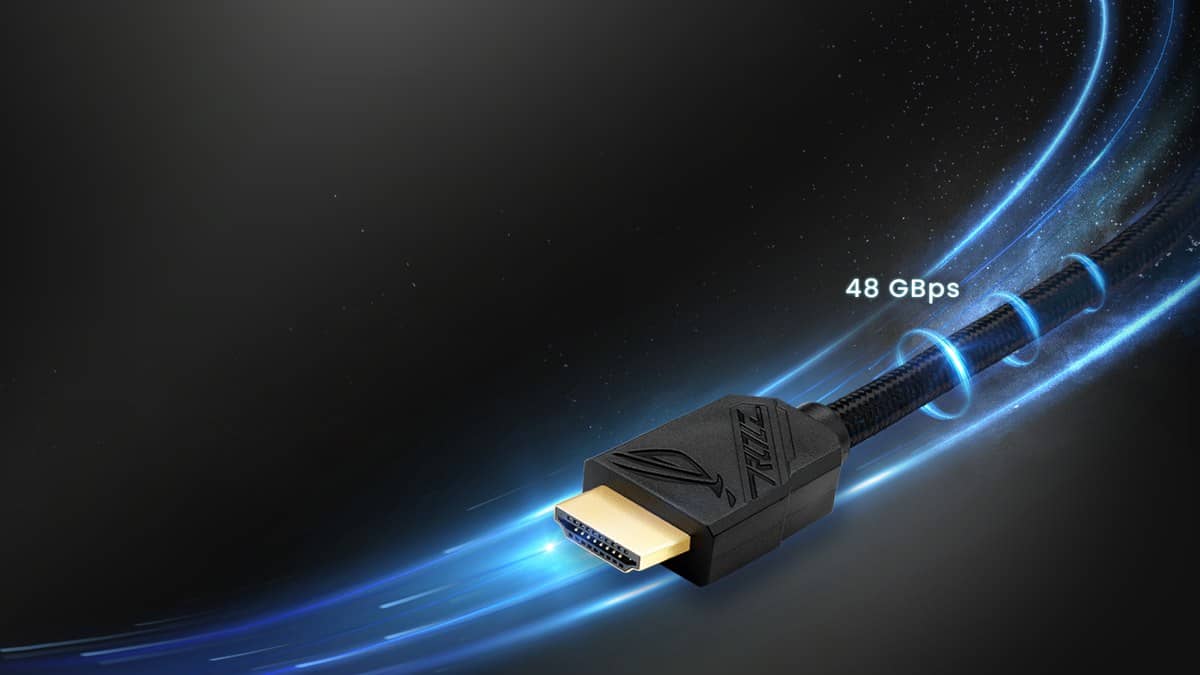
NEW DELHI: The ROG LHR60 Ultra High Speed HDMI cable has a stated bandwidth of 48Gbps, with ASUS advertising support for display output up to 8K at 60Hz and 4K at 144Hz. Its India product page shows a starting price of Rs 999. Those are cable capabilities to match with the connected equipment, rather than a promise that any laptop and monitor will produce those modes.
| Detail | Official information |
|---|---|
| Model code | LHR60 |
| India starting price displayed | Rs 999 |
| Advertised bandwidth | 48Gbps |
| Advertised output support | 8K at 60Hz; 4K at 144Hz |
| Nominal length | 1.8 metres |
| Construction features | Nylon-braided sleeve and gold-plated connectors |
| Gaming features advertised | VRR, Quick Frame Transport and Auto Low Latency Mode |
Price as of 31 October 2026, 00:15 IST. ASUS's India announcement dated 20 August 2026 also lists Rs 999 and availability from that date. The current ROG page describes its figure as a starting price, so it should not be extended into an invented range of cable versions.
Start with the bandwidth category
HDMI Licensing Administrator describes Ultra High Speed HDMI cables as applicable to systems supporting a maximum bandwidth of 48Gbps. The same official page distinguishes the newer Ultra96 cable category. The LHR60 specification belongs to the former bandwidth class; its name does not establish support for every subsequent HDMI capability.
This is relevant when a cable is used between an existing gaming laptop and a newly installed monitor. The cable is only one part of that connection. The output mode must also be supported by the source and the particular input on the display.
For a desk that includes a dock or adapter, the useful check is the entire signal path. Reading a resolution number on the cable box cannot establish the capabilities of an intervening device. A direct connection and a connection through an accessory are different configurations to verify.
What the refresh-rate claim means
ASUS's 4K at 144Hz statement is an advertised output capability. It does not mean a game will run at that frame rate. Display refresh and the computer's production of new game frames describe different parts of the experience.
A practical check begins with the laptop's supported external output and the monitor's supported HDMI modes. The resolution and refresh setting can then be checked in the connected system. There is no basis here to assign the cable a universal frame-rate improvement.
The LHR60's nominal length also makes it a specific desk accessory rather than an unspecified long-run installation cable. Before routing it behind a monitor arm, the cable path should be considered as well as the straight-line distance between the devices.
VRR and automatic game mode do different work
The HDMI administrator explains that variable refresh rate allows a source to send frames as they become ready. Rendering time can vary with scene complexity and the computer's workload. VRR addresses the mismatch between that varying delivery and a fixed display cadence.
That is why the VRR claim should be understood as support for a compatible gaming connection. It is not a claim that the cable makes the graphics processor finish complex scenes faster, nor a guarantee that every screen offers the required feature.
Auto Low Latency Mode has a separate role. HDMI's official explanation describes a signal from the source that lets a display switch automatically into a low-latency mode, then return to its previous mode when that setting is no longer needed.
For a screen shared between work, games and video, the distinction matters. Automatic mode switching is about the display's processing behaviour; VRR is about the timing of frame delivery. Neither feature should be reduced to a blanket claim of zero lag.
Construction claims and identification
ASUS cites bend and connector-cycle testing for the LHR60. Such laboratory durability claims do not provide a fixed lifespan for every desk arrangement. The published construction details are more concrete: a braided exterior, plated connectors and a defined cable length.
The HDMI administrator says certified cable packaging carries the appropriate certification label. That gives readers a separate identification check rather than relying entirely on decorative packaging or an HDMI version number. The specific model code remains useful when comparing the product page with the received item.
Related desk coverage includes the TV and projector price guide, the Acer Nitro XV272U X1 vs VG270 X1 price: VG270 X1 starts lower at Rs 10,999 and our Samsung monitor price list India: Rs 6,199 to Rs 1,73,999 for Essential, ViewFinity, smart and Odyssey.
Official sources: ROG features, LHR60 specifications, HDMI cable categories, VRR and automatic low-latency mode.