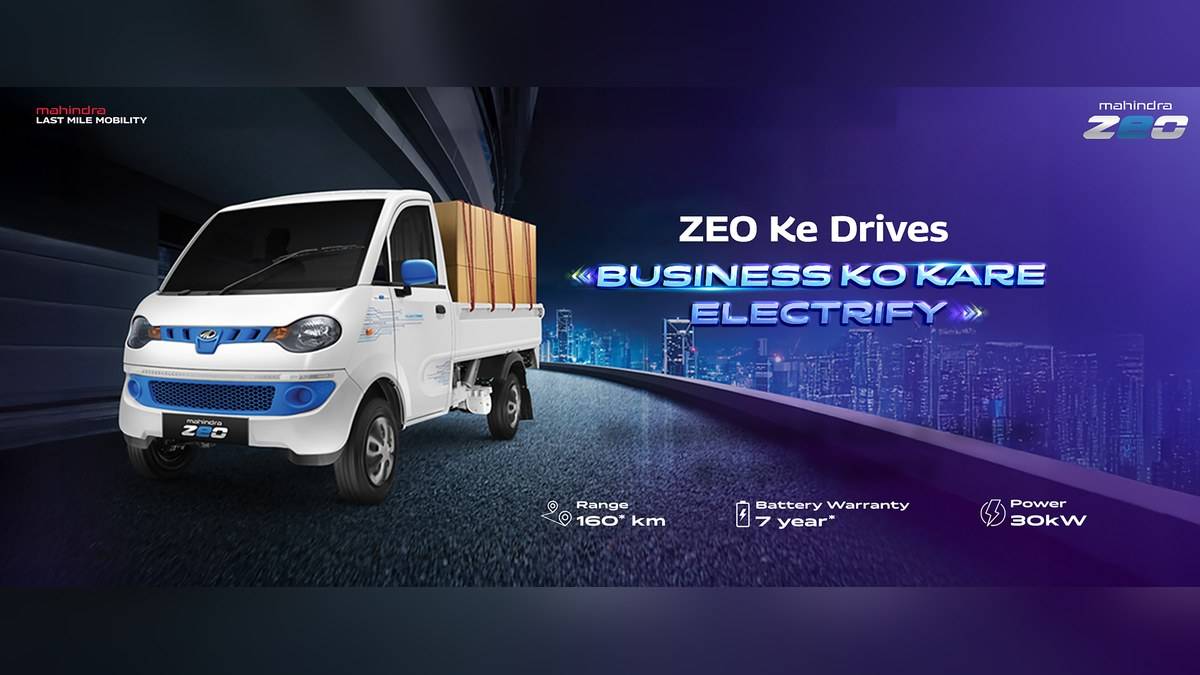
NEW DELHI: Mahindra lists a DC fast-charging time of 71 minutes from 0% to 80% for the ZEO on its official product page. The same page separately advertises adding 100 km of range in 60 minutes. Those describe different measurements: a change in battery charge and a claimed addition to driving distance.
| Item | Official figure or detail |
|---|---|
| DC charging claim | 0% to 80% in 71 minutes |
| Separate range-addition claim | 100 km in 60 minutes |
| Battery highlighted in specifications | 21.3 kWh |
| Motor output | 30 kW; 114 Nm peak torque |
| Drive modes | Power and Eco |
| Published top speed | 60 km/h |
Read the charging window before arranging a shift
The percentage window is the essential qualification. The advertised time ends before the battery is full, so it cannot be treated as a complete recharge duration. A delivery roster that requires a full battery after every stop needs a separate charging estimate. Extending the published time by simple proportion would create a figure Mahindra has not supplied.
The range-addition statement is useful for a different planning question: whether a charging break could support another round. It does not mean every vehicle will gain exactly that much usable road distance regardless of cargo and conditions. Keep the company claim attached to its wording rather than converting it into a guaranteed delivery radius.
A charger stop includes more than the charging session
For a bakery dispatch or a milk collection route, the practical issue is when the vehicle must leave again. Time spent reaching the charger, waiting for access and returning to the collection point belongs in the working schedule. None of those activities is included merely because the brochure quotes a battery charging time.
Treat charger availability as part of the route assessment. A charging location shown on a map is not proof that a compatible, working point will be available when the vehicle arrives. Establish the equipment and access arrangements before relying on it for a tightly scheduled commercial run. This is a planning check, not a claim about a particular charging network.
The distinction matters most when deliveries have appointment windows. A truck may finish its charging session within a manufacturer benchmark yet miss a loading slot because it had to wait beforehand. Separating session time from the whole stop makes the dispatch plan easier to audit if the round later runs late.
Match the battery description to the actual vehicle
The product page highlights a battery capacity in its specification summary and also refers elsewhere to another battery option. An operator should therefore match the charging discussion to the configuration written on the vehicle quotation and supplied documentation. A family-level page is not a substitute for identifying the battery in the specific truck.
This guide uses the charge-window statement exactly as the product page presents it. It does not assign an independently tested result to every configuration. Ask for the applicable charging specification with the vehicle documents, particularly when a fleet contains trucks supplied at different times or with different equipment.
The ZEO page also describes Power and Eco drive modes. These are vehicle functions, not a promise that a driver can recover a missed charging stop by selecting another mode. The delivery plan should remain workable with a sensible reserve rather than depending on a particular mode to rescue an overextended round.
Measure the work that follows a charge
A useful commissioning record joins the charging session to the subsequent assignment. Note the displayed charge at arrival and departure, the consignment and the route completed. Keep the record specific to the truck and charging location. That makes it possible to distinguish a route change from a charging problem without inventing a universal consumption figure.
The ZEO is described by Mahindra as an electric mini truck with a cargo focus. Its charging claim is consequently most useful when paired with actual dispatch needs: a predictable depot break, a return to load more goods, or a planned pause between delivery rounds. A headline benchmark alone does not describe those working arrangements.
The company page provides NEMO fleet functions including charging-pattern information and energy-use monitoring. Where those functions are available on the supplied vehicle, the operator can use the records alongside dispatch notes. A route log still needs the human explanation for an unusual day, such as a changed delivery sequence or a prolonged wait at a customer.
The practical reading is precise: the official fast-charge benchmark stops at 80%, while the separate distance claim describes potential range added during a charging period. Preserve that distinction in fleet instructions and charger discussions. It prevents an appealing charging headline from becoming an unsupported promise of a full battery before the next departure.
Related reading
Mahindra XEV 9S from Rs 21.40 lakh, XEV 9e from Rs 21.90 lakh: range, chargers and what BaaS means; Mahindra XUV 3XO EV costs Rs 13,88,999 to Rs 14,95,999, charger extra; Mahindra BE 6 price list: Rs 19.45 lakh to Rs 26.95 lakh, XEV 9e from Rs 21.90 lakh.
Official sources: Mahindra ZEO charging and battery specifications, Mahindra ZEO official business-use feature and landscape company image.