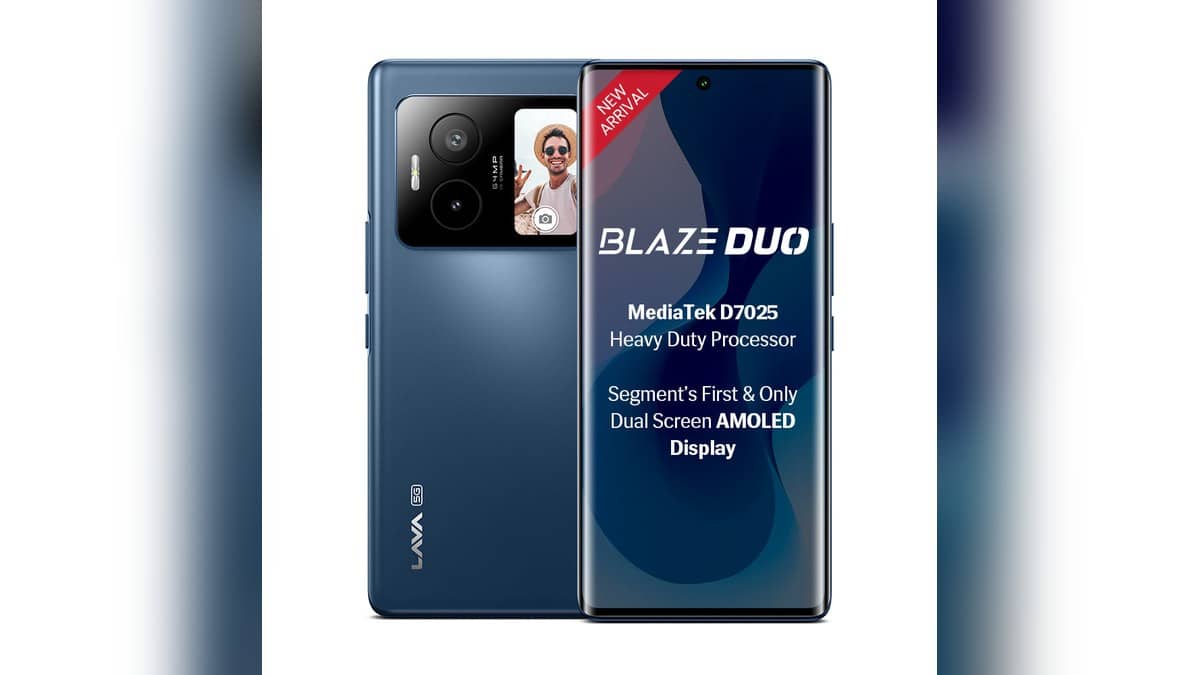
NEW DELHI: Lava Blaze Duo has a 1.58-inch secondary AMOLED display alongside a 6.67-inch main display. That small extra panel is the defining detail behind the Duo name. Lava's official catalogue lists the range from Rs 16,999, with 6GB and 8GB RAM configurations, both paired with 128GB storage.
| Feature | Official specification |
|---|---|
| Secondary display | 1.58-inch AMOLED |
| Main display | 6.67-inch, 120Hz, 3D curved AMOLED |
| Processor | MediaTek Dimensity 7025 |
| RAM and storage options | 6GB/128GB and 8GB/128GB, LPDDR5 RAM and UFS 3.1 storage |
| Rear and front camera headlines | 64MP Sony sensor and 16MP selfie camera |
| Battery and charging | 5000mAh, 33W charging |
| Verified catalogue starting price | Rs 16,999; individual variant prices not separately exposed in the readable listing |
Price as of 29 October 2026, 10:29 IST. The official shop currently marks the handset unavailable. The starting figure should not be turned into a complete price list for both RAM options, or treated as confirmation that an order can be placed.
The rear panel is the reason to distinguish Duo from other Blaze phones
The product photographs place the compact screen in the rear camera area. This creates a different design question from the usual choice between flat and curved main displays. With Blaze Duo, the extra panel is part of the back of the handset, while the large front screen remains the principal space for everyday apps.
The size matters. A small secondary panel and a full-size main screen cannot sensibly be treated as interchangeable workspaces. The specification confirms that the additional display exists and uses AMOLED technology. It does not, by itself, establish that every installed app can run on that panel or that it duplicates the front interface.
For someone interested in the rear screen, the useful demonstration would be the exact function they expect to use. Ask to see that behaviour on the phone rather than assuming broad app support from the word Duo. This is especially relevant when the rear panel, rather than the processor or storage, is the feature attracting attention.
The main screen still carries the everyday workload
Lava identifies the front display as a curved AMOLED panel with a 120Hz refresh rate. Its size places the small rear panel in perspective: this remains a conventional large-screen smartphone for reading, typing and viewing content, with an additional display built into the rear design.
A refresh-rate specification is not a benchmark. This report has not measured game frame rates or how consistently individual apps use the display's maximum setting. Readers comparing the broader Blaze range can consult the separate Blaze Curve guide, while keeping the two model names distinct.
What changes between the listed memory options
The verified options differ in RAM while retaining the same stated storage capacity. Lava names LPDDR5 memory and UFS 3.1 storage on the Duo listing. The important practical distinction is that selecting the higher RAM option does not, in this published specification, also provide a larger built-in storage tier.
Keep the base RAM figures separate from Lava's additional asterisked expansion figures. A plus-sign memory claim should not obscure which configuration is being described on an invoice. Nor should the catalogue's starting price be assigned to both configurations when their separate prices cannot be read and verified.
Cameras and charging alongside the unusual design
The official camera headlines are a 64MP Sony rear sensor and a 16MP front camera. Those figures identify the listed camera package; they do not establish image quality. In particular, the existence of a rear screen is not evidence of any specific photography workflow unless that function is separately demonstrated or documented.
Lava pairs a 5000mAh battery with 33W charging. Neither figure tells us how much power the secondary screen consumes during a particular routine. This report therefore makes no battery-life claim for leaving the rear display active and no claim that the extra panel saves power in practice.
Who this design is for
Blaze Duo is most relevant to a reader interested in an unconventional rear display while retaining a large curved main screen. Someone focused mainly on storage should notice that both listed RAM options retain the same capacity. The secondary panel is a distinct design feature, not a substitute for a larger storage configuration.
For context on other approaches within Lava's range, see the Agni generation comparison and Blaze 5G configuration guide. Each concerns a different model rather than another name for Blaze Duo.
Official sources: Lava Blaze Duo product listing and Lava's official catalogue.