A payment app can look perfectly healthy to its maker while an attacker is already inside the phone. A rooted device, a hooking tool rewriting the payee field, a fake overlay on top of the screen or a cloned copy of the app can all sit between a customer and the bank's server. Sense, a mobile security product from GoSense AI, is built around that gap. This explainer sets out what the company says Sense does, how its main parts work and where a bank or fintech should ask for proof.
Everything below comes from the company's own website, checked on 9 October 2026. These are vendor claims, not independent test results.
The idea: defend from inside the app
Most fraud tools look at a transaction after the app sends it to the server. Sense puts a protection layer inside the running app, so it can watch the app's own execution. The company calls this runtime application self-protection, or RASP. Its pages say the layer acts in the same thread as the attack, which means a verdict can arrive before money moves.
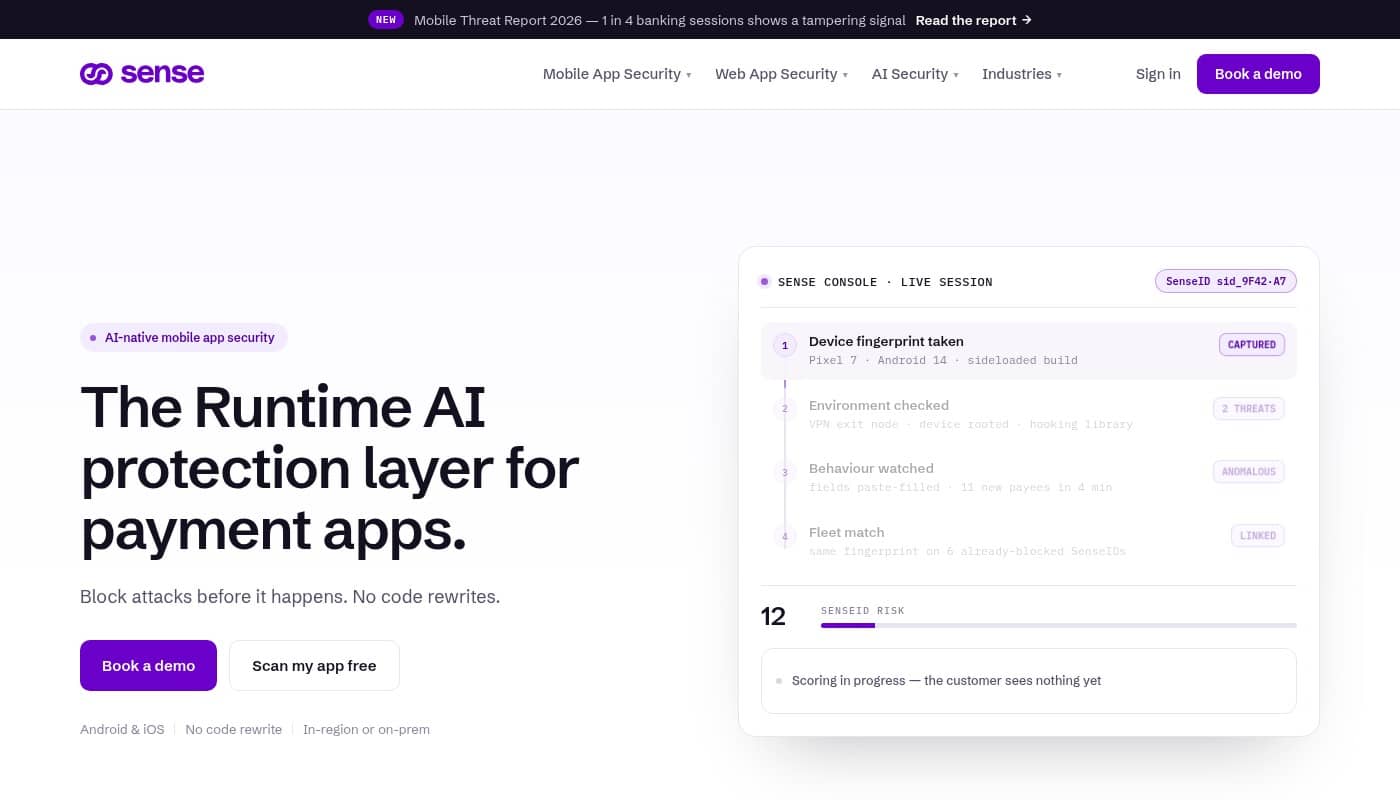
The company describes more than 100 runtime checks on Android and iOS. They cover root and jailbreak detection, emulators and cloned apps, hooking and debugging frameworks, screen-share and overlay abuse, and network interception by a proxy sitting on the payment call. A sample console on its homepage shows a transfer being refused when a hooking library is found rewriting the payee field.
The company also says integration takes under two minutes of work and needs no code rewrite, and that it can run in-region or on a customer's own servers. Those are points a bank's security team will want to test in a pilot.
The four building blocks
Sense groups its mobile product into four blocks that feed one signal engine, so what one block sees the others start enforcing.
The first is runtime defence, the RASP layer described above. The second is code obfuscation, a build-time step that renames symbols, flattens control flow and encrypts strings, keys and assets, so a decompiled APK or IPA returns noise instead of readable business logic. The company shows a simple PIN check before and after hardening to make the point.
The third is App Auth, an attestation layer. Each request to the bank's API is digitally bound to a genuine, untampered install on a trusted device, with short-lived signed tokens. The company says cloned apps, repackaged builds and scripted clients are rejected at the edge, before the bank's backend sees them.
The fourth is Silent Mobile Verification, which aims to prove a phone number without sending a one-time password. The company describes a check that runs over the cellular data path, asks the carrier network to confirm that the number matches the line, and binds the result to the device, with a verdict in about two seconds. No SMS is sent and no code is typed.
Why the OTP is the target
The company's argument against OTPs is plain. A code is a secret that the customer is asked to share, and anything shareable can be phished. It lists scam calls, forwarding malware, code-relay scams and mule farms as the attacks that exist because the code goes to a phone line rather than to a person. It also points out that a lender pays for every message, plus retries and drop-off at the OTP screen.
That does not mean OTPs are about to vanish. Indian banks and payment apps work under rules from the Reserve Bank of India and the National Payments Corporation of India, and any change to authentication has to fit those rules. The company publishes a checklist that maps its controls to RBI, NPCI and SEBI expectations, which is a sensible place for a compliance team to start.
Beyond mobile: bots, takeovers and AI
Sense is not only a mobile product. Its site also lists bot detection, which tries to tell a real customer from a script in real time, and account takeover protection, which scores login and post-login session risk. A third group covers AI security, with runtime protection that inspects prompts and tool calls in flight and model security that scans, signs and inventories models before they ship.
The homepage also describes a device fingerprint, called a SenseID, that links a device and its behaviour to a ban. In the sample, a return attempt with a new install and a new phone number is matched back to the blocked device in about 40 milliseconds. Fleet-wide matching of that kind is useful only if the data is handled lawfully, so buyers should ask how the fingerprints are stored and for how long.
The numbers and the proof
A banner on the site promotes a Mobile Threat Report 2026, a 32-page document dated February 2026 that the company says found one in four banking sessions showing a tampering signal. The company says it is based on what Indian banking apps faced. The report was not independently reviewed for this article, so treat the headline figure as the company's own.
On certification, the site lists SOC 2 Type II, ISO 27001 and alignment with the Digital Personal Data Protection Act. It offers a free scan in which a team uploads an APK or IPA and sees what an attacker would see in under ten minutes, which is a low-risk way to judge the product. Its customer logo strip names a few firms, including TMB, Ippopay and Prayaan.
What a buyer should ask
A bank or fintech weighing Sense should ask for three things. First, evidence on false positives, because a security layer that blocks genuine customers costs money too. Second, performance data on low-end Android phones, which many Indian customers use. Third, how updates reach older app versions, since attackers often target builds that users have not updated.
For readers following how Indian startups are applying AI to regulated sectors, our recent coverage of Gnani.ai's voice platform and the Quanfluence funding round shows where investor and customer interest is heading. GoSense says teams can book a demo through its website.