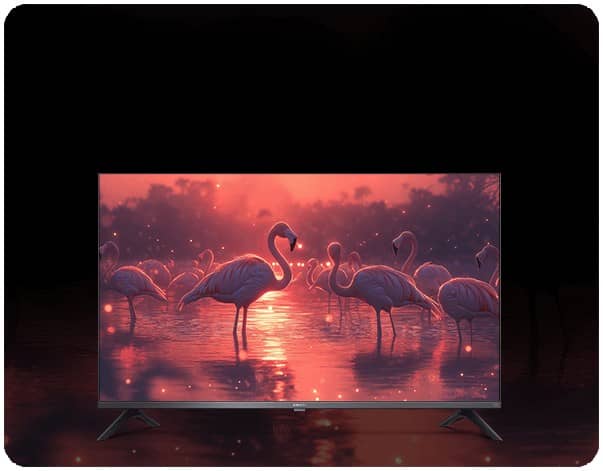
Walk through any TV listing in this festive sale and you will see the same handful of labels: LED, QLED, Mini LED, QD-Mini LED and OLED. They are printed in large type, often next to a big discount badge, and they are not always explained. They matter, because the label tells you how the TV makes its picture and roughly how good it will look in a dark room.
Here is what each term means, what it costs this season and how to choose.
LED: the starting point
Almost every TV sold in India is an LCD TV. An LCD panel cannot make its own light, so a backlight of LEDs shines through it. That is all the LED label means. A basic LED TV has a fairly simple backlight that lights the whole screen evenly, or in a few large zones.
The weakness shows in dark scenes. Because the light behind the panel is always on across large areas, blacks look greyish, and bright objects on a dark background can have a faint glow around them. In a bright living room in the afternoon, you may not notice. In a dark room at night, you will.
QLED: better colour, same basic design
QLED adds a layer of quantum dots, tiny particles that turn the backlight into purer red and green light. The result is richer, more accurate colour and usually higher brightness than a basic LED TV. It is still an LCD with a backlight, so it does not fix the grey blacks on its own.
QLED is now common in mid-priced sets. Amazon offered Xiaomi's 55 inch FX Pro QLED at Rs 29,999 as an early deal last week, as we reported in our Xiaomi FX Pro QLED story. Many QLED TVs at this price also offer 120Hz modes for gaming, but check whether that is the panel's native refresh rate or a processing feature.
Mini LED: the backlight gets smarter
Mini LED replaces the backlight with thousands of much smaller LEDs, grouped into many local dimming zones. Each zone can brighten or dim on its own, depending on what is on screen. A dark sky can stay dark while a bright moon next to it stays bright.
This is the biggest picture upgrade an LCD TV can get. Blacks look deeper, contrast improves and HDR content looks much punchier. The number of dimming zones matters a lot. More zones generally means more precise control and less glow around bright objects, so look for the figure in the specifications.
QD-Mini LED: both upgrades together
QD-Mini LED combines a quantum dot layer for colour with a Mini LED backlight for contrast. It is the top tier of LCD TVs. TCL's 55 inch SmartChoice QD-Mini LED Google TV is listed at Rs 59,990 on Amazon's Great Indian Festival page, with a 144Hz refresh rate and up to 512 dimming zones, according to Amazon (price as of 9 October 2026, 2:50 AM IST).
Brands use slightly different names for the same idea, such as QD-Mini LED, QLED Mini LED or Neo QLED, so read the specifications rather than the name. The two things to look for are quantum dots and local dimming with a stated zone count.
OLED: no backlight at all
OLED works differently. Each pixel makes its own light and can switch off completely. That gives true black, effectively unlimited contrast and no glow around bright objects, with wide viewing angles. It is the best choice for watching films in a dark room.
The trade-offs are price and brightness. OLED TVs usually cost more than Mini LED sets of the same size, and most are not as bright, which matters in a sunlit room. OLED panels can also suffer burn-in if the same static image, such as a news channel logo, stays on screen for many hours every day, though modern sets have features to reduce the risk.
Resolution, size and motion settings
Almost every TV of 43 inches and above sold this season is 4K, so resolution is rarely the deciding factor. Size is. For a 55 inch 4K TV, a viewing distance of roughly 7 to 8 feet is comfortable for most people. If your sofa is much further away, a bigger screen will make more difference than a better panel.
Most TVs also switch on motion smoothing, often called MEMC, by default. It makes sports look smoother but can give films an unnatural, video-like look. If a film looks oddly smooth on your new TV, turn this setting down or use the film or Filmmaker mode.
How to choose
Start with your room. If you watch mostly in the daytime in a bright room, a bright QLED or Mini LED TV will serve you better than OLED. If you watch films at night with the lights off, Mini LED or OLED is worth the extra money.
Then look past the label. For any LCD TV, check whether it has local dimming and how many zones. Check the native refresh rate if you game on a console, and the HDR formats it supports, such as Dolby Vision and HDR10+. Look for the number of HDMI 2.1 ports if you have a newer console.
Finally, compare prices across stores and with the brand's own site, since struck-out prices on sale listings are often inflated. Our report on the Acerpure Nitro QLED TV shows how specifications can vary within one label. And if the TV is a Diwali gift, check the installation terms on the order page, because wall mounting is not always free. Amazon's full list of festive TV deals is on its Great Indian Festival page.