NEW DELHI: The Garmin Forerunner 165 is rated for up to 19 hours in GPS-only mode and up to 17 hours with all satellite systems enabled, according to Garmin's specification. Its up-to-11-day smartwatch figure describes a different operating mode. For runners planning training around work, the relevant battery number changes when an outdoor activity starts.
| Forerunner 165 specification | Official figure |
|---|---|
| GPS-only GNSS | Up to 19 hours |
| All-systems GNSS | Up to 17 hours |
| Smartwatch mode | Up to 11 days |
| Battery-saver smartwatch mode | Up to 20 days |
| Display | 1.2-inch AMOLED, 390 x 390 pixels |
| Weight | 39g |
| Charging | Garmin proprietary plug charger |
Read the activity figure before the daily figure
Garmin separates GPS-only operation from all-systems GNSS in the specification for the standard Forerunner 165. These are alternative tracking configurations, not consecutive stages that can be added together. Likewise, battery-saver smartwatch operation does not describe continuous outdoor route recording. Each quoted maximum belongs with its mode.
A practical way to read the table is to start with the job being asked of the watch. Recording a run has a different power budget from wearing it through an office day. Someone alternating commuting, sleep tracking and outdoor training cannot simply assume the smartwatch maximum will remain intact while adding unlimited GPS sessions.
For an Indian runner leaving home before work, that distinction is more useful than a single large battery headline. The question is whether the watch is ready for the planned recording session, with reserve for the rest of the day. Garmin's published limits provide a planning reference; they are not measurements of that person's particular week.
The standard watch and Music model need separate treatment
The figures here come from Garmin's standard Forerunner 165 product specification. Garmin also sells a Forerunner 165 Music. Its announcement identifies stored music and direct wireless-headphone listening as Music-model functions. Do not read the standard watch's battery table as a promise about endurance while downloading or playing stored songs.
The standard product page lists smartphone music control. That is useful when the phone is supplying the audio, but it should not be confused with carrying an onboard music library. Decide which device is doing the work before interpreting either the connectivity requirements or the power claims.
This distinction also keeps the article's scope clear. No local price comparison or claim about the current Music-model premium follows from the battery figures. They explain operating modes on the documented hardware. They do not establish which package is available for delivery to an Indian address.
What the run recording is built around
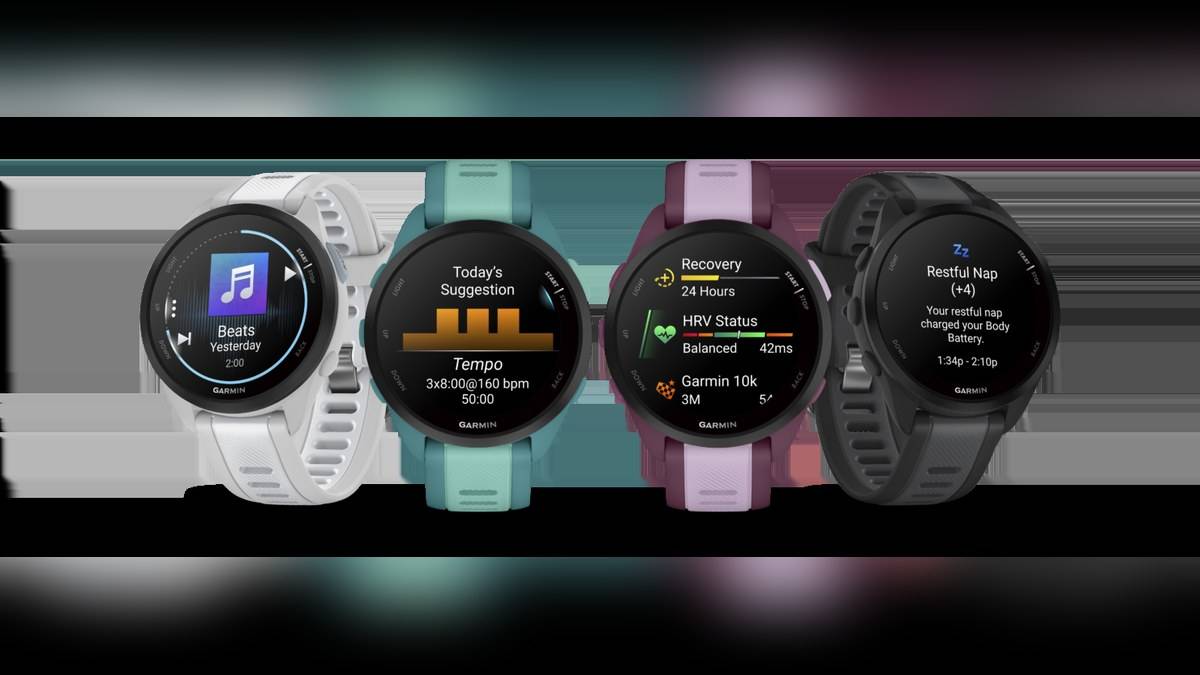
The Forerunner 165 combines a touchscreen with physical buttons and built-in satellite positioning. Garmin's running tools include pace and distance, wrist-based running dynamics and Training Effect. The interface therefore serves more than a route trace: it brings workout information and the subsequent training assessment onto the same device.
Daily suggested workouts respond to performance and recovery, while race information can be entered into Garmin Connect. Garmin also documents free Coach plans for 5K, 10K and half-marathon training. Those features explain why battery during recorded exercise matters on this model: its purpose includes repeated structured sessions, rather than occasional activity logging alone.
There is a useful separation between recording a session and deciding what to do next. A finished route tells the runner where the watch tracked the activity. Suggested workouts and recovery guidance interpret the broader training record. Neither is evidence that the published battery maximum will be reproduced on every run.
Garmin specifies a 43 x 43 x 11.6mm case and industry-standard 20mm quick-release bands. Those dimensions make the Forerunner 165 a particular physical package, not merely a set of software menus. A runner checking fit alongside the charging routine can use the documented measurements rather than inferring size from a close-up product photograph.
Leave room for the connected features
Smart notifications require a paired compatible phone. Garmin's safety and tracking features also carry phone-connection requirements. Built-in GPS should therefore be read as a location-recording capability, not proof that every connected function remains available after leaving the phone behind.
The watch uses Garmin's proprietary plug charger. Planning an overnight trip around this model consequently includes that cable, even if the phone uses another familiar connector. The detailed battery table helps judge the intended recording session; it does not remove the need to restore charge between uses.
Readers comparing endurance claims across wearables can also consult our separate Garmin CIRQA screen-free band goes on sale in India at Rs 25,990 and Garmin Enduro 4 launches at 899.99 dollars with up to 320 hours of GPS battery: UK price and India status. Our Amazfit T-Rex 3 battery: 27 days typical, 42 hours with accurate GPS covers another sports watch. Each model's operating conditions need to travel with its battery claim.
Official sources: Garmin Forerunner 165 specification and Garmin's Forerunner 165 series announcement.