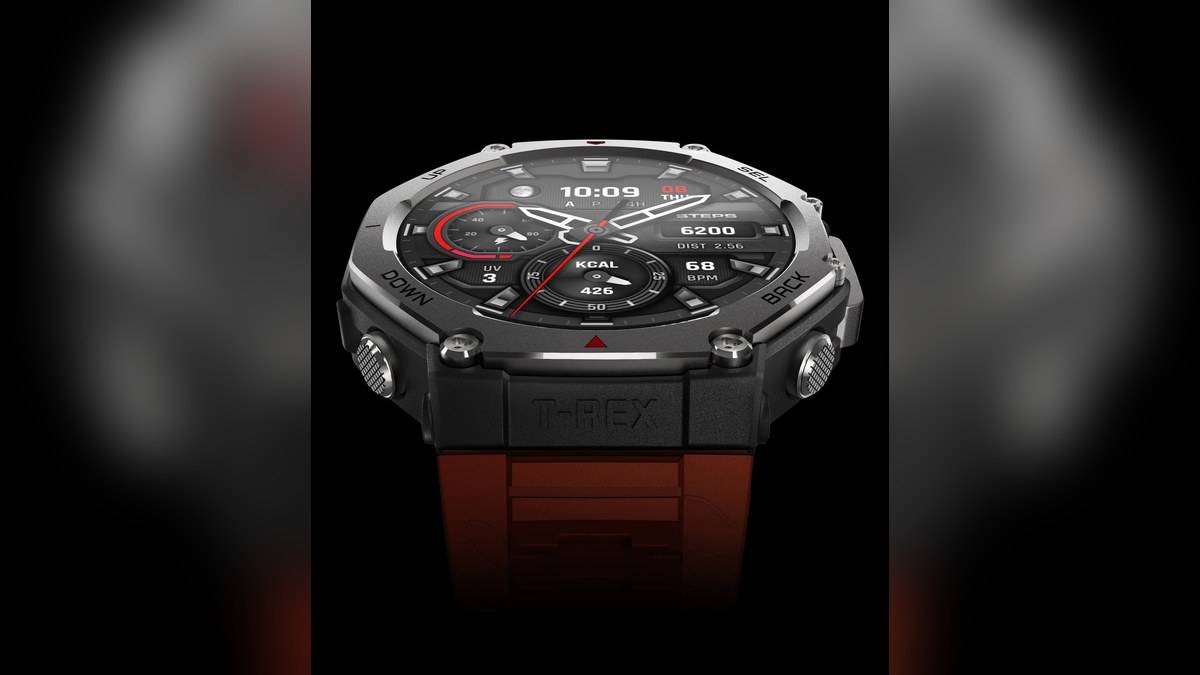
NEW DELHI: Amazfit T-Rex 3 is rated for up to 27 days of typical use, but its Accurate GPS mode is quoted at up to 42 hours. Those figures describe different operating conditions. The much larger 180-hour GPS maximum requires restrictions that matter if you plan to use the watch for a trek or a long race.
| Item | Official detail |
|---|---|
| Typical use | Up to 27 days |
| Heavy use | Up to 13 days |
| Accurate GPS | Up to 42 hours |
| GPS maximum | Up to 180 hours, restricted setup |
| Battery and charging | 700mAh rated; approximately 3 hours |
| India store price | Rs 19,999 for the selected Haze Gray option |
Price as of 6 November 2026, 04:41 IST. The official India page also lists Lava and Onyx in its colour selector, but this report records the displayed Haze Gray price rather than assuming a separately verified checkout price for every colour. The article explains battery operation, rather than presenting a complete variant price list.
Why the daily figure is not a race timer
The typical-use test includes heart-rate measurements at five-minute intervals, sleep tracking, a static watch face and limited illuminated-screen use. It is a defined laboratory routine, not a promise that every combination of monitoring, alerts and outdoor recording will last the same number of days. Amazfit says results vary with settings and operating conditions.
A runner recording an event continuously is using the watch differently from someone who checks time and notifications through the day. The battery question should therefore start with the activity: how long must GPS record, which measurements must remain available, and how often will the screen be used? The 27-day label alone does not answer those questions.
What the 180-hour maximum gives up
Amazfit limits the maximum GPS battery setting to Hiking and Climbing workout modes. Its note says the maximum requires recording only the GPS trajectory and manually switching off factors including heart-rate monitoring, Bluetooth connectivity and wake-on-wrist-raise. That is a materially different experience from a fully connected training session.
For someone documenting a long route, a trajectory-focused mode may be useful. For an athlete who wants live heart-rate information throughout an effort, that same configuration removes something central to the workout. Neither user should assume the maximum battery claim describes the data they will personally record without checking the selected mode.
The watch also has Battery Saver and Clock modes. The former limits health monitoring and turns GPS off; the latter turns off phone Bluetooth and all-day heart-rate monitoring. Their longer endurance figures belong to reduced-function operation. They are not substitute estimates for a normal GPS workout.
Screen brightness has its own conditions
The 1.5-inch AMOLED display has a 480 x 480 resolution and an advertised peak of 2,000 nits. The India notes say that peak is unavailable below 30% battery and in Low Temperature mode. Automatic brightness must be enabled for the watch to reach the peak in suitable surroundings.
This matters on a trip because a specification sheet can otherwise suggest that maximum visibility and maximum endurance arrive together. In practice, the battery reserve and active mode affect which display behaviour is available. Check readability in the configuration you intend to use, especially before depending on a map during an unfamiliar outing.
Cold-weather and navigation preparation
Low Temperature mode must be enabled in settings. The official notes say it activates when the watch surface falls below minus 10 degrees Celsius, with limited functions available. The quoted low-temperature GPS endurance is up to 28 hours. That is another reason to avoid carrying the normal accurate-GPS estimate unchanged into a cold mountain itinerary.
The watch provides downloadable offline maps, dual-band positioning and six satellite systems. However, its India navigation note requires an imported route file and a downloaded map matching the actual location. It also warns that a straight line back to the starting point may not be a practical route. A route should be prepared and reviewed before the outing begins.
Charging is through a magnetic base, with an approximate full-charge duration of three hours. The packing list includes that base but excludes a USB Type-C cable. On a trip, keeping the watch and its base together is as relevant as choosing a battery mode: a generic cable by itself cannot replace the watch-specific charging interface.
Who it is for
T-Rex 3 is most relevant to someone who values route recording, map access and a configurable outdoor watch. It has a stainless-steel bezel, polymer frame and a body weight of 68.3g without the strap. That substantial build should be considered by anyone who also wants to wear it through the night.
The microphone does not imply wrist calling: Amazfit's official FAQ says T-Rex 3 supports call notifications but does not support Bluetooth phone calls. Someone prioritising spoken calls should resolve that requirement before treating the rugged design as an all-purpose upgrade. For long outings, choose the battery mode around the information needed, then leave room for actual conditions to differ from the laboratory claim.
For more wearable context, read our Amazfit Active 2 variant guide, Bip 6 and Bip Max comparison and boAt smartwatch range guide. Those are separate model reports, rather than prices applied to this watch.
Official sources: India specifications and battery test notes, Amazfit FAQs and Amazfit outdoor feature details.