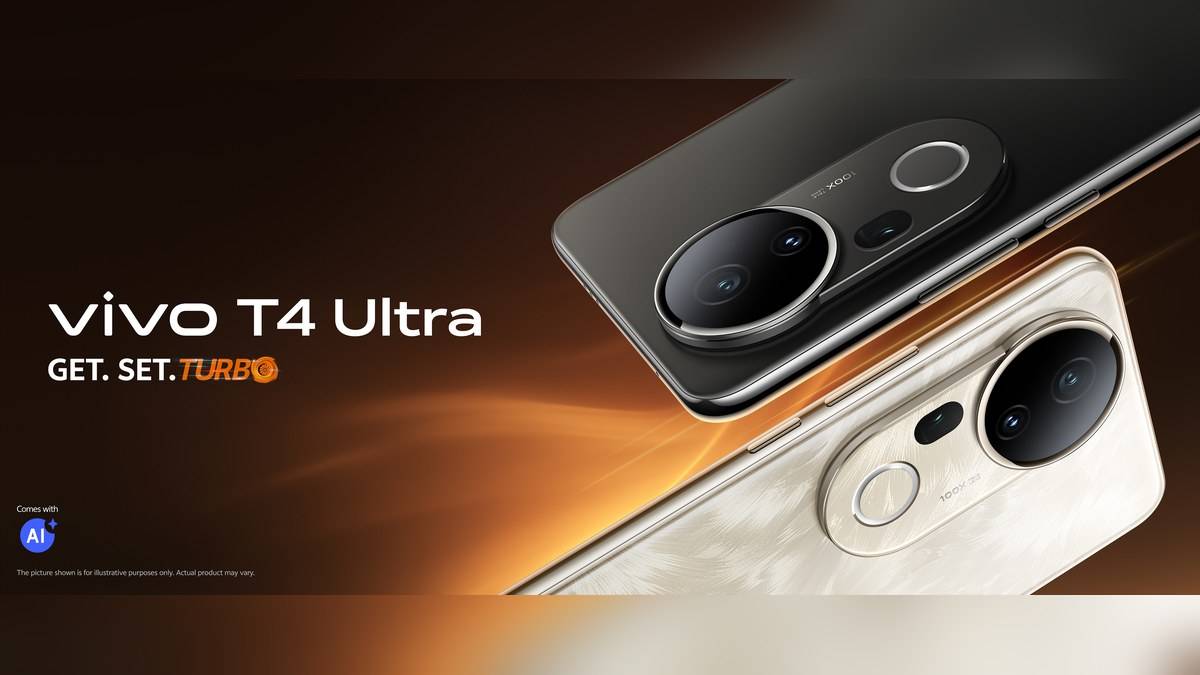
NEW DELHI: Vivo lists 90W FlashCharge support for the T4 Ultra and advertises a 48-minute charge to 100% on its India product page. That time is a manufacturer claim, not a measured result from this desk. The same phone has a 5500 mAh typical battery, so its charging specification and battery capacity describe different parts of the power system.
| Power-system detail | Official information |
|---|---|
| Supported charging | 90W FlashCharge |
| Typical battery capacity | 5500 mAh |
| Advertised full-charge time | 48 minutes to 100% |
| Starting percentage beside that claim | Not stated in the opened passage |
| Box contents | Charger and USB cable listed |
| Ingress protection | IP64 |
The missing starting percentage matters. A claim of reaching full charge should not be rewritten as a precisely defined empty-to-full test unless the source supplies that starting point. Vivo's general disclaimer also says results can vary with the environment, software and usage habits. Those qualifications belong alongside the headline time.
Keep the charger and handset specifications together
The official specification page lists both a charger and a USB cable among the box contents. For an owner checking the charging claim, the supplied equipment is the sensible reference setup. A different adapter's printed wattage alone does not establish that the handset will use the same charging behaviour.
This is especially relevant when a household shares chargers among a phone, tablet and laptop. The largest power figure printed on an adapter does not, by itself, demonstrate the power reaching a particular device. A slow session with unfamiliar equipment is therefore not a clean test of the T4 Ultra's advertised system.
Our vivo Y31t charging explainer covers a separate model's supported power. Its figure should not be imported into the T4 Ultra's specification, just as the Ultra's charging claim should not be applied to another handset carrying the T-series name.
Separate a battery-size question from a charging-time question
The capacity figure describes the phone's battery, while the wattage describes its charging support. Neither is an everyday endurance result. A user interested in getting through a day of commuting is asking a different question from someone who wants to replenish the phone before leaving home.
Vivo's product page publishes separate single-activity endurance claims, but they are not a timetable for mixed use. Calls, camera use, navigation and background apps do not constitute the same workload as a manufacturer demonstration of a single activity. Combining those claims into a predicted day of use would suggest precision the source does not provide.
The wording also needs to preserve typical capacity. It would be incorrect to silently relabel that value as a minimum guarantee. Our guide to typical and rated battery figures explains why those terms should remain distinct when comparing specification sheets.
How to make a useful charging observation
Owners who want to understand their own phone can note the starting battery level, the equipment used and whether they kept using the screen. They should record the finishing level as well. Without those basic observations, two apparently different charging times may simply describe different starting points or different workloads.
That exercise does not recreate a laboratory test, and the product page does not provide enough detail to reproduce the advertised time exactly. Its value is narrower: it creates a consistent personal reference for later sessions. A comparison is more informative when the charger, cable and phone activity remain similar.
A single session should also be kept separate from a long-term battery-health conclusion. The opened charging passage does not give a battery-retention commitment tied to the headline time. A fast charge, a full-charge indication and retained capacity after years of use are distinct measurements.
Check the model identity before borrowing advice
The T4 Ultra is specified with the Dimensity 9300+ platform, a 6.67-inch display and storage choices reaching 512GB. Those details identify the device being discussed. Its processor and camera hardware also make it inappropriate to borrow endurance expectations from a similarly named phone without checking the actual specifications.
The official product page describes a quad-curved AMOLED screen with a refresh rate reaching 120Hz. That is relevant context for interpreting the phone as a complete device, but it is not a charging-test condition. The published time does not establish what happens while a user is playing a game or recording a long video.
Vivo's page cautions against charging the device when wet. Its IP64 listing should not be read as approval to ignore that instruction. The practical sequence after water exposure is to follow the phone's safety guidance, rather than treating a charging-speed claim as a reason to reconnect immediately.
Price and software are separate checks
The opened India store selection, Phoenix Gold with 12GB RAM and 256GB storage, displays Rs 37,999. Price as of 7 November 2026, 00:24 IST. This is the verified price for that selection, not an inferred price for the other configurations and not confirmation that an order can be fulfilled immediately.
The product documentation lists Funtouch OS 15 based on Android 15. For subsequent announcements, readers can consult our vivo software rollout report. An update announcement does not replace the need to check the software and charging behaviour of the individual handset.
Official sources: T4 Ultra product page and charging claim, India specifications and verified store selection.