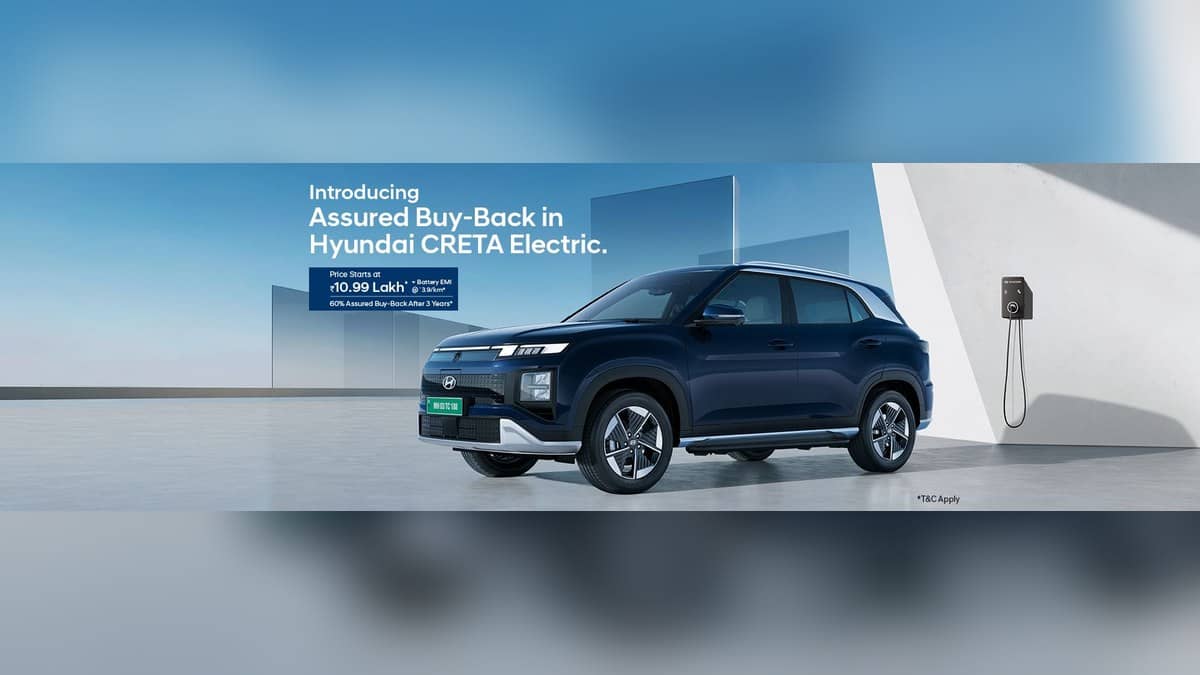
NEW DELHI: Hyundai lists six airbags as standard across the Creta Electric range, but its Level 2 driver assistance equipment is tied to selected trims. The distinction matters because the model's safety headline combines equipment supplied throughout the range with features that require an Excellence, Excellence Knight or corresponding higher-specification version.
| Safety equipment | What Hyundai's equipment table shows |
|---|---|
| Six airbags | Standard across listed trims |
| ESC, hill-start and hill descent assistance | Standard across listed trims |
| Front and rear disc brakes | Standard across listed trims |
| ISOFIX child seat anchors | Standard across listed trims |
| Rear parking sensors and rear camera | Standard across listed trims |
| SmartSense assistance suite | Excellence, Excellence Knight, Excellence LR, Excellence LR Knight and Lounge |
| Factory-listed dashcam | Excellence Knight, Excellence LR Knight and Lounge |
This is an equipment guide based on Hyundai's official Indian safety page, feature matrix and brochure checked on 4 November 2026. It does not assign a crash-test score or claim that the assistance suite is available on every Creta Electric carrying the same battery size.
Start with the equipment shared across the range
Hyundai's safety page identifies the airbag arrangement as front, side and curtain protection. It also explains that electronic stability control can adjust braking and power delivery to help maintain stability. These are useful distinctions when reading a showroom feature card: an airbag count and an electronic intervention system describe different parts of the safety package.
The brochure separately identifies standard safety equipment, including the airbags, stability systems and disc brakes. It lists three-point belts and seatbelt reminders for all seats. That gives a family a more concrete starting point than the total number of safety features used in the advertising headline.
The practical check is to look at the rear bench as carefully as the driver's display. A compatible child seat, its installation and access to the belt buckles are part of a household's use of the vehicle. The presence of ISOFIX anchors is useful information, but it does not establish that every child seat will fit every position.
The assistance package follows trim, not battery capacity
The online feature matrix marks forward collision warning, collision avoidance functions, lane assistance and Smart Cruise Control with Stop & Go against selected higher trims. Its standard-equipment columns should be read individually. Executive and Premium descriptions should not inherit the complete SmartSense list simply because the safety overview discusses the model as a whole.
This is particularly relevant to the Creta Electric because its battery and equipment choices overlap. Hyundai offers 42 kWh and 51.4 kWh packs. The specifications page gives different motor outputs, 99 kW and 126 kW respectively, but identical body dimensions. Moving to the larger battery therefore changes the powertrain specification without automatically answering every equipment question.
Our existing Creta Electric battery and variant guide explains that separate choice. For this safety check, the trim name is the important identifier. It should appear in full on a written vehicle specification rather than being shortened to a battery size or a broad description such as top model.
A dashcam, a parking camera and ADAS do different jobs
The brochure presents the surround-view monitor and blind-spot view monitor alongside the SmartSense functions. It also cautions that assistance equipment varies by variant. The feature matrix is therefore the useful cross-check for a particular car, while the brochure explains the broader collection of functions Hyundai offers.
The dashcam deserves its own check. Hyundai's current table lists it for the Knight versions of Excellence and Excellence LR, and for Lounge. Its presence is a different question from whether a car has a rear parking camera. Treating all camera-based features as one package would conceal a meaningful difference between the named trims.
Similarly, the standard rear camera and parking sensors establish a baseline for reversing assistance. They should not be described as equivalent to a surround-view system. A demonstration can establish what appears on the actual car's display and which controls select it, without relying on photographs of another version.
Use the brochure's limits as well as its feature list
Hyundai explicitly says SmartSense is not a substitute for attentive driving and that its effectiveness depends on conditions. That qualification belongs alongside the Level 2 label. A count of assistance functions cannot establish that a vehicle will handle every road situation or remove the driver's responsibility.
The Creta Electric's convenience page also discusses smartphone-based digital access and in-car charging payments. Those functions concern access and convenience; they do not expand the standard safety equipment. Keeping those descriptions separate makes it easier to assess what a demonstration actually proves about the chosen vehicle.
Readers checking ownership details can also consult the existing Creta Electric charging explanation and vehicle and battery warranty guide. Each addresses a different part of the car's specification, which should remain separate from its safety equipment and trim eligibility.
Official sources: Hyundai safety page, equipment matrix, brochure, specifications and convenience features.