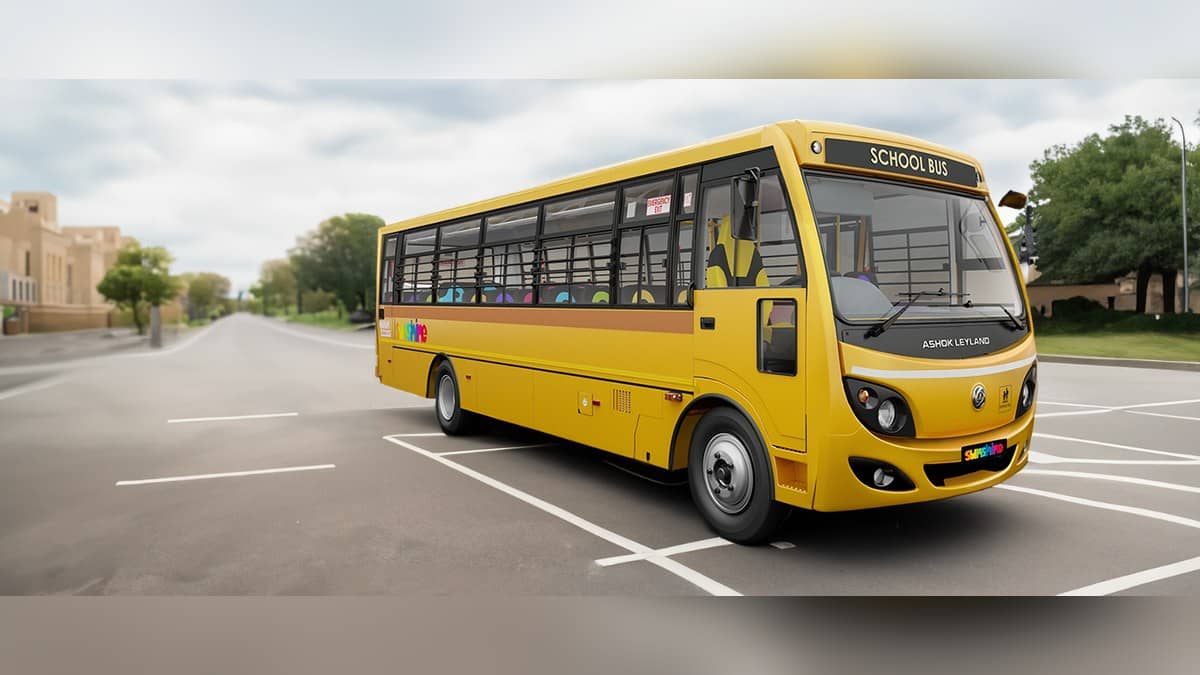
NEW DELHI: Ashok Leyland's Sunshine school-bus specification lists indicative seating layouts of 32+D and 40+D in a 2x2 arrangement, and 39+D and 49+D in a 3x2 arrangement. Those are the layouts on the detailed technical page. They should be distinguished from the broader 32 to 51 seating range advertised on the Sunshine overview.
| Sunshine specification | Official published detail |
|---|---|
| 2x2 school-seat layouts | 32+D or 40+D |
| 3x2 school-seat layouts | 39+D or 49+D |
| Body width | 2,200 mm |
| Wheelbase choices | 4,560 or 5,200 mm |
| Overall lengths listed | 8,135 or 9,415 mm |
| Engine output | 110 kW and 450 Nm |
| Transmission | Five-speed direct drive |
| Company starting-price listing | Rs 13,50,000 onwards |
Price as of 3 November 2026, 23:56 IST. The company gives an onwards amount for Sunshine, without attaching individual prices to the school-seat layouts in this table. It is not possible to derive a price per layout from the published material.
Read the layout before the headline capacity
The technical sheet labels its seating figures as indicative. The notation places the driver separately from the school-seat count. It also distinguishes the arrangement across the bus, rather than merely offering a larger or smaller total. That makes the layout description useful to a school transport administrator examining how a particular bus will work.
The overview's wider capacity range is a family-level summary. It does not identify the precise configuration behind its upper endpoint in the material opened for this report. There is no reason to substitute that endpoint into a seating plan which the technical sheet labels differently, or to treat all Sunshine buses as having the same interior.
A school route needs an actual seating plan tied to the vehicle serving it. The published family maximum cannot settle where children board, where an attendant would sit, or how bags are handled on that vehicle. Those questions require the interior arrangement, rather than a calculation based only on the Sunshine name.
Width and length answer different route questions
The published body width stays a separate figure from the listed length and wheelbase choices. Width describes the bus across its body; wheelbase concerns the spacing between its axles. Neither is a substitute for a verified turning requirement or a complete drawing of the bus in its final configuration.
Consider a school whose bus enters through a narrow gate and then waits inside a crowded courtyard. Seating demand matters during the journey, but the gate, waiting position and boarding path are part of the same operating problem. Looking only at the capacity headline would leave the physical access question unanswered.
The technical sheet lists alternative wheelbases and overall lengths, but its text does not explicitly map every seating arrangement to each dimension. We have therefore preserved the alternatives without creating a configuration matrix. Matching a seat plan to a particular length would require clearer variant documentation than the displayed list provides.
The drivetrain details behind the school layout
Sunshine's detailed page identifies a 3.84-litre, four-cylinder H-series diesel engine with turbocharging and aftercooling. It lists a cable-shift mechanism and an air-assisted hydraulic clutch actuation system. These are more specific descriptions than treating the bus as a generic passenger carrier with a school-seat count attached.
Parabolic suspension is listed at both ends. Ashok Leyland also presents iALERT among the model's fleet-management features on its overview. The pages do not establish a measured comfort advantage on a particular school route or specify a complete monitoring-service package, so those outcomes and subscription assumptions have not been added.
For a transport office, the practical connection is between the seat allocation, the actual bus and the route roster. Maintaining those as linked records avoids letting a family-level brochure figure stand in for an individual vehicle's configuration. The published specifications provide reference points, while leaving the final operating arrangement to be documented separately.
Related commercial-vehicle coverage includes Car price guide, Inside the Partner 4 Tyre's 140 hp diesel specification and Loading the Saathi: 1,120 kg and a 2,500 mm cargo deck. These reports cover different commercial transport uses.
Official sources: Sunshine technical specification and indicative school-seat layouts, Sunshine overview and Ashok Leyland starting-price listing.