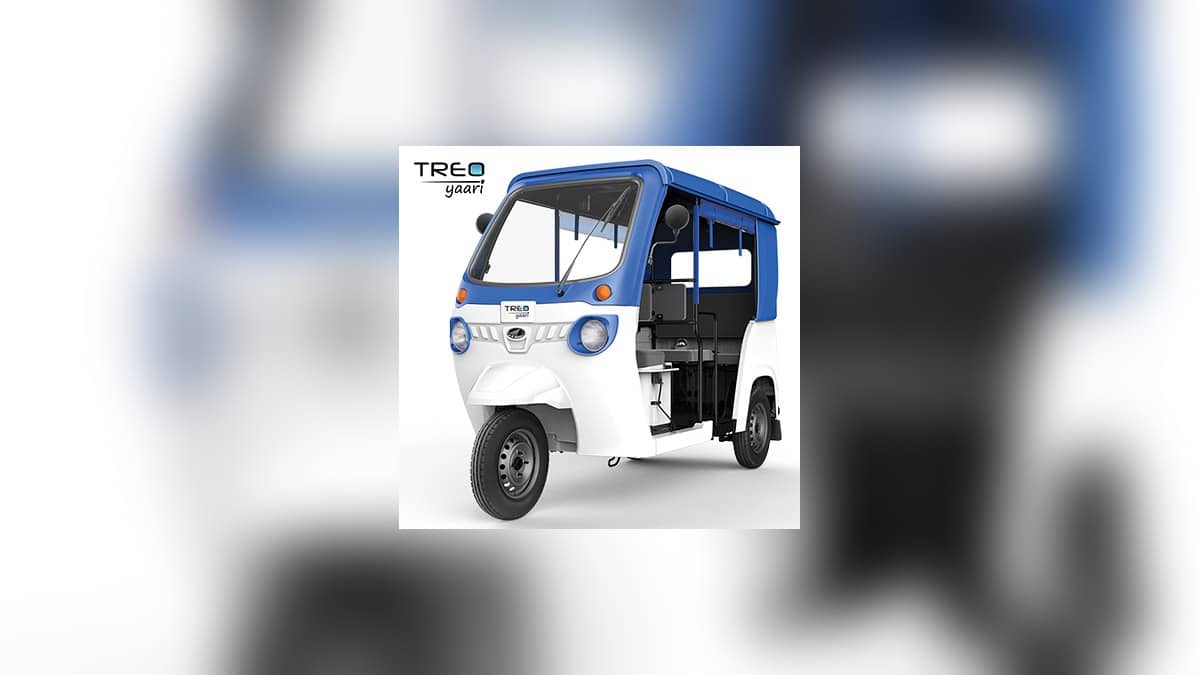
NEW DELHI: Mahindra's Treo Yaari Passenger page lists Rs 1,96,000 to Rs 2,04,000, below the Rs 2,50,000 introductory starting figure still shown on Piaggio's Ape WavE page. These are differently qualified company figures, rather than matched on-road quotations. The seating layouts also differ: the Yaari accommodates a driver and four passengers, while the WavE accommodates a driver and three.
| Published detail | Mahindra Treo Yaari Passenger | Piaggio Ape WavE |
|---|---|---|
| Company website price | Rs 1,96,000 to Rs 2,04,000 | Introduced from Rs 2,50,000 |
| Price qualification | Range without individual variant prices | Starting figure; local taxes and state subsidies can affect final price |
| Seating | Driver plus four passengers | Driver plus three passengers |
| Battery description | 48 V lithium-ion | 51.2 V lithium-ion, LFP |
| WavE battery capacity | Not used for this comparison | 5.4 kWh rated |
Price as of 3 November 2026, 23:56 IST. This timestamp records the website check. It does not turn Piaggio's introductory figure into a newly announced price, or establish that both companies include identical charges.
What the price gap actually describes
Mahindra publishes the Yaari amount as a range in its affordability section. It does not attach each endpoint to a named configuration there. Assigning the lower figure to a particular roof, battery or trim would add information the page does not supply. Both endpoints belong in the comparison, with that limitation visible.
Piaggio uses a different formulation. Its FAQ says the WavE was introduced at the stated starting price and explains that local taxes and state-specific subsidies affect the final amount. That wording matters to a driver comparing a printed quotation with a website. A disagreement between the totals does not, by itself, establish that the vehicle price has changed.
A useful comparison would therefore keep the vehicle amount, registration, insurance and any incentive treatment in separate columns. Neither page provides enough detail to reconcile those items across these particular vehicles. This report consequently makes no claim about which has the lower delivered cost in an Indian state.
Passenger layout changes the comparison
The Yaari's passenger layout is the most concrete reason to resist treating this as a price contest between identical products. A driver serving a shared local route would need to consider how its seating arrangement fits that service. The WavE's passenger compartment is configured differently. A rupee difference alone cannot describe the operational consequence.
Consider a station feeder where people arrive together carrying bags. The relevant question is how the approved seats, boarding access and luggage fit the actual queue. On a route dominated by individual hires, the same passenger count may have a different significance. These are service-design questions, rather than a basis for projecting fares or promising higher daily income from either vehicle.
Mahindra describes the Yaari as an e-rickshaw with a clutch-free driving arrangement. Piaggio presents the WavE as an electric passenger three-wheeler. Those descriptions should remain visible on any comparison sheet, alongside the exact model name. A reference to a different Treo version would make the exercise misleading before the running-cost arithmetic even begins.
Battery figures need their own column
The WavE page identifies its battery chemistry and rated energy capacity. Mahindra's Yaari page identifies the battery's voltage and lithium-ion construction. Voltage and stored energy describe different things, so their figures should not be placed opposite each other as though the larger number measures a larger battery.
We have also excluded the Yaari's charging time, range and speed from the table because different sections of its official page give different figures. Choosing whichever value makes a comparison look cleaner would hide that inconsistency. Operators needing those specifications would require documentation tied to the vehicle configuration, rather than an assumption based on the price endpoints.
For related reading, see our reports on EV battery rental explained: BaaS prices for Punch.ev, Syros EV, Creta, BE 6, Mahindra BE 6 price list: Rs 19.45 lakh to Rs 26.95 lakh, XEV 9e from Rs 21.90 lakh and Mahindra Bolero Neo price: Rs 9.06 lakh to Rs 10.85 lakh for five diesel variants. They cover separate models and should not be used to fill gaps in these specifications.
Official sources: Mahindra Treo Yaari Passenger and Piaggio Ape WavE.