
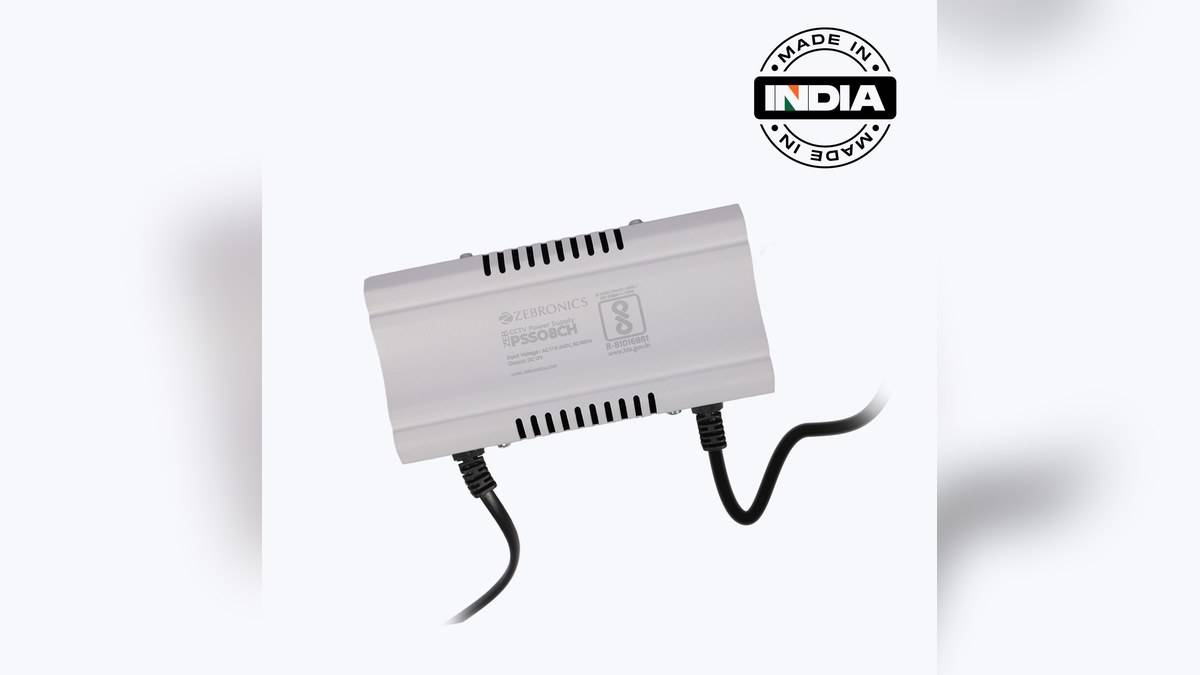
NEW DELHI: Zebronics lists the Zeb PSSO4CH indoor CCTV power supply at Rs 849 and the PSSO8CH at Rs 1,299. Both official pages describe metal-bodied DC power supplies with electrical protection features. Before a household approves either for a camera installation, the required output capacity and camera compatibility still need to be confirmed.
| Item | Official listing |
|---|---|
| PSSO4CH | Rs 849; input current 0.3A; weight with cord 247g |
| PSSO8CH | Rs 1,299; input current 0.5A; weight with cord 275g |
| Both input ranges | AC 110V to 240V; 50/60Hz |
| Both output ranges | 12.3V to 12.8V |
| Both dimensions | 14.2 x 7.1 x 4.26 cm |
| Both operating temperature ranges | 0 degrees C to 45 degrees C |
| Output capacity | Maximum output current and wattage not established in the readable tables |
Price as of 20 November 2026, 10:56 IST. Zebronics lists these prices with tax included.
The two official prices and shared specifications
According to Zebronics' official product pages, both models have the same published output-voltage range and enclosure dimensions. The listings differ in their quoted input current and weight. These details identify the products, but the input-current figures should not be mistaken for the output current available to power cameras.
This price list covers these two standard PSSO models only. It does not import specifications from a Pro version or assume that a similar enclosure carries the same electrical rating. The full model printed on the unit should match the quotation, invoice and documentation supplied at installation.
For an existing home CCTV system, replacing the power supply begins with identifying what the cameras require. Ask the installer to check their voltage, polarity and rated load against the exact replacement. A familiar brand or a model name that appears to match the camera count is not a sufficient compatibility check.
A model name is not an output-load calculation
The readable specifications name the output voltage but do not establish a clear maximum output-current or output-wattage rating for these standard models. This guide therefore does not promise that either unit will run a particular number of cameras. Obtain the missing rating from the label or exact-model documentation before finalising the installation.
That omission matters when a quotation simply pairs a recorder channel count with a power-supply name. The recorder's video inputs and the cameras' electrical demand are separate constraints. A system may fit the recording connections while still needing a different power arrangement. Have the installer document both parts of the design.
The useful handover record is a list of the connected camera models and the power equipment supplying them. Keep the relevant labels and ratings accessible for future maintenance. When a camera is replaced, the new unit's requirements can then be checked against the existing supply rather than assumed to be identical to the old camera.
Protection features are not backup power
Zebronics lists overload, overvoltage, short-circuit and over-temperature protection in the specification tables. These are advertised protection functions. They do not establish battery backup, an assured recording duration during an outage or immunity from every electrical fault. Neither opened listing identifies a battery-backed operating arrangement for these supplies.
For a household concerned about footage during a power cut, ask for a separate explanation of how the cameras and recorder remain powered. Backup for the recorder alone does not answer the camera-power question. The pages here do not provide a tested outage scenario, so no runtime estimate should be attached to their prices.
The products are categorised as indoor power supplies. Plan their location accordingly and have the installer address cable routing, ventilation and access for servicing. The readable pages do not state an outdoor ingress-protection rating. A camera installed outside the building does not automatically make its indoor power equipment suitable for the same location.
Check the installed system, not just the indicator
Both listings identify an LED indicator and a non-detachable Indian power cord. An illuminated indicator is useful information, but it is not a complete acceptance test of a CCTV installation. Ask for live video from every connected camera and then confirm that the recorder has captured usable playback from those feeds.
Where the installation uses cameras with illumination, include a demonstration under the conditions in which that lighting operates. This is a practical commissioning request, not a claim about measured demand from these supplies. The opened pages do not establish the electrical behaviour of a particular camera combination or cable run.
Our Zeb AHDPDSL24 camera guide provides related camera context. The Zeb HDXVR 208 guide addresses the recording side, while the Zeb EnergiUPS price guide concerns separate backup equipment. Their requirements and specifications should be checked independently before combining products.
The official prices are component prices. Cabling, connectors, cameras, recording hardware and installation labour need their own entries in a complete quotation. Neither supply page confirms a bundled CCTV system. Retain the exact model and invoice details so that any later service discussion starts from the hardware actually fitted.
The price difference between these units is clear, but the missing output-capacity confirmation is material. A responsible installation decision needs that figure before the system is wired. This is where the comparison stops: the published input specifications and model names cannot replace a verified output rating for the intended camera load.
Official sources: Zebronics PSSO8CH product page, Zebronics PSSO4CH product page.