
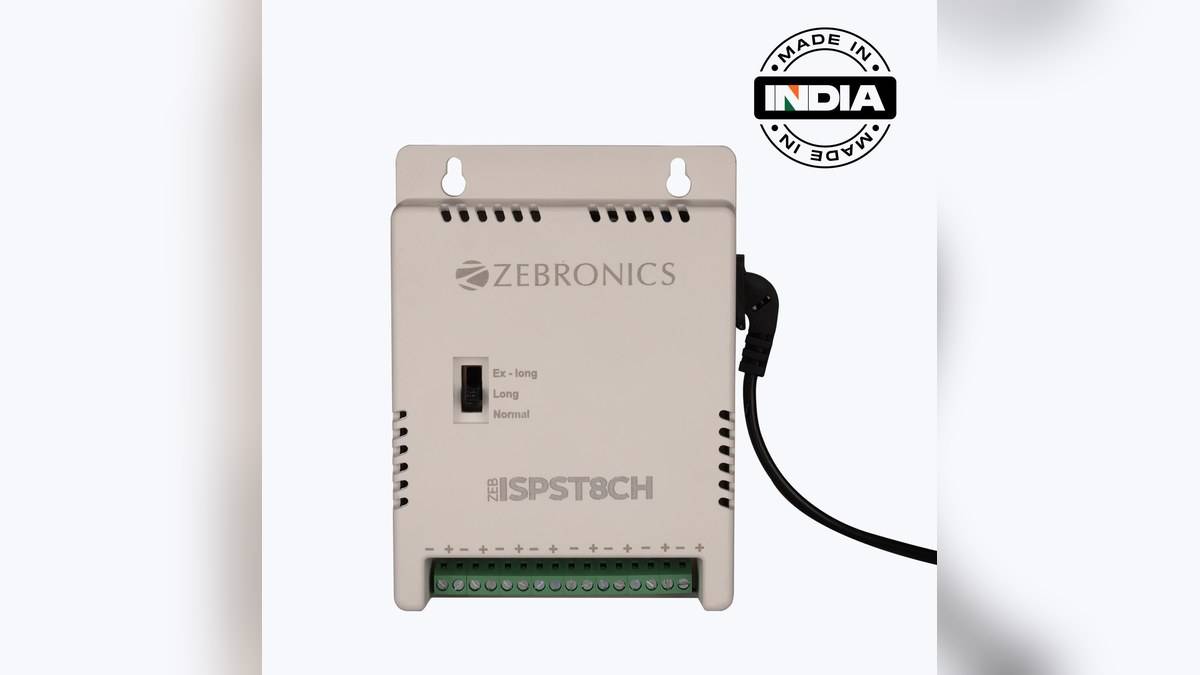
NEW DELHI: Zebronics lists the ISPST4CH indoor CCTV power supply at Rs 899 and ISPST8CH at Rs 1,199, including tax. Their official pages specify DC 12V output, with four terminal pairs on the smaller model and eight on the larger one. For an existing home camera installation, the first check is the camera's power requirement and wiring, followed by the number of connections needed.
| Item | ISPST4CH | ISPST8CH |
|---|---|---|
| Listed price | Rs 899 | Rs 1,199 |
| Output voltage | DC 12V | DC 12V |
| Output connections | Four terminal pairs | Eight terminal pairs |
| LED indicators | Four | Eight |
| Input voltage range | AC 120V to 265V | AC 120V to 265V |
| Body | Plastic | Plastic |
Price as of 27 November 2026, 23:54 IST. Zebronics' product pages and linked official data sheets establish these specifications. This comparison covers the two named models, not a complete installed CCTV package. Cameras, recording equipment and site wiring need their own quotation.
Match the supply to the camera system
Both units are listed as indoor power supplies. The presence of several output terminals is useful for distributing power, but it does not prove that every connected camera will be suitable. Before replacement, have the installer record the camera voltage, its required current and the existing power arrangement. The model label on the old supply is also worth photographing.
Crucially, the official specification tables do not state a total DC output-current budget or a per-terminal output-current rating. Their AC input-current entries must not be substituted for those missing limits. Ask for that information before approving the load. This is especially relevant when adding cameras to a system that already works: spare terminals alone do not establish spare power.
That missing budget is why the choice cannot sensibly be reduced to camera count. The ISPST8CH provides more connection points, while the published output voltage remains the same. A home with cables gathered near its recorder may find the larger terminal layout useful, but the installer still needs to establish electrical suitability for the actual cameras.
What the extender switch does and does not establish
Both product pages list an extender switch. The data sheets show Normal, Long and Ex-long positions. Neither sheet supplies a cable-distance guarantee for those settings. Treat the switch as an installation adjustment requiring the product instructions, rather than permission to promise a particular cable run without testing it.
At handover, ask the installer to label the terminal pairs by camera location and explain the chosen setting. Then check the picture from each installed camera under the conditions in which it will normally operate. A label such as entrance or staircase is more useful to a householder troubleshooting later than an unexplained bundle of identical wires.
The model-specific difference is physical as well as numerical. ISPST4CH measures 9.5 x 3.5 x 14.3 cm and weighs 285g with its power cord; ISPST8CH measures 10.4 x 3.5 x 14.3 cm and weighs 302g with the cord. Allow room for cable bends and access to the connections when deciding where either unit will be mounted.
Protection, placement and the handover test
The data sheets list overload, overvoltage, short-circuit and overtemperature protection. They also specify a fixed Indian two-pin power cord and an operating temperature range from 0 to 45 degrees Celsius. These details belong in the installation plan. They do not establish outdoor weather protection or a battery-backed supply.
For a household, the useful acceptance test is a tidy, documented installation that someone can maintain. Keep the unit accessible for inspection, with its ventilation clear and the camera connections identified. Ask the installer to show how a failed camera connection can be distinguished from a wider supply fault without disturbing unrelated cables.
If continuity during a power cut is part of the brief, have that requirement written separately into the installation quote. An ordinary powered demonstration does not show outage performance. Confirm that the recording equipment and the camera supply remain operational together, then check footage recorded during the demonstration rather than relying on a live picture alone.
Other approaches and service records
Power distribution depends on the chosen camera architecture. Our Zeb compact PoE network guide, Smart Cam 100 guide and IP recorder guide provide related reading. Do not assume those components can be connected to an ISPST terminal simply because they appear in the same surveillance catalogue.
Zebronics' warranty policy lists two years for surveillance power supplies. Save the invoice, product identity and installation notes together. Describe any later fault by camera location and symptom, such as all feeds failing together or a single feed dropping, rather than immediately assuming the power supply needs replacement.
ISPST4CH is the lower-priced option in this pair; ISPST8CH provides the larger terminal layout. The unresolved output-current budget remains the decisive pre-installation question for both. Obtain it before treating either quoted price as a complete answer to a home's CCTV power needs.
Official sources: ISPST4CH, ISPST8CH, their linked Zebronics data sheets and warranty policy.