
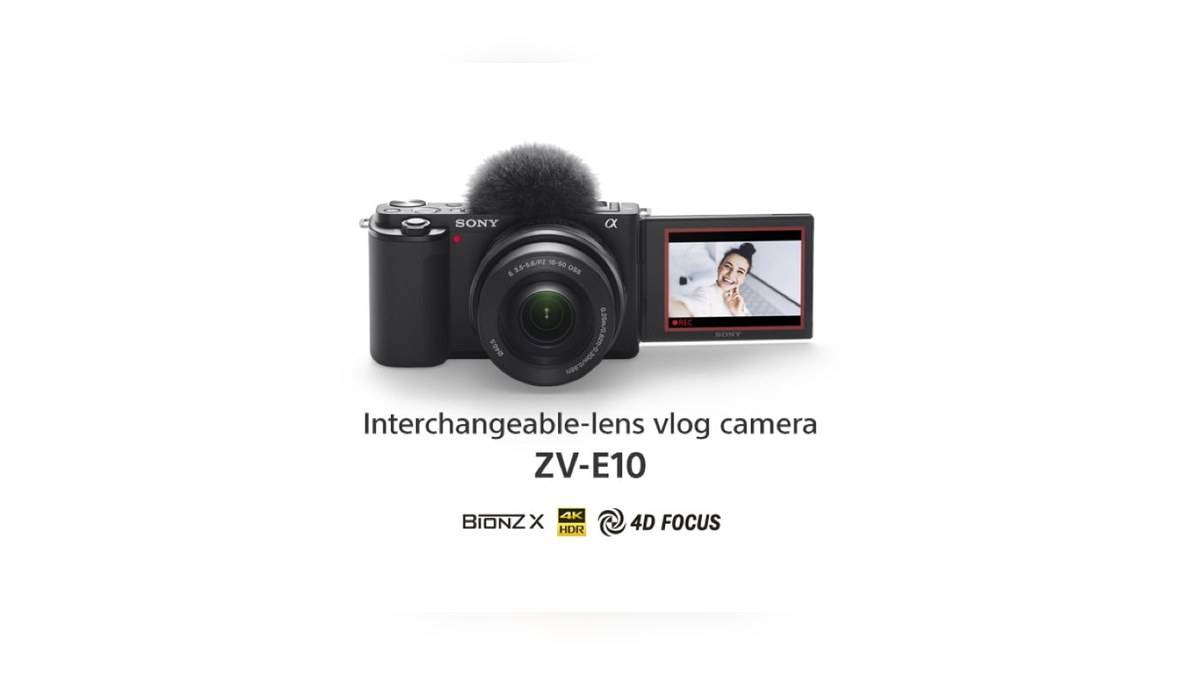
NEW DELHI: Sony's India camera catalogue lists the ZV-E10 body at Rs 61,990 and the ZV-E10K lens kit at Rs 72,990. For a creator putting together a recording setup, the distinction is essential: the body figure excludes a lens. The original ZV-E10 combines an interchangeable-lens system with controls aimed at people presenting directly to camera.
| Item | Official information |
|---|---|
| ZV-E10 body, catalogue MRP | Rs 61,990 |
| ZV-E10K with 16-50mm lens, catalogue MRP | Rs 72,990 |
| Sensor | Approximately 24.2-megapixel APS-C Exmor CMOS |
| Lens mount | Sony E-mount |
| Still-image formats | RAW and JPEG |
| External microphone connection | 3.5mm stereo minijack |
| Headphone connection | 3.5mm stereo minijack |
| Supplied battery | NP-FW50 |
Price as of 27 November 2026, 23:55 IST. Sony India's camera catalogue at apr2026.pdf is the named source for the two MRPs. Its separate India specification page establishes the configurations and connections. The figures are catalogue prices, not a new launch announcement, a discount claim or confirmation of stock at a particular outlet.
Start by identifying the exact kit
Sony's specification table distinguishes the body, the ZV-E10L package and the ZV-E10K package. It identifies SELP1650 with the L kit and SELP16502 with the K kit. The checked catalogue prices the body and K configuration; it does not provide a separate L-kit figure in the relevant entry. No price for that older kit has been filled in by assumption.
The table also shows Black for the body and L kit, with White and Black listed for the K kit. A colour option in the specification sheet is not evidence of local stock or a separate price premium. Match the model code and lens on the quotation to the package actually being considered.
For someone filming a cooking demonstration or explaining an object at a desk, the lens choice affects the entire physical arrangement. Consider how much of the work surface should appear, how close the camera can sit and where the presenter will stand. Solve that composition before ordering a body and choosing a lens later.
Understand the presentation controls
Sony highlights Product Showcase Setting, a Bokeh Switch and a Still/Movie/S&Q button on the India overview. These are dedicated aids for changing the kind of shot being made. They are more useful when linked to a repeatable recording routine than when treated as reasons to skip learning exposure and focus behaviour.
A sensible rehearsal is to record the actual action planned for the finished video: face the camera, bring the object into the intended position and watch the result back. Repeat with the relevant presentation setting changed. That establishes whether the chosen setup serves the scene without making an unsupported promise that every automatic transition will succeed.
Build the sound setup as carefully as the picture
The overview specifies a directional three-capsule microphone and a supplied wind screen. The detailed specification table lists microphone and headphone sockets. That gives the operator a route to use external sound equipment and monitor it, rather than judging audio solely from the camera's image on screen.
For an indoor demonstration, listen for fans, traffic and reflections before recording the main take. Make a short sample from the position in which the presenter will speak. An external microphone can be part of the setup, but the existence of a socket does not establish that every accessory will work correctly with every cable or power requirement.
Sony lists the wind screen and its adaptor among the supplied items. Check the exact package contents before adding accessories to the budget. A promotional picture may include a grip, lens or other equipment that is not part of the selected body-only package, so the written contents list is the better reference.
Stabilisation depends on how you shoot
The official specifications distinguish lens-supported stabilisation for still photographs from lens-supported Standard Mode and electronic Active Mode for movies. Those are separate operating arrangements. Do not describe the camera as having a sensor-shift stabiliser on the strength of the word stabilisation in a feature list.
For a fixed desktop scene, establish a stable camera position and rehearse the framing. For handheld work, test the complete camera and lens combination while moving as the actual shot requires. Keeping the recording method consistent makes the resulting comparison more informative than switching several settings and accessories at once.
Consider the alternative workflow
The Alpha 6400 is another Sony format to assess when still photography and its control layout matter. A fixed-lens compact offers a different ownership routine again. The relevant question is whether interchangeable lenses and a creator-oriented interface solve the work being done, rather than whether a model is simply described as a vlog camera.
Our guides to the Sony BRAVIA extended warranty price list: Rs 2,600 to Rs 1,05,000, and what it excludes, Sony BRAVIA TV price list: 27 models from Rs 28,490 to Rs 25,64,991 and Sony camera price list: Alpha 7 V at Rs 2,40,990, Alpha 7R VI at Rs 4,19,990, 30 models explain other camera formats. Use them to compare the recording and carrying routine, without assuming they share an identical audience or budget.
Official sources: Sony India camera catalogue and ZV-E10 specifications.