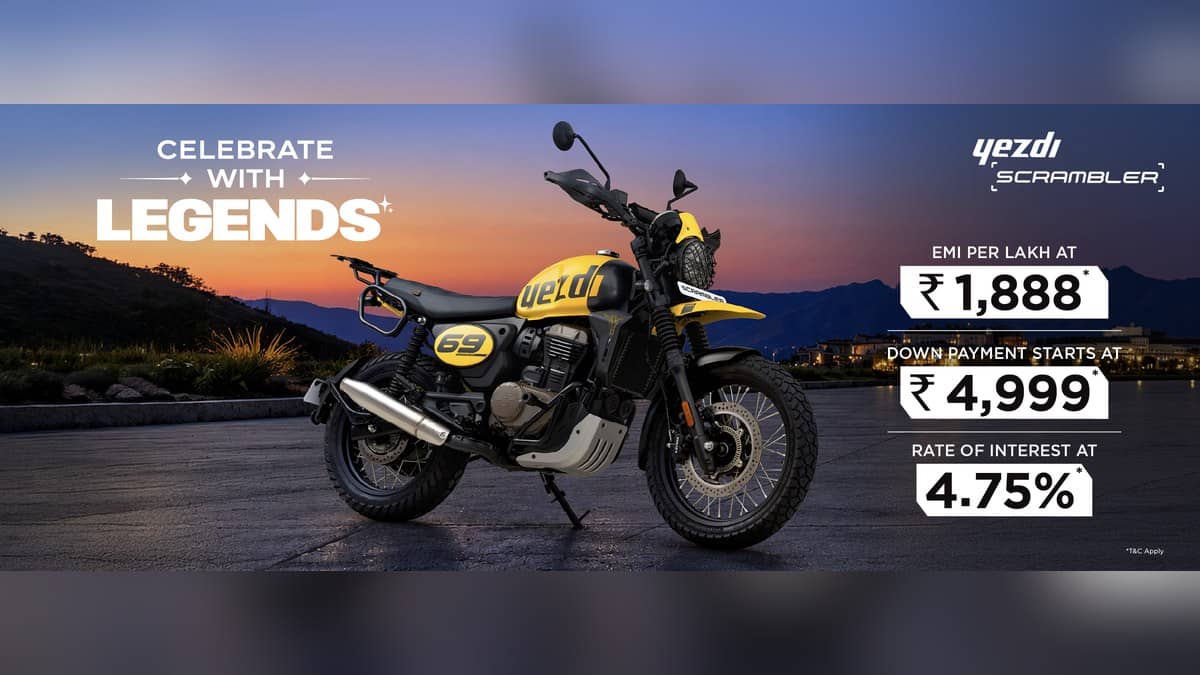
NEW DELHI: The Yezdi Scrambler official specification lists 150 mm of front suspension stroke and 130 mm of rear wheel travel. Those figures describe movement at the suspension, while the separately listed 813 mm seat height describes the riding position. Reading them together is more useful than treating the Scrambler name as a complete statement of capability.
| Item | Official detail |
|---|---|
| Front suspension | Telescopic hydraulic fork; 150 mm stroke |
| Rear suspension | Twin shocks; 130 mm wheel travel; five-step preload |
| Seat height | 813 mm |
| Engine | 334 cc, liquid-cooled single-cylinder DOHC |
| Transmission | Six-speed constant-mesh gearbox |
| Tyre sizes | 100/90-19 front; 140/70-17 rear |
Start with the dimensions you will feel
The front and rear suspension figures are not interchangeable measurements of ground clearance. Nor do they say how much movement remains once a particular rider and luggage are aboard. Before comparing motorcycles, label each figure correctly so a longer travel number does not become an accidental claim about obstacle clearance.
At a showroom, assess the seated riding position before discussing rough-road use. Check your reach to the handlebar and controls, and how confidently you can support the motorcycle at a stop. Ask staff for assistance while you do this. A seat-height entry is a useful starting point, but it is not an individual fit assessment.
If your routine includes a pillion or luggage, explain that use case during the demonstration. A comfortable solo display-bike position does not answer every question about a loaded journey. Ask the representative to show the relevant handbook guidance, rather than trying to predict the loaded feel from an unladen showroom photograph.
What rear preload adjustment does and does not establish
The specification identifies stepped preload adjustment at the rear. Ask the workshop to show the current setting, the approved adjustment method and the guidance for your normal load. Record that explanation with the handbook. Having an adjuster on the motorcycle is different from knowing which setting is appropriate for your use.
Do not interpret the number of adjustment steps as a list of riding modes or a guarantee of comfort. It describes an adjustment facility. A practical demonstration should explain what the workshop is changing and why. If the proposed setup includes other changes, ask for those to be described separately.
For an owner moving between solo commuting and loaded leisure rides, this is a more useful ownership question than asking whether the suspension is simply soft or hard. Describe the load, route and symptom. A complaint that the rear feels uncomfortable after adding luggage gives a workshop more direction than a request for a universally best setting.
Keep the tyre and brake discussion specific
The front tyre entry belongs to a larger-diameter wheel than the rear entry. Carry the full markings into a replacement enquiry rather than asking for Scrambler tyres by appearance. The official page describes semi-knobby tyres and spoke wheels, but appearance alone does not establish the suitability of a different tyre or wheel assembly.
The same distinction applies when discussing braking equipment. Ask for a demonstration of the controls and the handbook explanation of the system fitted to the actual motorcycle. A component list should help you identify equipment; it cannot reproduce the feel of braking on the road you use, with your load and riding conditions.
Have the salesperson identify the exact motorcycle being demonstrated. Note any accessories or alterations on it, especially if they affect the rider contact points. A different handlebar position or added luggage can change what you experience, even when the model name on the tank remains the same.
Read the engine label without guessing
The website calls the engine KATAR and separately gives the displacement in the specification. Use the technical entry when identifying the motorcycle for service or parts. A marketing name is useful for recognising the product, but workshop paperwork should make clear which actual model and specification is involved.
The liquid-cooled engine and six-speed transmission also deserve attention during the control familiarisation. Ask the representative to explain the relevant checks in the handbook and demonstrate the normal starting procedure. Do not transfer maintenance instructions from an older motorcycle merely because it carries the same brand badge.
This model-specific approach brings the Scrambler back to concrete ownership: front stroke, rear travel, adjustable rear preload, wheel sizes and the rider position. Each entry answers a different question. Together they can structure a useful demonstration without making unsupported promises about how the motorcycle will perform on every surface.
Before leaving, write down the questions the demonstration did not resolve. These might include loaded comfort, replacement tyre availability or the adjustment procedure. Seek the relevant handbook entry or an authorised workshop explanation. That is a firmer basis for using the Scrambler than allowing a broad adventure image to stand in for operating guidance.
Related reading: Scooter and bike price guide; Yezdi Adventure warranty: how the 4-year/50,000 km cover works; Jawa 350 vs Yezdi Roadster price: Roadster starts lower at Rs 1,99,969.
Official source: Manufacturer product information.