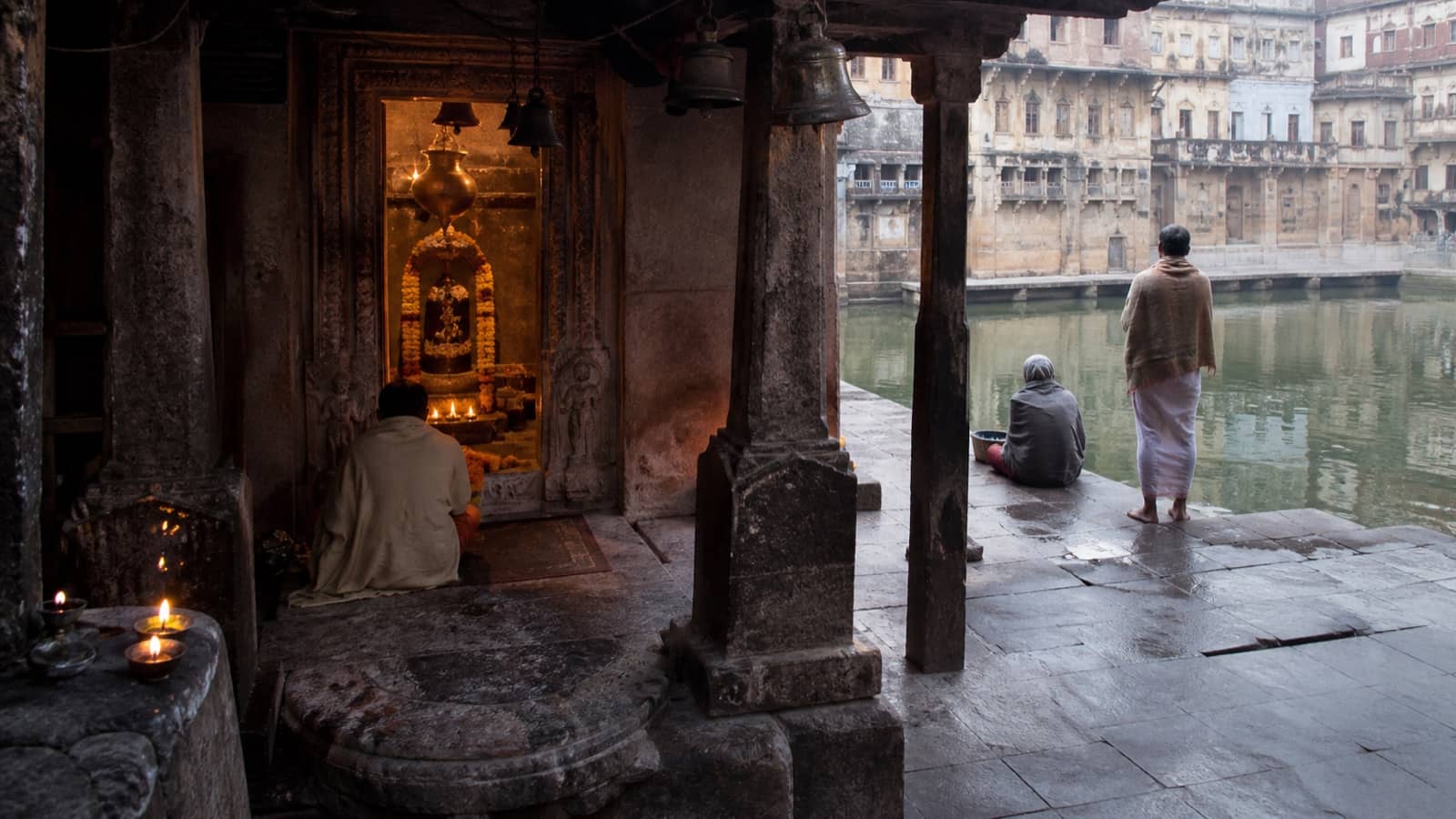
VARANASI: In the crowded Karnaghanta quarter, a small Shiva shrine carries a story much larger than its footprint. Local religious tradition identifies the lingam near Karnaghanta Pushkarini as Vyasneshwar, established by sage Ved Vyas, the figure associated with the Mahabharata and the Puranic corpus. The account was brought back into focus in a local heritage report published on Friday, offering residents another reason to look closely at a site that is easy to pass in the rush of the old city.
The tradition says Ved Vyas, a devotee of Vishnu, came to Kashi with thousands of disciples after a philosophical dispute with other sages about the nature of the supreme. His experience of Shiva's presence in the city is then linked with the installation of the lingam beside the pushkarini. Over time, the deity came to be known as Vyasneshwar. Worship is considered especially significant on Guru Purnima because Ved Vyas is central to India's idea of the guru lineage.
Such accounts belong to sacred geography rather than modern archaeological proof, and that distinction should be kept clear. A temple tradition can be historically important to a community even when its claims cannot be dated like an inscription or excavated layer. Varanasi is built from both kinds of record: material remains that specialists can analyse and stories transmitted through priests, pilgrims, neighbourhood memory and texts.
Karnaghanta itself rewards slow attention. Tanks and small shrines once organised daily life in many mohallas, providing water, ritual space and a shared landmark. As roads, buildings and drainage systems changed, some of these sites became physically obscured. The challenge is not only to preserve a sanctum but to understand its relationship with the water body and the lane around it. Cleaning, signage and careful documentation can make that relationship visible without turning a neighbourhood shrine into a theme park.
Visitors should treat the place as an active site of worship, not simply a photo stop. Modest clothing, quiet behaviour and permission before photographing people are basic courtesies in the narrow precinct. The story of Vyasneshwar remains, above all, a local belief about knowledge meeting devotion in Kashi. Whether one approaches it as faith, folklore or urban history, the shrine adds another layer to a city where the monumental and the nearly hidden exist side by side.
Heritage documentation can begin with simple, verifiable details: the shrine's present custodians, architectural features, condition of the tank and references in published local texts. Recording oral tradition alongside those facts preserves both without confusing them. That work is especially urgent in dense neighbourhoods, where renovation can erase an old surface or inscription before anyone has photographed it properly. Community memory is strongest when it is paired with careful records.