Under FIVB indoor volleyball rules, every completed rally awards a point, and the first team to win three sets wins the match. Sets are normally played to 25 points, while a deciding fifth set is played to 15. Every set requires a two point lead. When the receiving team wins a rally, it scores, gains service and rotates one position clockwise.
| Part of the game | FIVB indoor rule |
|---|---|
| Players on court | Six per team |
| Sets one to four | 25 points, minimum two point lead |
| Deciding fifth set | 15 points, minimum two point lead |
| Team contacts | Up to three hits, excluding a block contact |
| Winning service back | Score a point and rotate clockwise |
Volleyball scoring rules: why 25 points may not end a set
The FIVB basic rules page explains rally scoring. A team can score whether it served or received. If the serving team wins, it adds a point and serves again. If the receiving team wins, it adds a point and takes the next service. Winning back service is therefore a scoring event as well as a change of server.
For example, at 24-24 in an ordinary set, winning the next rally makes the score 25-24 but does not finish the set. Another consecutive point would make it 26-24 and produce the required margin. If the other team instead levels at 25-25, play continues. There is no fixed ceiling that overrides the two point requirement.
The same principle applies in a fifth set, with a lower initial target. At 14-14, a point produces 15-14 and play continues. A 16-14 finish is sufficient. These are examples of applying the rule, not scores from a current fixture. A match can end after three or four sets if a team has already won three; a fifth is necessary when the teams are level at two sets each.
Volleyball rotation rules: when do players move?
The receiving team rotates when it wins the right to serve. It does not rotate again merely because it wins another rally while already serving. FIVB's Official Volleyball Rules 2025-2028, Rule 7.6, describes a clockwise movement: the player in position 2 moves to position 1 to serve, while position 1 moves to position 6.
The positions are numbered around the court. Positions 4, 3 and 2 form the front row from left to right; 5, 6 and 1 form the back row from left to right. Imagine a team receiving with a particular player in position 2. If that team wins the rally, that player moves into position 1 and becomes the next server. A winning streak then keeps the service with that player until service is lost.
Service order still matters even when a team's tactical formation looks unusual. Under Rule 7.7, serving out of rotational order gives the opponents a point and the next service, with the order corrected. That is a different issue from whether a player has moved to a preferred attacking location during a rally.
Can volleyball players change positions after the serve?
Yes. Rule 7.4 permits both teams to move after the service hit. At that hit, the receiving team's players must respect their rotational order. The 2025-2028 text gives the serving team freedom to occupy any position at the service hit, while maintaining the applicable service order and other rules. Older diagrams which suggest identical positioning restrictions for both teams can therefore be misleading.
Movement does not erase front row or back row status. The rules restrict a back row player's completed attack from the front zone when the ball is entirely above the net, while allowing an attack launched legally from behind the attack line. A back row player may land in the front zone after such a jump. Watch the take off and the contact, rather than the landing alone.
Three touches, blocks and legal ball contacts
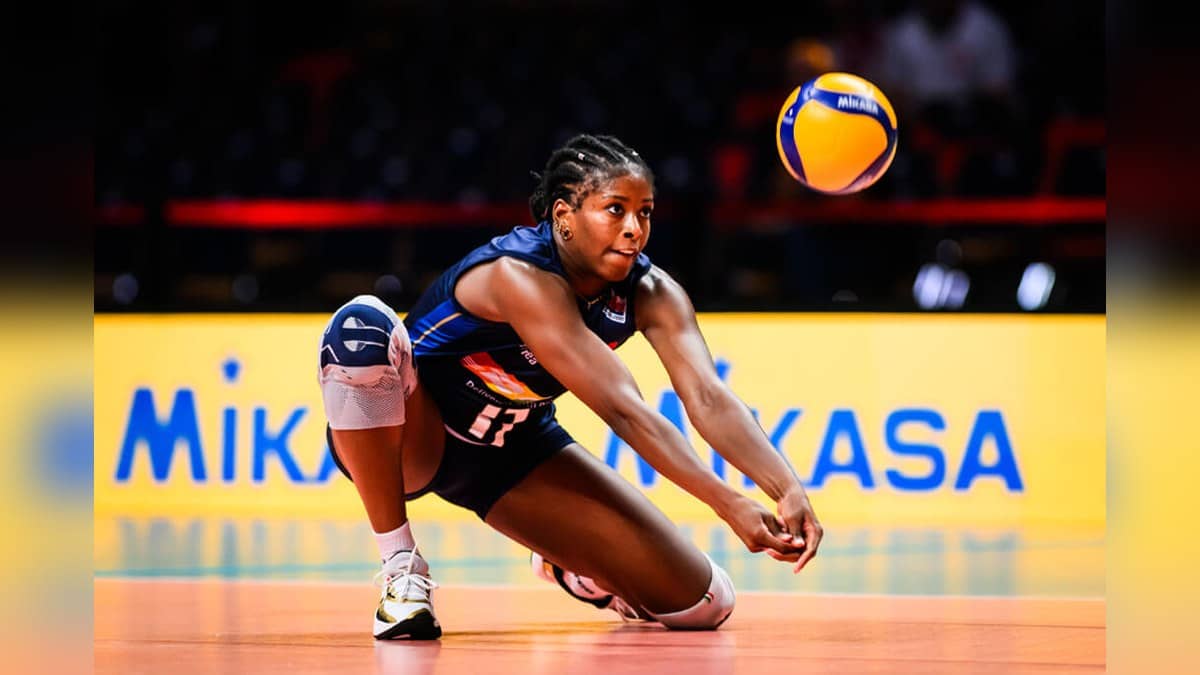
A team has up to three hits to return the ball, with the block contact excluded from that count in indoor volleyball. The familiar pass, set and attack is a useful pattern, rather than a requirement to use all three contacts every time. The ball may touch any body part, but it must rebound rather than be caught or thrown.
A player generally cannot hit twice consecutively, but FIVB provides specific exceptions, including contacts within one blocking action and successive body contacts during the team's first hit when they occur in one action. Seeing two contacts is not enough by itself to decide every double contact question. The type of action matters.
This guide covers the indoor game and the edition listed on the official FIVB rules page, checked on 31 October 2026. For other scoring and officiating questions, see our explainers on badminton scoring changes, net run rate calculations and hockey penalty corners.