
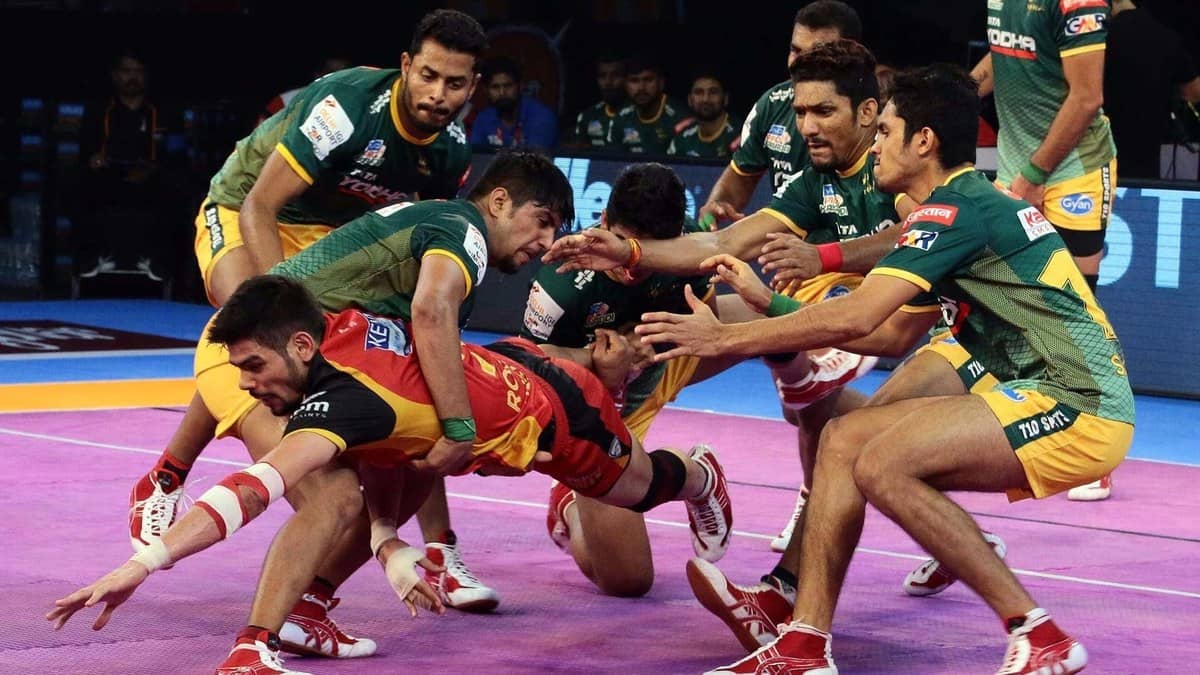
A super tackle in Pro Kabaddi is a successful tackle by a defending side reduced to three or fewer players on the mat. It earns two points instead of the normal one. Only one eliminated teammate is revived, because the extra point does not provide a second revival. The number of defenders available matters, rather than how many join the tackle.
| Ordinary play situation | Tackle reward | Defending players revived |
|---|---|---|
| Four or more defenders on the mat | One point for a successful tackle | One, if available |
| Three or fewer defenders on the mat | Two points for a successful super tackle | One, if available |
| Additional super tackle point | Included in the two point total | No additional revival |
What is a super tackle in kabaddi?
The league's official What is a Super Tackle? explanation defines the reward for stopping a raider from escaping to the midline when the defending team has three or fewer players. It is a defensive scoring rule. A spectacular hold with a full defence can still be an ordinary one point tackle.
Imagine seven defenders are present but only two complete the hold. The tackle does not become a super tackle merely because two people did the physical work. Now imagine a defence reduced to three players, with one of them completing the successful hold. That satisfies the player count condition described by the league. Count the defending side on the mat, not just the bodies around the raider.
Being in a super tackle situation is not itself a score. The defence still has to complete a successful tackle. If the raider gets back safely, the mere presence of a small defence does not automatically award it two points. This distinction helps explain why commentary may describe an opportunity before the scoreboard changes.
Why does a super tackle revive only one player?
The official Pro Kabaddi gameplay guide separates the points total from the revival mechanism. It says the defending side receives only one revival for a successful tackle even when it is a super tackle. The extra point improves the score without bringing a second player back. Revivals follow the order in which players were eliminated.
Take a hypothetical defence with three players on court and four waiting after elimination. A successful super tackle adds two points and allows one teammate to return. The side then has four available players, assuming no other event changes the count. It does not immediately grow to five simply because two points appeared on the scoreboard.
In the same example, a later successful tackle with all four defenders still present would be an ordinary tackle under the definition. If another player is lost before a subsequent defensive raid, the headcount must be assessed again. The super tackle condition is a situation during play, not a permanent label earned for the remainder of the match.
Super tackle scoring example: read the points and headcount
Suppose Team A trails 18-20 and has three defenders on the mat. A successful super tackle moves its score to 20-20, with one revival. The example illustrates two simultaneous effects: the deficit disappears and the defence gains a player. It is not a result from an actual fixture, nor does it predict whether Team A will win.
Now change only the starting headcount to four defenders. An ordinary successful tackle would make the same score 19-20. That one player difference changes the tackle reward in the example. For viewers learning the game, the scoreboard and the number of defenders tell a fuller story together than the excitement of the hold alone.
Is a super raid the same as a super tackle?
No. The league's gameplay guide uses super raid for an attacking return that scores through three or more defender touches, or through at least two defender touches plus a bonus point. A super tackle belongs to the defence. The shared word does not mean both actions have one fixed scoring value or identical revival consequences.
In particular, avoid counting the extra super tackle point as though it were another defender put out by a raider. The scoring action and the revival rule need to be identified separately. That habit also helps when reading a match summary which lists raid points and tackle points in different columns.
Do these revival rules apply in a PKL tie breaker?
Use the rules for the phase being played. The league's 23 August 2025 Season 12 format notice sets out a separate five raid tie breaker with seven players per side and no out or revival rules. The ordinary play examples above should therefore not be carried over automatically into that shootout.
The official explanations were rechecked on 31 October 2026. For other rules that change the way a sporting moment is judged, read our guides to hockey penalty corner positions, cricket review limits and football handball decisions.