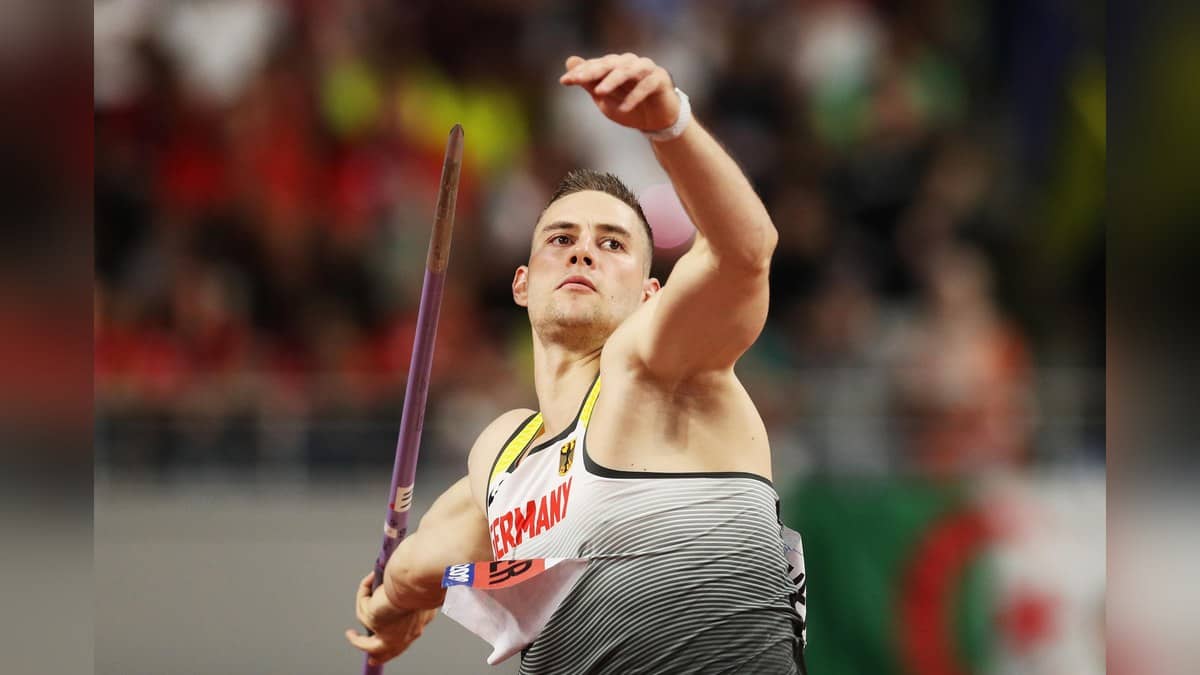
A valid javelin throw must be made with a legal throwing action, land metal head first inside the sector and survive the runway rules. Distance alone cannot make a foul count. World Athletics also distinguishes senior and youth implement weights, and explains that the normal competition format gives three attempts before the leading eight receive another three.
| Rule to watch | Official explanation |
|---|---|
| Senior implement weight | 800 g for men, 600 g for women |
| Throwing action | Over the shoulder or upper part of the throwing arm |
| Landing | Metal head first, inside the sector |
| Normal trial format | Three attempts, then three more for the leading eight |
What makes a javelin throw valid?
The World Athletics javelin guide sets out the basic requirements. The athlete holds the implement by its grip and delivers it over the shoulder or the upper part of the throwing arm. The metal head must be the first part to strike the ground. The first landing must also be within the throwing sector.
A long flight can therefore end without a recorded distance. Imagine two throws which appear equally far from the stands. In the first, the head lands correctly inside the sector. In the second, the rear of the implement reaches the ground before the head. The distance comparison is irrelevant until the second attempt passes the landing requirement, which it does not in this example.
The guide describes the landing sector as approximately 29 degrees. That is a restricted area, rather than the whole grass field in front of the runway. When watching, follow the initial contact point as well as the flight. A throw can travel far and still fail because it lands outside the permitted sector.
Javelin foul rules: the runway and the throwing arc
The athlete must keep within the runway boundaries and cannot leave the runway before the javelin lands. Touching the boundary lines or the ground outside is among the failures listed by World Athletics. Turning completely around so that the back faces the throwing arc before release is another listed failure. These restrictions make the throw an entire attempt, not just the instant of release.
Consider an athlete who releases cleanly and then carries too much momentum forward. Even if the javelin lands legally, a boundary violation can invalidate the attempt. Conversely, holding the finish within the permitted area does not rescue an implement that lands outside the sector. Watching the thrower and the landing area answers two separate parts of the validity question.
World Athletics also lists leaving too early, failing to use the grip and failing to begin within the permitted time among the possible failures. This guide does not assign a single time allowance to every competition situation. The official Book of Rules directory is the place to consult the competition and technical regulations for the event concerned.
How is javelin throw distance measured?
The official explanation measures from the nearest mark made by the head at its first landing to the inside edge of the throwing arc, along the line towards the centre of the circle of which the arc forms a part. It is not measured from the athlete's release point. Nor should a spectator use the place where the implement finally stops after moving on the ground.
For a simple comparison, imagine a throw lands at one point and then slides forward. The later resting place is visibly farther away, but it does not move the measurement origin to that resting place. The first qualifying landing mark governs the measurement. This is why a broadcast view of the final position alone may not explain the distance shown.
How many attempts do javelin throwers get?
World Athletics describes the normal format as three trials for each athlete, followed by three additional trials for the eight athletes with the best valid performances. Major championships typically have qualification before a final. The word normal matters: check the specific competition format before assuming that every event will provide an identical progression.
The winner is decided by the best valid distance, not the average of all attempts. If best marks are tied, the guide identifies the next best performance as the comparison. As an illustrative example, two athletes could each have a best of 80.00 metres. A next best mark of 79.50 would rank ahead of 79.00. Those figures demonstrate the comparison and are not results from a real meet.
Javelin weight: senior and youth categories
The standard senior weights are 800 g for men and 600 g for women. World Athletics lists 700 g for under 18 men and 500 g for under 18 women; the under 20 weights are 800 g and 600 g respectively. Check the age category before comparing performances or reading an equipment specification. A lighter youth implement and a senior implement are different competition conditions.
These rules were checked on 31 October 2026 without using live rankings or record claims. For more explanations of how officials judge sporting actions, read our guides to offside and interference, hockey penalty corners and DRS reviews in cricket.