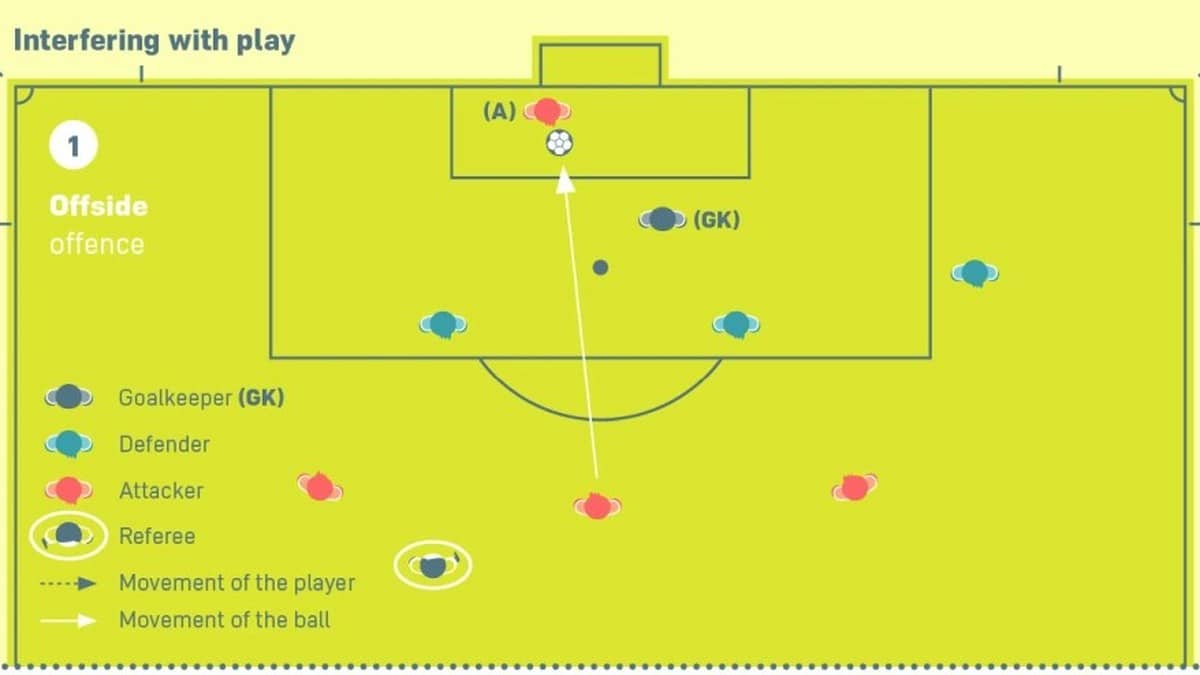
Football's offside rule has two parts: where an attacker is when a team-mate plays the ball, and whether that attacker then becomes involved in play. Standing beyond the defence alone is not an offence. Under IFAB Law 11, the player must be in an offside position and become involved in a way the law penalises.
| Situation | Basic answer |
|---|---|
| Level with the second-last opponent | Not in an offside position |
| Hands or arms ahead | Hands and arms do not count |
| Ball received directly from a throw-in | No offside offence |
| Offside offence committed | Indirect free kick |
What is an offside position in football?
The official Law 11 puts a player in an offside position when a relevant part of the head, body or feet is in the opponents' half and nearer their goal line than both the ball and the second-last opponent. The halfway line itself is excluded. The Premier League's explanation of which body parts count likewise excludes hands and arms.
Use the second-last opponent, not automatically the last outfield defender. Also check the ball: an attacker level with or behind it does not meet the positional test. The usual reference is the first contact of the team-mate's play or touch. For a goalkeeper's throw, it is the final contact at release.
There is no offside offence from receiving a goal kick, throw-in or corner kick directly. The word directly matters. A later touch by a team-mate creates a new situation to assess.
Can a player be offside without touching the ball?
Yes. IFAB's guidance for match officials gives the example of an attacker who clearly blocks the goalkeeper's view. The attacker can be penalised even without a touch. Another example concerns an attacker challenging a defender for the ball and preventing that opponent from playing it.
Compare that with an offside-positioned attacker who runs towards a pass while an onside team-mate also approaches and plays it. If the first player neither touches the ball nor interferes with an opponent, the official examples allow play to continue. Simply appearing in the camera frame is not enough to settle the decision.
The examples also explain rebounds. A player who was offside when a team-mate shot can be penalised for playing the rebound from the goalkeeper's save. The save does not erase the earlier position. By contrast, an onside team-mate can play that rebound while an uninvolved offside player remains unpenalised.
Another sequence starts with one attacker offside but uninvolved. An onside team-mate receives the pass, runs forward and then passes again. If the previously offside attacker is onside at this new pass, the earlier position does not permanently disqualify that player from the move.
Does a defender's touch cancel offside?
Not every touch does. Law 11 distinguishes a controlled, deliberate play from a deflection, and treats a deliberate save separately. An unsuccessful clearance can still be deliberate play, as the Premier League's explanation of the IFAB clarification also sets out. The question is whether the defender had control and an opportunity to play the ball, not whether the clearance reached its intended destination.
When replaying a disputed attack, keep a small sequence of events in mind: the team-mate's touch, the attacker's position, any intervening defensive action and the attacker's involvement. Looking only at the final shot removes the events that explain why a flag may be correct.
Why do assistant referees delay the offside flag?
The IFAB VAR protocol permits a delayed flag or whistle in a very clear attacking situation, such as a player about to score or making a clear run towards the opponents' penalty area. A delayed signal is therefore not, by itself, evidence that the assistant missed the position.
If the assistant delays and the attack produces a goal, the flag must then be raised for the suspected offence. The protocol also specifies other outcomes requiring that signal, including a penalty, free kick, corner, throw-in or retained possession after the initial attack.
Position and interference can require different review treatment. The protocol says factual questions such as offside position usually suit a review based on information from the VAR. Subjective questions such as interference can require the referee to inspect the footage. The referee retains the final decision.
What does the offside flag signal mean?
In IFAB's communication guidance, the assistant first raises the flag with the right hand. Once the referee stops play, the flag indicates the area where the offence occurred. If the referee has not seen it, the assistant maintains the signal until it is acknowledged or the defending team clearly controls the ball.
For a viewer, the useful habit is to follow both officials. The assistant provides information with the flag; the referee's decision determines the restart. A paused image, a raised flag and a completed review are different stages of that process.
More local sports coverage includes the proposed Nadesar sports centre, the Ganjari sports township plan and questions about judging at a Delhi sporting event.