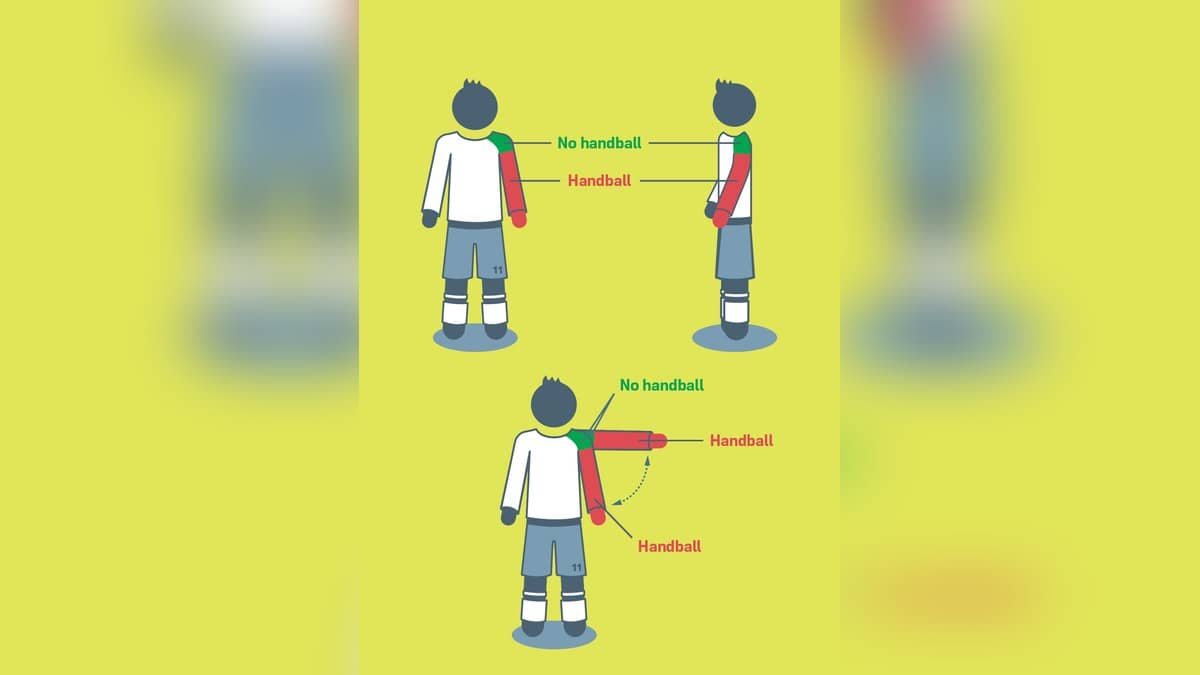
Football's handball rule does not punish every contact between the ball and a player's arm. Under IFAB's 2026/27 Law 12, the central questions are whether the contact was deliberate, whether the arm position made the body unnaturally bigger, and whether the player scored directly or immediately after the ball touched their own hand or arm. Accidental contact can still be an offence, but an appeal alone does not establish one.
The official reference is IFAB Law 12, Fouls and Misconduct. It sets the upper boundary of the arm, for handball decisions, at the bottom of the armpit. That explains why identifying the actual point of contact matters before discussing intention or the position of the arm.
| Situation | What the law asks |
|---|---|
| Deliberate contact | Did the player deliberately use the hand or arm? |
| Arm away from the body | Was its position justified by that specific movement? |
| Scorer's accidental contact | Did the ball go straight in, or did the player score immediately afterwards? |
| Goalkeeper outside own penalty area | The ordinary handball restrictions apply |
What counts as deliberate handball?
A player commits an offence by deliberately touching the ball with the hand or arm. Moving the arm towards the ball is an example given in the law. The question is about the action, rather than whether the player enjoyed an advantage afterwards. A deliberate touch does not become legal just because the player failed to control where the ball went.
There is also a separate route to an offence: making the body unnaturally bigger. IFAB asks whether the arm position was a consequence of, or justified by, the player's movement in that specific situation. A player who adopts an unjustified position risks the ball striking that arm and being penalised. This is why "it was accidental" does not settle every dispute.
Equally, the mere sight of an arm away from the torso is not the whole test. The movement that produced the position matters. A useful way to read a replay is to consider the player's action and the arm together, rather than treating a paused frame as a complete explanation. The official law requires that situational judgement.
Is accidental handball always an offence before a goal?
The law specifically rules out a goal scored directly from the scorer's hand or arm, even accidentally. This includes a goalkeeper scoring in the opponents' goal with a direct hand or arm touch. The goalkeeper's handling privilege in their own penalty area is not permission to score this way at the other end.
A player also cannot score immediately after the ball has touched their own hand or arm, even if that contact was accidental. The important words are the scorer's own contact and the immediate scoring action. This provision should not be expanded into a claim that every accidental arm touch anywhere earlier in an attacking move automatically cancels a goal.
For example, a hypothetical attacker whose accidental arm contact is followed immediately by that same player scoring falls within the specific scoring restriction. If an accidental touch involves someone else, the referee must still assess the relevant handball criteria. The existence of a later goal does not remove the need to identify the actual offence.
When does handball mean a penalty or a red card?
For an ordinary outfield handball offence, the restart is a direct free kick, or a penalty kick when the defender commits the offence inside their own penalty area. The handball assessment comes first. A ball hitting an arm inside the box does not automatically create a penalty if the contact is not an offence under Law 12.
The card is a separate question from the restart. Law 12 distinguishes deliberate handball that denies a goal or an obvious goal-scoring opportunity from a non-deliberate handball offence. Deliberately denying that opportunity by handball means a sending-off, except for the goalkeeper within their own penalty area. If a non-deliberate handball offence denies that opportunity and a penalty is awarded, the offender is cautioned.
For non-deliberate handball outside the offender's own penalty area that denies a goal or an obvious goal-scoring opportunity, the law lists a sending-off offence. These distinctions explain why two incidents can produce different cards even though both involve an arm stopping the ball. Readers should avoid assuming every penalty must bring either the same card or no card.
Can the goalkeeper handle a teammate's pass?
Within the goalkeeper's own penalty area, some handling offences lead to an indirect free kick. Law 12 includes handling after a deliberate kick from a teammate or directly from a teammate's throw-in, subject to its stated exception where the goalkeeper has clearly kicked or attempted to kick the ball to release it into play. These are different provisions from an outfield defender's handball.
Our offside guide explains another common football appeal. Readers comparing decisions across sports can also use our guides to cricket reviews and hockey penalty corners.