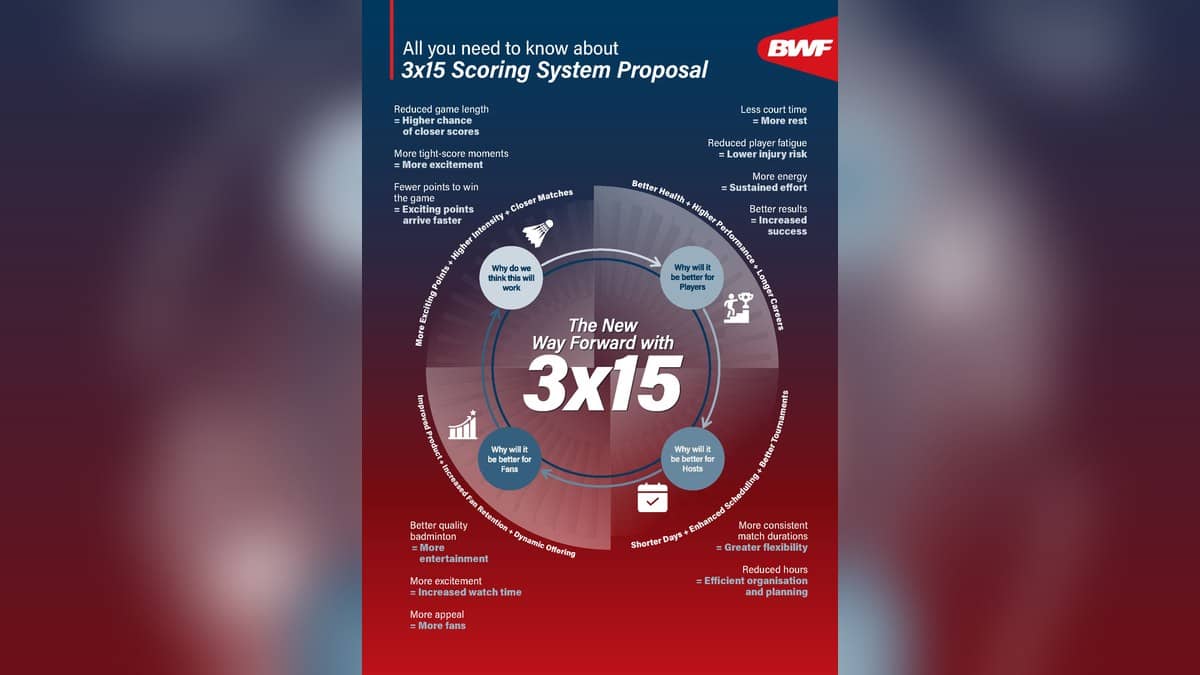
Badminton's standard scoring system is changing from games to 21 points to games to 15 points on 4 January 2027. The match remains best of three games. Until that transition, the existing standard system uses 21-point games, with a two-point lead needed at 20-all and a deciding point at 29-all. Under the new system, those tie thresholds become 14-all and 20-all.
The Badminton World Federation confirmed the adoption in its 25 April 2026 announcement. Members approved the proposal at the 87th BWF Annual General Meeting by the required two-thirds majority. The effective date matters: approval in April did not make every subsequent match a 15-point contest.
| Rule | Current standard system | From 4 January 2027 |
|---|---|---|
| Match format | Best of three games | Best of three games |
| Ordinary game target | 21 points | 15 points |
| Two-point lead required from | 20-all | 14-all |
| Final deciding point at | 29-all | 20-all |
| Midgame interval score | 11 | 8 |
| Third-game change of ends | First side to 11 | First side to 8 |
How does badminton scoring work now?
Under the current Laws of Badminton, the side winning a rally adds a point. It does not need to have served to score. A rally can be won because the opponents commit a fault or because the shuttle lands within their court and ceases to be in play. The scoring principle applies to both singles and doubles.
A standard match is best of three games, so winning two games wins the match. A game normally ends when a side reaches 21, subject to the close-score rules. At 20-all, play continues until one side leads by two points. A hypothetical score of 22-20 therefore finishes the game, while 21-20 does not.
There is a ceiling on that extension. If both sides reach 29, the next point wins: 30-29 is a completed game. It is incorrect to insist on a two-point margin beyond that point. The side that wins a game serves first in the next game, as stated in Law 7.6.
What are the new 15-point rules for 2027?
The forthcoming version changes the ordinary target to 15 while retaining rally scoring and the best-of-three structure. If the score reaches 14-all, a side must gain a two-point advantage to finish the game, unless the final-point ceiling has been reached. A hypothetical 16-14 wins; 15-14 does not.
The new ceiling is 21 points. At 20-all, whichever side scores the next point wins the game 21-20. This means "15-point badminton" is shorthand for the normal target, not a promise that every game ends when someone first reaches 15. Close games can still extend beyond that target.
Both texts can be accessed through the official BWF statutes page. It lists the existing Laws of Badminton, version 5.0, and the replacement version 6.0 marked effective 4 January 2027. Comparing Law 7 in those documents is the clearest way to separate the present rules from the approved future rules.
When do players take breaks and change ends?
In the current standard system, the midgame interval is allowed when the leading score reaches 11 and lasts no more than 60 seconds. In the new system, that score becomes eight. The permitted interval between games remains no more than 120 seconds. These are maximum permitted durations under the ordinary interval provisions.
Players change ends after the first game and after the second if a third game is needed. During the deciding third game, the current changeover happens when a side first reaches 11. Under the new law, it happens at eight. A player can therefore use the leading score to distinguish the midgame changeover from the end-of-game changeovers.
If the players miss a required change of ends, Law 8 says to correct it as soon as the mistake is discovered and the shuttle is not in play. The existing score stands. The rule does not require the players to erase points merely because they remained on the wrong ends for part of a game.
Does every local game have to use the same format?
The standard match provision allows other arrangements through the relevant BWF sections on handicap matches and alternative laws. A school, club or adapted competition may therefore use a specified format that differs from the headline standard. Check the actual competition rules before treating a short local match as evidence that the international transition has already happened.
BWF has published its intended benefits for the change, including more consistent match durations, but those aims should be distinguished from a guaranteed result for every match. For readers learning other sports, our guides cover hockey penalty corners, football offside and cricket net run rate.