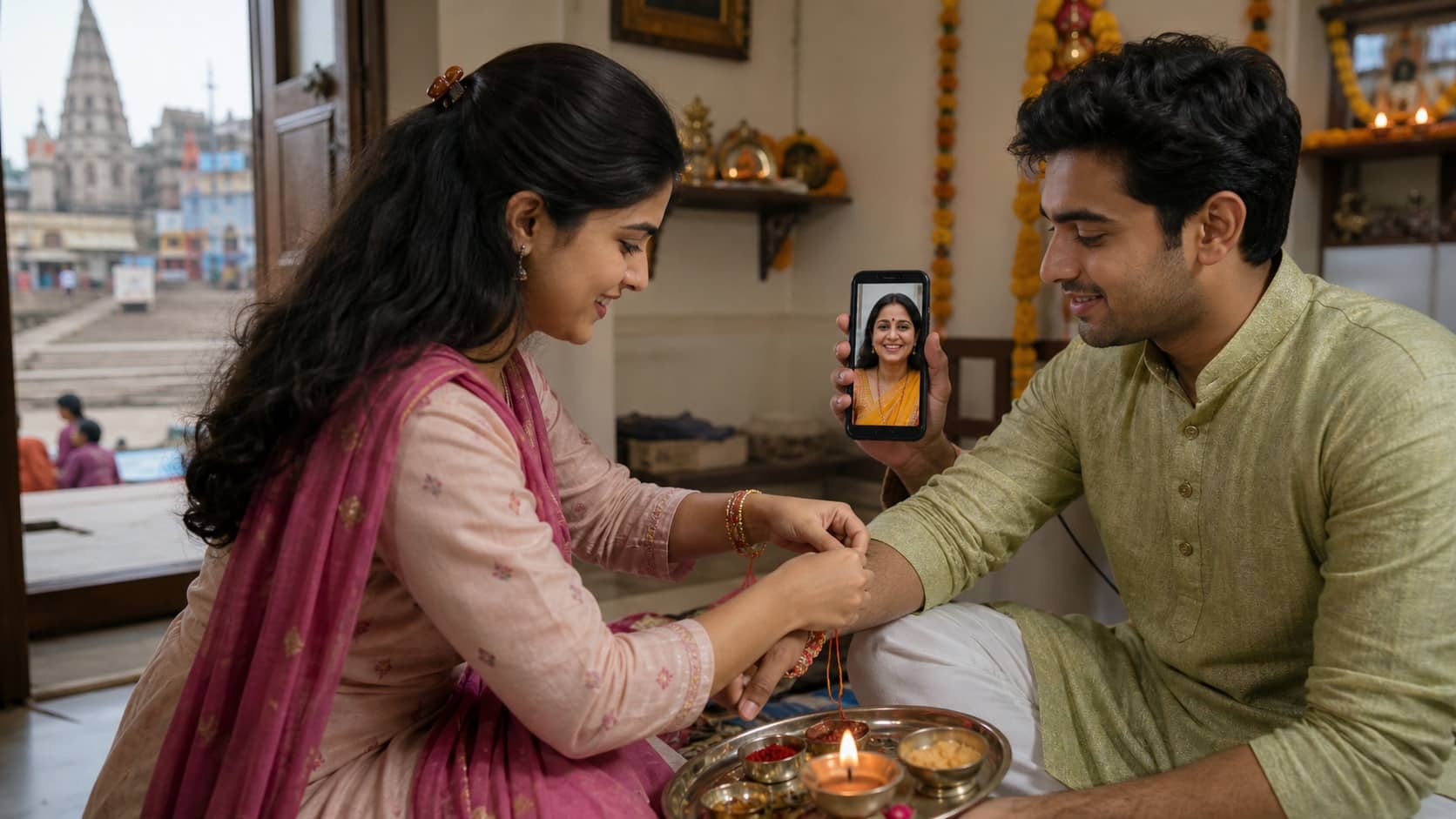
Raksha Bandhan in Varanasi unfolded this year in two spaces at once: around family courtyards and dining tables, and on phone screens connecting relatives who could not travel home. Traditional rakhi ceremonies remained at the centre of the day, while video calls, online participation and community pledges gave the festival a more contemporary shape.
Across the city, sisters tied rakhis, families exchanged sweets and elders offered blessings. For relatives living outside Varanasi, a live call allowed them to join the moment, watch the ritual and speak with the family together. Some households arranged the ceremony around a convenient online time, an adjustment that has become familiar in families separated by work, study or migration.
The digital format does not reproduce every physical detail, but it changes what absence means. A sibling hundreds of kilometres away can still be present for the conversation, see the family gathering and share the emotion of the day. Rakhis and gifts may be sent in advance, leaving the actual call to carry the personal part of the exchange.
Public observances expanded the meaning of protection beyond siblings. Community groups organised programmes around social harmony and service, while participants at some gatherings took pledges connected with the protection of the Ganga. Such events use the festival’s central idea—the acceptance of responsibility for another’s wellbeing—to speak about neighbours, the environment and civic life.
Varanasi gives that broader symbolism a natural setting. The city’s festivals are often simultaneously domestic, religious and public. A ritual performed inside a home can sit alongside a temple observance, a neighbourhood programme or a gathering on the riverbank. The result is not one uniform celebration but many small versions of the same day.
The traffic, market rush and monsoon weather around Raksha Bandhan also shape how people participate. Families plan travel around crowded roads and transport schedules, and those unable to make the journey increasingly rely on the phone rather than postpone the exchange. Technology here is less a replacement for tradition than a tool that keeps it possible when distance or logistics intervene.
What remained constant was the language of affection and duty. Whether a rakhi was tied in person, shown across a screen or used as a symbol at a community event, the gesture carried the expectation of care. Varanasi’s celebrations demonstrated how a long-established festival can absorb new habits without losing its emotional core—and how its idea of protection can move from the family wrist to the river and the wider city.