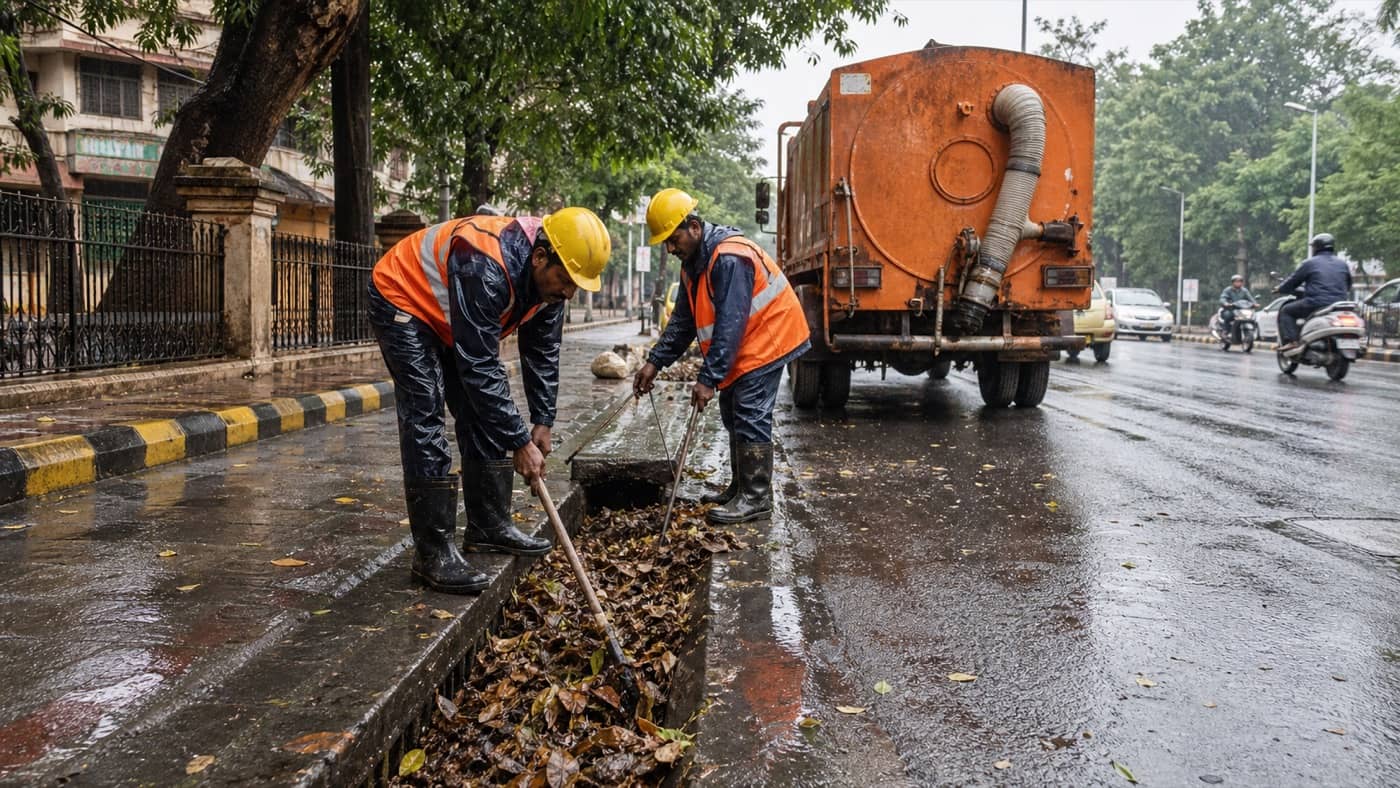
VARANASI: Municipal teams have been cleaning gully pits and sewer chambers and removing fallen branches from roads after heavy rain, with the corporation saying most low-lying areas remained under control. The response followed directions from Mayor Ashok Kumar Tiwari and Municipal Commissioner Himanshu Nagpal.
Branches or trees were cleared near the commissioner’s residence, Sundarpur Road, Bhikharipur and the Maidagin crossing, according to the civic update. Work was also under way near Banshidhar Apartments in Sigra. Officers were told to inspect their respective zones continuously instead of waiting for complaints to accumulate at the central office.
The corporation’s claim of broadly normal conditions should be read alongside the lived reality of individual streets. Drainage performance can vary block by block: one cleared gully pit may empty a road quickly, while a blocked downstream sewer leaves another pocket under water. Residents’ photographs and time-stamped complaints remain useful evidence when an official citywide summary misses a local failure.
Gully pits are the small entry points through which surface water reaches the drainage network. During intense rain, plastic, leaves and silt can cover the grating in minutes. Cleaning before the monsoon is essential, but repeated clearing during a storm is often unavoidable. Sewer chambers add another risk; they should be opened only by trained workers with barriers and protective equipment.
Fallen trees and branches require a coordinated response because they can block traffic, damage cables and conceal live electrical wires. A cutting crew should not begin work until the site is checked for power hazards and traffic is diverted. Quick removal is useful only when the workers and passers-by are protected.
Varanasi’s dense lanes, construction activity and uneven road levels make water management unusually local. The municipal commissioner’s inspection order can help if it produces a public log: location, complaint time, team arrival, action taken and whether the drain was restored. That record would reveal repeat hotspots needing engineering work rather than another emergency cleaning round.
The immediate operation is about reopening roads and drains. The longer test comes with the next downpour. If the same points flood again, the city needs to examine pipe capacity, gradients, encroachment and solid-waste collection. Rain is the trigger, but the depth and duration of urban waterlogging are shaped by what happens before the first cloudburst.
Residents can help by keeping waste out of drains and reporting a blockage before intense rain, but that does not transfer responsibility away from the corporation. Major chambers, pumping points and trunk lines are public infrastructure. Citizen cooperation works when it complements scheduled maintenance, transparent budgets and engineering fixes—not when it becomes an excuse for recurring failures.