
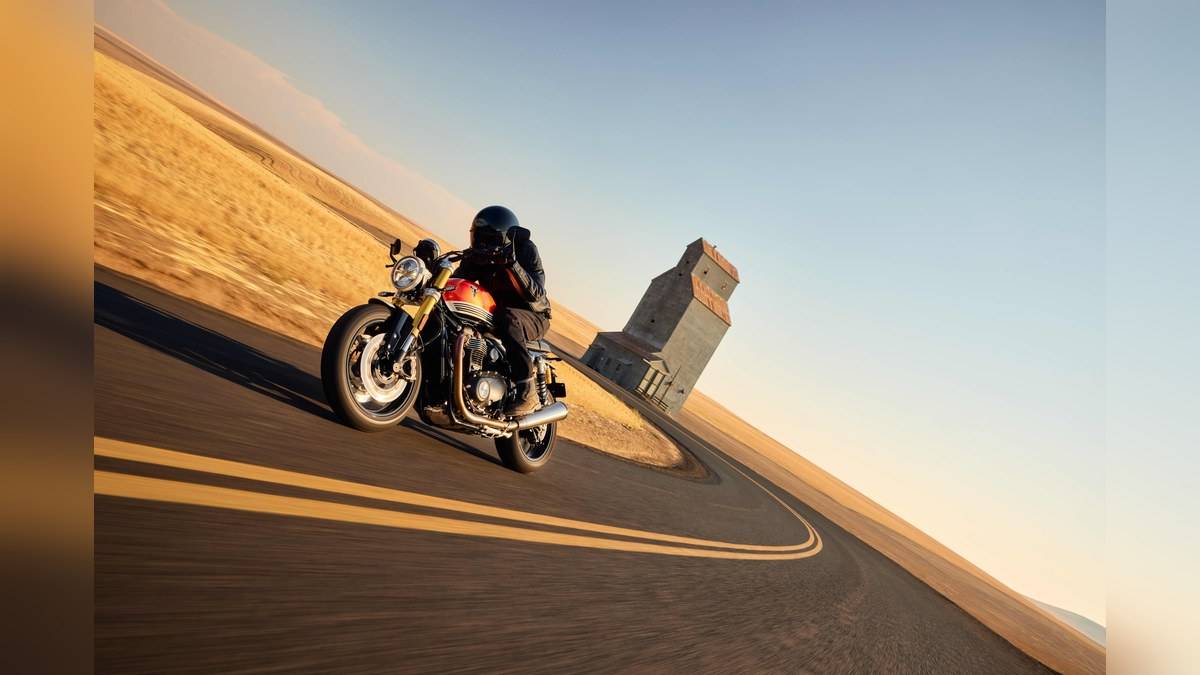
NEW DELHI: Triumph specifies 120 mm of front wheel travel and 123 mm at the rear for the Speed Twin 1200 RS. Its Marzocchi forks and Ohlins rear units give the motorcycle a distinctly sporting chassis specification. Understanding the difference between travel and adjustment explains more about this roadster than the suspension brands alone.
| Item | Official listing |
|---|---|
| Front wheel travel | 120 mm |
| Rear wheel travel | 123 mm |
| Forks | 43 mm upside-down Marzocchi |
| Rear units | Ohlins twins with external reservoirs |
| Rear adjustments | Preload, compression and rebound damping |
| Front brakes | Twin 320 mm discs; Brembo Stylema calipers |
| Seat and weight | 810 mm; 216 kg wet |
Travel describes movement, not a comfort rating
Wheel travel is the available movement of the wheel through the suspension's operating range. It does not directly describe how soft a motorcycle feels over a particular bump. For the RS, the front and rear figures should therefore be read as dimensions of the chassis package, rather than a promise about how it will behave on every Indian road.
The difference between the two published figures also should not be turned into a claim that one end is more comfortable. Front and rear suspension perform their work through different arrangements and carry different loads. A meaningful account of ride quality needs to explain the surface, rider and settings. The specification supplies a starting point for that assessment, rather than its conclusion.
The rear units offer distinct controls
Triumph explicitly lists rear preload, compression and rebound damping adjustment. Preload changes the spring's initial loading; compression damping controls the resistance during compression, while rebound damping governs the return movement. Treating these controls as interchangeable can make an adjustment difficult to interpret, particularly when several changes are made before the motorcycle is assessed again.
On the RS, the external reservoirs and twin-shock appearance are visible parts of the design. The useful ownership detail is the listed adjustment capability. A rider describing an unsettled response should identify what the motorcycle is doing, and under which conditions, before deciding that an adjuster needs attention. The presence of premium components does not remove the need for a systematic diagnosis.
There is no verified universal click setting in the product page for a particular rider, pillion or road. Publishing one would imply a precision that the available source does not support. The relevant handbook and an accurate record of the existing configuration are the appropriate basis for set-up work. This explainer does not prescribe a suspension tune.
Load changes the question being asked
Consider an RS used for a solo evening ride and later prepared for a longer trip with luggage. The motorcycle name and installed shocks stay the same, but the load being supported changes. The point of recording the configuration is to make those differences explicit. Simply copying a setting from another rider would leave their weight, luggage and preferences unknown.
Preload should also not be confused with a general cure for every harsh response. It concerns how the spring is initially loaded, whereas damping controls movement. If the wrong adjustment is used to chase an unrelated symptom, the result becomes harder to understand. That distinction is especially useful on the RS because the rear specification offers all of these controls separately.
The brakes and wheels complete the context
The RS pairs its suspension with cast wheels and a substantial front braking package. When braking transfers load towards the front of a motorcycle, the fork's response becomes part of the overall experience. That is why the brake specification and suspension specification belong in the same discussion, even though neither component list independently establishes stopping distance or handling quality.
A retro outline can obscure this context. Twin rear units and a rounded tank might suggest a motorcycle chosen entirely for appearance, yet the RS specification includes detailed chassis hardware. Its character should be understood through the complete assembly. There is no need to invent a track comparison or claim superiority over another model to explain what is installed.
Seat height remains a separate measurement
The listed saddle height helps describe rider reach; the wet weight helps describe the mass involved. Neither tells a reader how much suspension movement is available after the rider sits down. Confusing those measurements can lead to false conclusions about ground clearance or remaining travel. They answer different questions and should remain separate in any description of the RS.
For an Indian rider moving between a smooth expressway approach and a damaged connecting road, that separation is useful. A suspension package can have sporting intent while still requiring thoughtful speed selection for the surface. Adjustment cannot make a visible road hazard disappear, and an equipment explainer should not imply that the hardware makes every route equally suitable.
The strongest verified conclusion is specific: the Speed Twin 1200 RS combines the stated front and rear travel with separately listed rear preload and damping controls. Those details explain its set-up potential. Actual comfort, grip and confidence still need to be evaluated under identifiable conditions, with the motorcycle in a known configuration and changes documented carefully.
Related coverage: Triumph Speed T4 price report, Scrambler 400 X and Speed 400 comparison, Scrambler 400 XC price explainer.
Official source: Triumph India Speed Twin 1200 RS product page.