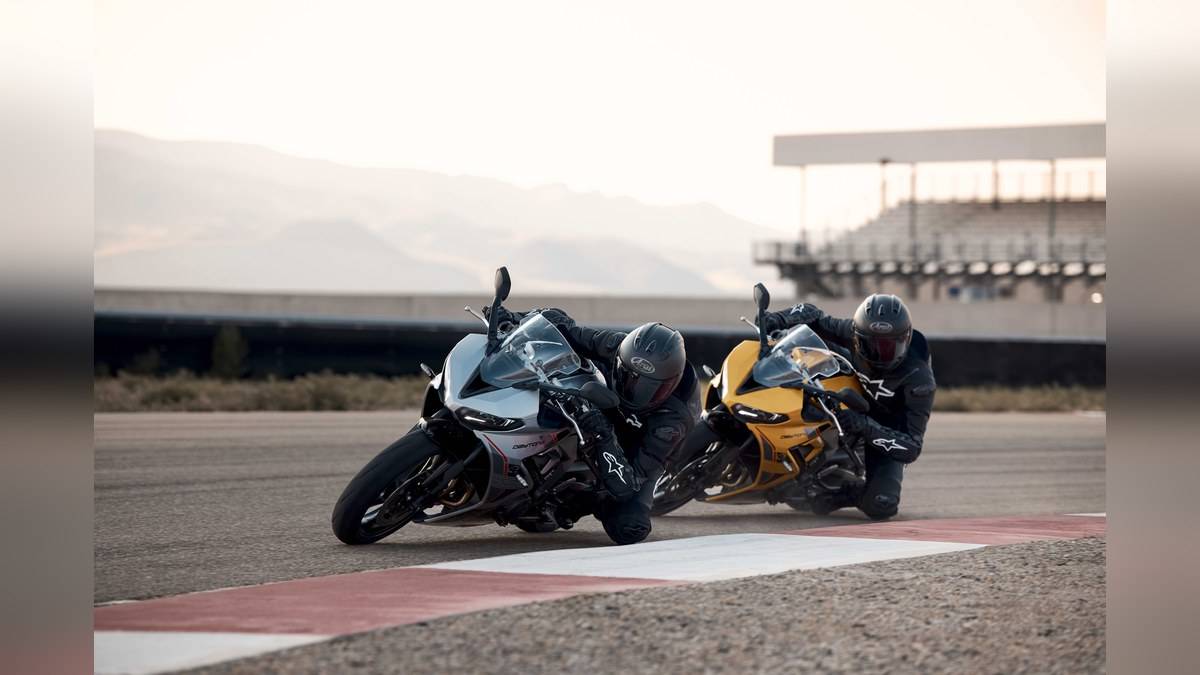
NEW DELHI: The Daytona 660 is listed from Rs 9,99,000 on Triumph India's current product page. The published starting price accompanies a sports motorcycle with adjustable Showa front suspension and a three-cylinder engine. It is not a complete price schedule for every finish, and it should not be read as the amount payable on the road.
| Item | Official listing |
|---|---|
| Published price | From Rs 9,99,000 |
| Engine | 660 cc inline three-cylinder |
| Peak power | 95 PS at 11,250 rpm |
| Transmission | Six-speed |
| Front suspension | 41 mm Showa forks; compression and rebound adjustment |
| Seat height | 810 mm |
| Wet weight | 201 kg |
Read the price beside the current equipment
Price as of 9 November 2026, 23:41 IST. The official page identifies the motorcycle as the New Daytona 660. It lists Cosmic Yellow and Sapphire Black, Aluminium Silver and Sapphire Black, and a Sapphire Black option, but does not attach a readable individual price to each. There is consequently no verified upper price to add to the starting figure.
That is a useful boundary for readers comparing an older quotation with the current web listing. Matching the model name alone is insufficient when equipment descriptions can differ between iterations. The suspension adjusters, tyre specification and fitted electronics should be checked against the particular motorcycle being described. This article reports the current page and does not claim a newly announced Indian launch date.
What the triple layout tells you
The engine's peak power arrives high in the rev range. That is relevant to the Daytona's sporting character, but it does not mean the engine can only be used near its peak. Equally, the three-cylinder layout alone cannot establish how smoothly it runs through congestion. Those are distinct questions that a specification table cannot settle without riding evidence.
For readers used to comparing motorcycles by capacity, the Daytona illustrates why displacement is only part of the picture. Engine architecture, the location of peak output and the intended riding position all matter. A fairing may attract attention first, yet the relationship between the engine and the chassis is the more useful way to understand this particular sports model.
Triumph describes Shift Assist for clutchless changes in both directions and lists Sport, Road and Rain modes. These functions address different parts of the riding experience. Gear-changing assistance changes an interaction with the transmission, while riding modes affect the electronic riding package. Neither description is evidence of a measured lap-time benefit or an automatic solution to difficult road conditions.
Adjustment is the important suspension detail
The front forks allow compression and rebound damping adjustment. The rear Showa unit has preload adjustment. Those are separate controls with separate purposes, so the presence of an adjuster at each end should not be interpreted as identical adjustment capability throughout the motorcycle. The official wording is more useful than a broad claim that the whole suspension is fully adjustable.
In practical terms, the fork specification gives scope to alter how the suspension responds, but it creates no universal setting for Indian roads. A rough commute and a smooth circuit session ask different questions of the same hardware. Alterations should follow the applicable handbook, with the original settings recorded so changes can be understood and reversed methodically.
This also explains why equipment alone cannot determine comfort. A rider's position, the surface and the suspension set-up interact. Calling the Daytona comfortable for every day, or unsuitable for every commute, would go beyond the evidence available here. The readable page establishes the hardware, while a useful evaluation of the ride would require a clearly described route and conditions.
A sports shape still needs a fit assessment
Clip-on handlebars and the listed seat height describe the starting geometry of the rider's relationship with the motorcycle. They do not establish wrist load for every body shape. Reach to the bars, room around the tank and the ability to operate the controls without strain deserve attention together, especially for a rider whose typical journey includes prolonged slow traffic.
The wet weight also belongs in that assessment. The ease of moving a motorcycle out of a parking slot is different from how light its steering might feel at speed. A rider can be comfortable with one task and less comfortable with the other. No claim about effortless low-speed manoeuvring follows simply from the Daytona's sports styling or its engine size.
Keep optional connectivity outside the base assumption
The instrument display is compatible with accessory-fit My Triumph connectivity for navigation, phone and music functions. Compatibility does not establish that the module is fitted to every motorcycle carrying the starting price. A precise equipment record should distinguish the instrument itself from the additional hardware and app connection required to make those functions available.
The current Daytona listing is therefore best understood through its specific combination of a high-revving triple, adjustable front damping and sports ergonomics. The starting price is verified; a colour-by-colour total is not. Keeping those limits clear allows the model's equipment to be explained without turning an incomplete web price into a complete on-road quotation.
Related coverage: Triumph Speed T4 price report, Scrambler 400 X and Speed 400 comparison, Scrambler 400 XC price explainer.
Official source: Triumph India Daytona 660 product page.